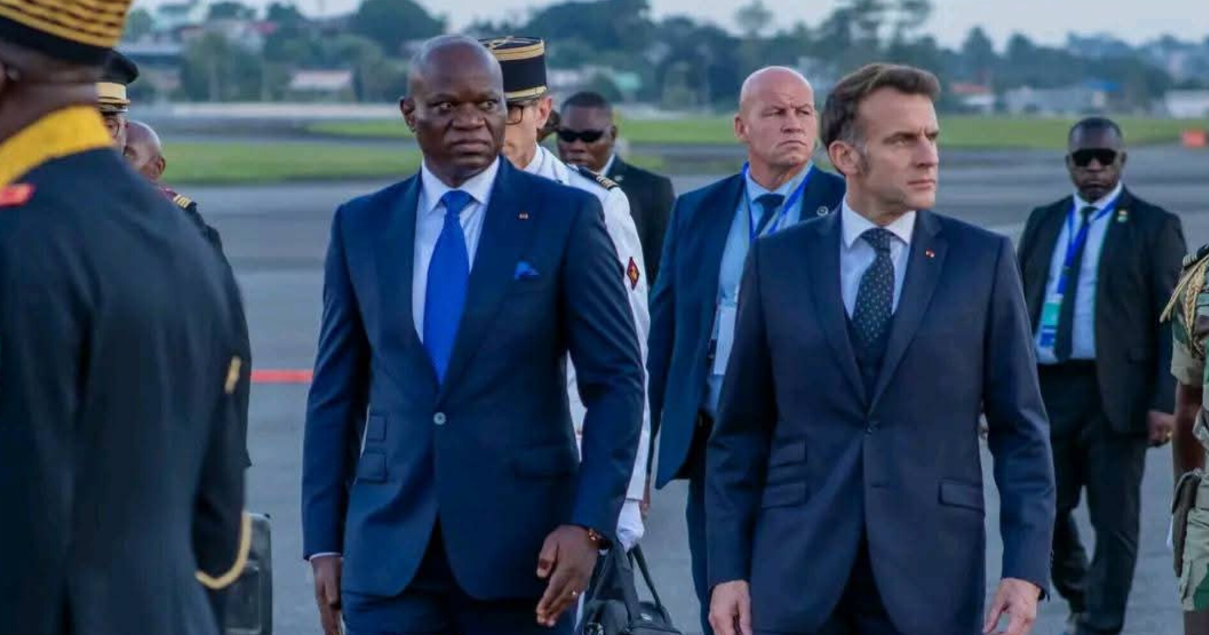
For three days, Gabonese President General Brice Clotaire Oligui Nguema is on a landmark state visit to France. The high-stakes talks with President Emmanuel Macron center on two pivotal issues: reshaping the military presence at Camp de Gaulle and accelerating the country’s manganese transformation strategy. This diplomatic engagement reflects a bold yet calculated approach—one that rejects the confrontational posturing seen elsewhere in Africa while asserting Gabonese sovereignty.
Camp de Gaulle: from colonial legacy to shared strategic vision
At the heart of the discussions lies the future of Camp de Gaulle, home to the French military presence in Gabon. Once a symbol of unchallenged French influence, the base now stands at the crossroads of change. As France reconfigures its military footprint across West and Central Africa, Gabon is not opting for abrupt withdrawal but for a carefully negotiated transformation.
The Gabonese government proposes redefining the base’s role—either converting it into a jointly managed training hub or scaling down the French military footprint to a minimal footprint focused on technical cooperation and counter-piracy operations in the Gulf of Guinea. This move signals a clear message: Gabon is reclaiming control over its security architecture without severing essential defense ties that underpin regional stability.
For Paris, the challenge is to adapt its military posture without destabilizing a key partner in a region where France has recently faced significant setbacks. The outcome of these negotiations will shape how France manages its post-colonial military footprint across Africa.
Manganese transformation: breaking free from raw material dependency
The economic dimension of the talks carries equal weight. Gabon, the world’s second-largest manganese producer, is determined to move beyond its role as a mere exporter of raw materials. For decades, most of its manganese was shipped abroad in unprocessed form—a model President Oligui Nguema now seeks to dismantle.
During meetings with French industrial leaders and representatives of the mining giant Eramet, through its Comilog subsidiary, the Gabonese leader delivered a clear ultimatum: future cooperation hinges on local industrialization. The Gabonese government demands a fairer distribution of value, the creation of skilled jobs for young Gabonese workers, and financial and technological support to establish high-value processing plants.
By leveraging its manganese resources in the global energy transition—critical for electric vehicle batteries—Gabon aims to position itself as a key player in sustainable supply chains. This shift represents more than economic reform; it is a strategic reassertion of national sovereignty over natural wealth.
Gabon’s pragmatic middle path in a region of extremes
This state visit underscores a distinct diplomatic philosophy. While neighboring military regimes in the Sahel—Mali, Niger, and Burkina Faso—have chosen public confrontation and anti-Western rhetoric, Gabon is charting a different course. President Oligui Nguema’s approach rejects both blind allegiance and reckless rupture.
Rather than severing ties with France, Libreville is diversifying partnerships with China, Turkey, and India while maintaining a firm but constructive dialogue with Paris. This pragmatic realism demonstrates that African sovereignty does not require diplomatic isolation or economic self-sabotage. It is a model built on negotiation, not confrontation—a lesson in geopolitical maturity.
The paradox of progress: governance and digital openness
Yet beneath the diplomatic success lies a domestic challenge. Gabon’s commitment to international openness and sovereignty is increasingly undermined by growing restrictions on digital freedoms. Regular internet shutdowns and social media blockages, ostensibly justified in the name of public order and misinformation control, raise serious concerns about the regime’s commitment to democratic openness.
Civil society leaders and opposition voices warn that such measures undermine the very sovereignty the government claims to defend. During informal discussions on the sidelines of the summit, French officials privately emphasized the importance of upholding fundamental freedoms and freedom of expression. For President Oligui Nguema, the task is delicate: maintaining internal stability without eroding the international credibility he has worked so hard to build.
Toward a new chapter in Gabon-France relations
The three-day visit closes with strategic momentum. By renegotiating the military footprint and advancing local industrialization of manganese, Gabon is redefining its partnership with France on its own terms. The path forward demands more than diplomatic finesse—it requires tangible action. To secure long-term success, Libreville must not only honor its international commitments but also ensure transparency, democratic participation, and digital freedom at home.
The Gabonese model—sovereign, pragmatic, and forward-looking—offers a compelling alternative in a region often divided between nostalgia and rupture. Its success will hinge on the delicate balance between asserting national pride and nurturing a partnership built on mutual respect and shared progress.