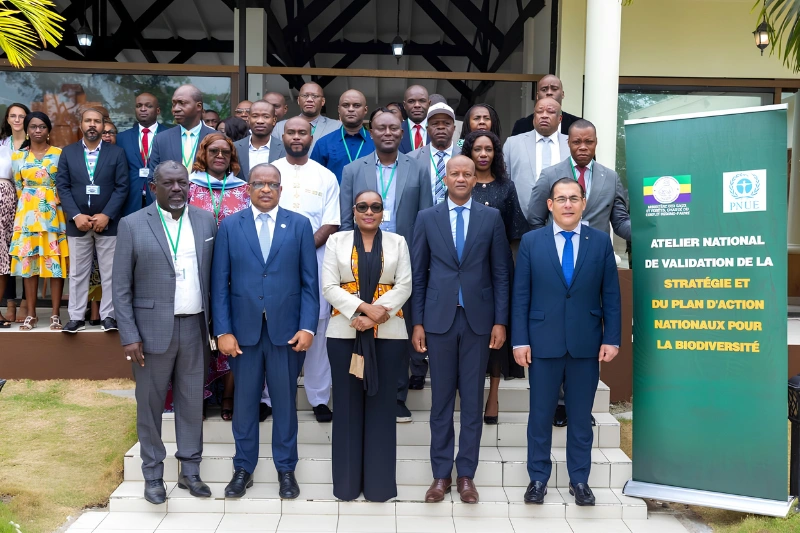
Gabon has reached a pivotal milestone in its environmental conservation efforts, finalizing a groundbreaking national strategy to preserve its lush forests, pristine coastlines, and diverse wildlife. The week-long national workshop for validating the National Biodiversity Strategy and Action Plan (NBSAP) 2022-2030 concluded successfully in Libreville this Tuesday.
Protecting 30% of the nation’s land and waters
The newly adopted roadmap serves as the country’s definitive guide for shaping public policies, enhancing ecosystem protection, and ensuring the sustainable management of Gabon’s extraordinary biological heritage. At its core, this ambitious plan aims to fulfill the commitments made by 196 nations under the Kunming-Montreal Global Biodiversity Framework.
By 2030, Gabon will prioritize four key objectives:
- Preservation: Safeguarding at least 30% of terrestrial, coastal, and marine areas
- Restoration: Revitalizing degraded ecosystems
- Mitigation: Addressing threats like poaching, deforestation, and pollution
- Financing: Mobilizing sustainable funding for conservation initiatives
The road ahead: turning vision into action
The finalized NBSAP, enriched with stakeholder feedback, is set to be submitted to the Government for final approval. Following this, it will be officially presented to the Convention on Biological Diversity (CBD) Secretariat, cementing Gabon’s leadership in global biodiversity conservation.
From policy to practice
According to Tsayi Mouvagha, the NBSAP coordinator, the real challenge now lies in implementation. « The critical next phase involves engaging government agencies, the private sector, local communities, and civil society to ensure this strategy translates into tangible results across every corner of the country. »
With 88% forest cover and 13 national parks, Gabon stands as a biodiversity powerhouse. The NBSAP 2022-2030 must now serve as a compass to balance economic growth, resource utilization, and conservation.
Ensuring success: the role of resources and collaboration
Yet, success hinges on more than just policy. Without dedicated funding and meaningful involvement from local governments, businesses, and neighboring communities, even the most well-crafted strategy risks becoming an empty promise.