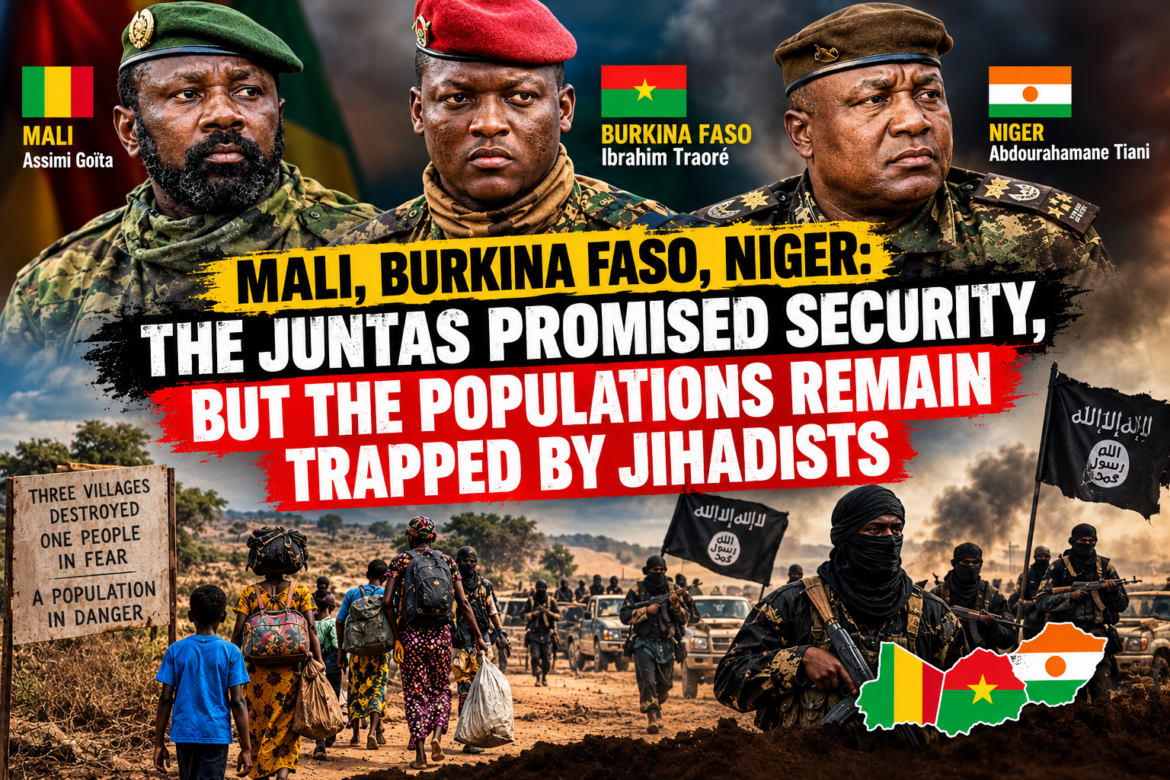
In the lawless tri-border stretch where Mali, Burkina Faso, and Niger converge, a lethal rivalry between two jihadist factions Islamic State in the Sahel and the al-Qaeda–linked Group for Support of Islam and Muslims (JNIM) has exploded into open warfare. The past weeks have seen shifting frontlines, scorched villages, and ever-rising death tolls on both sides. Yet behind the headlines of clashing militants lies an unsettling truth for the region’s ruling military councils: after pledging to restore security and reclaim territory, how much of that vow remains credible when civilians still bear the heaviest burden?
What the jihadist power struggle really looks like on the ground
The skirmishes between Islamic State in the Sahel and JNIM are no longer confined to hit-and-run raids on soldiers or symbols of the state. Commanders now fight for control of trade corridors, water wells, gold pits, and the allegiance of rural settlements whose inhabitants have no say in the conflict. Roads once used by farmers to reach markets are turned into ambush zones; grain stores are looted by whichever faction happens to be stronger that week; schools close when teachers disappear overnight. The result is a quiet but devastating reordering of daily life.
Local leaders in border towns describe how the two groups now impose competing taxation systems, command civilian movements through curfews, and punish suspected informants with beheadings or forced conscription. The local economy, already fragile, is grinding to a halt: cattle herds cannot be moved, salt traders hide their stocks, and the price of staple foods doubles within days. “We used to feed ourselves,” says a village elder from the Tillabéri region. “Now we wait for whatever food the fighters decide to spare.”
The military juntas’ unspoken strategic dilemma
Since toppling civilian governments, the juntas in Bamako, Ouagadougou, and Niamey have framed their legitimacy around four pillars: restoring territorial control, ending foreign military involvement, reclaiming sovereignty, and above all protecting citizens. Yet the intensity of the jihadist infighting has exposed a paradox: if the armed groups are busy destroying each other, why can’t state forces step in to shield the population? The answer lies in the same terrain that allows the militants to thrive: vast, sparsely policed stretches; intricate river networks; porous borders; and populations that have learned to distrust uniforms of any kind.
Operations mounted by national armies remain episodic; the terrain allows militants to melt into the civilian population and re-emerge elsewhere before dawn. Meanwhile, counter-insurgency doctrine calls for intelligence-driven patrols, community trust, and sustainable administrative presence resources that none of the three juntas can currently mobilise at scale. As a senior officer in the Nigerien gendarmerie put it, “We can chase fighters for weeks, only to find the trail ends at a village that hasn’t seen a government representative in two years.”
The human cost of unclaimed security
The rivalry between Islamic State in the Sahel and JNIM is not merely a military stalemate; it is a multiplier of civilian risk. Each faction releases battle reports that inflate its successes while downplaying its losses, making independent verification impossible for outsiders and irrelevant for terrified villagers. Confirmed numbers show that civilian casualties in crossfire have risen by 30% since the feud intensified, with entire districts cut off from medical evacuations.
Families trapped between the two forces face impossible choices: flee into already overcrowded displacement camps, subject themselves to extortion from whichever jihadist faction controls the nearest checkpoint, or attempt dangerous seasonal migrations across minefields and river crossings. Schools have closed in 40% of villages surveyed; vaccination teams no longer enter; and young men are increasingly press-ganged by whichever group happens to pass through at harvest time. “Sovereignty is not a flag you raise over an empty village,” remarks a human-rights monitor stationed near the border. “It is breakfast on your table, the clinic where your child can get malaria treatment, and the road that isn’t mined.”
The limits of sovereignty without deliverables
The three regimes have forged a new alliance the Sahel States Alliance positioning it as both shield and sword against foreign interference. Yet the alliance’s early operations have focused more on posturing than on tangible protection: joint patrols blocked by logistics shortfalls, intelligence-sharing paralysed by mistrust, and public statements that outpace concrete improvements. When jihadist fighters stage simultaneous attacks in two countries on the same day, the delay between incident and response grows embarrassingly long.
What citizens watch is not the wording of communiqués from Niamey, Ouagadougou, or Bamako, but whether the next school bell rings, whether the next harvest can be taken to market, whether the next dawn brings another body on the roadside. These are the metrics that will ultimately judge the juntas’ performance.
Can military rule still earn its security mandate?
There is no doubt that the jihadist threat predates the current coups and stems from decades of under-governance, environmental stress, and regional porosity. But the question now facing the juntas is not historical; it is existential. They have staked their legitimacy on ending insecurity; yet the people most exposed remain hostages of a conflict they did not choose and cannot escape. Until civilian life regains some semblance of normalcy functioning markets, functioning schools, functioning clinics the rhetoric of reclaiming sovereignty will ring hollow.
The true test of statehood is not how loudly a regime condemns external partners or how proudly it hoists a new flag. It is measured in the quiet moments: when a mother sends her child to school without fear of mortar fire, when a farmer drives his cart to the weekly market without a roadside ambush, when an elderly couple sleeps through the night without the dread of armed men at the door. Those moments have not yet arrived.
By Claire Mvondo — Journalist