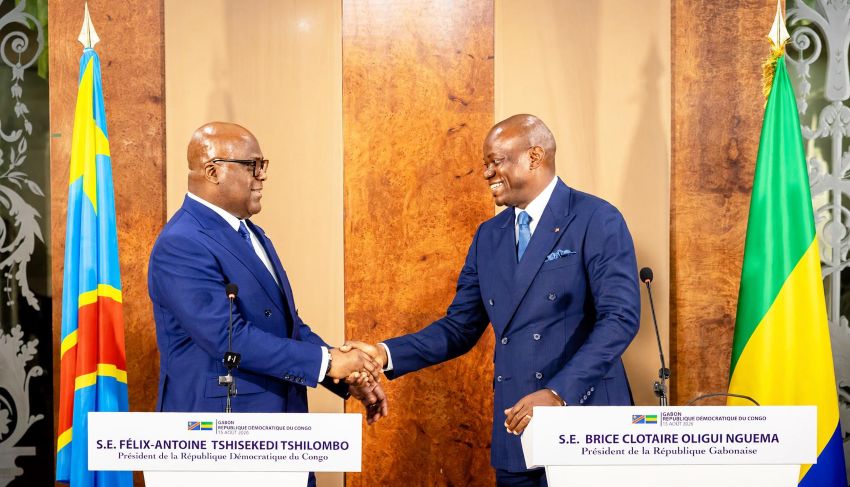
Gabon and Democratic Republic of Congo strengthen strategic partnership
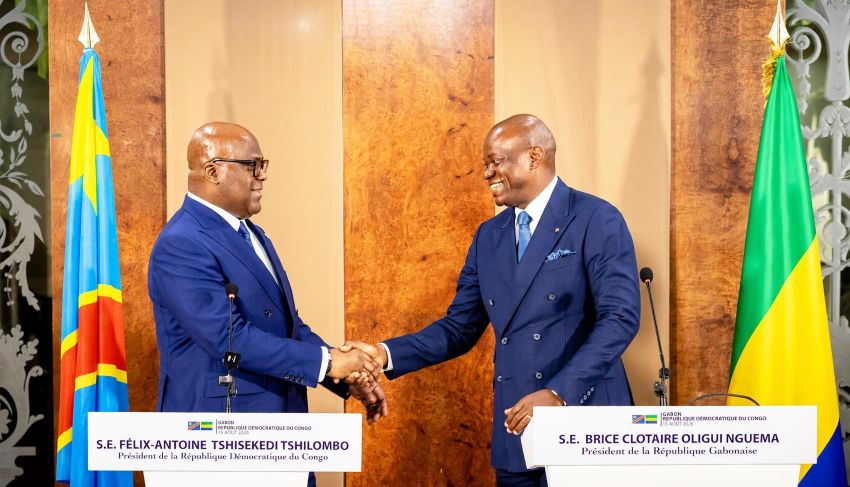
Libreville, August 15, 2026 – The visit of Félix-Antoine Tshisekedi Tshilombo to Libreville went beyond mere diplomatic protocol. The exchanges between the President of the Democratic Republic of the Congo and his Gabonese counterpart, Brice Clotaire Oligui Nguema, signaled a broader political ambition: to transform bilateral relations into a powerful tool for economic growth, regional stability, and African solidarity.
Three landmark agreements emerged from these discussions, giving substance to this shared vision.
The timing of the visit, coinciding with Gabon’s 66th independence anniversary, added symbolic weight. It was not just a display of goodwill between two nations, but a commitment from both leaders to embed their partnership in lasting cooperation. Key sectors like agriculture, infrastructure, transport, energy, mining, health, education, vocational training, digital innovation, and culture took center stage in the negotiations.
Behind this comprehensive agenda lies a shared conviction: while Gabon and the DRC boast abundant resources, their true strength lies in local transformation—creating jobs, fostering the circulation of African expertise, capital, and know-how within their borders.
From shared history to economic synergy
The two heads of state underscored the urgency of accelerating local processing of natural resources. This strategy is vital for both economies, which are striving to reduce reliance on raw material exports and build greater in-country value.
President Oligui Nguema highlighted Gabon’s ongoing reforms in digitalization, women’s empowerment, youth employment, living standards, and natural resource valorization. President Tshisekedi praised these initiatives and expressed Kinshasa’s eagerness to deepen ties with Libreville.
The envisioned cooperation extends beyond economics. Transnational organized crime, regional integration, and the conditions for peace and stability essential to development were also discussed. Their alignment extends to the Congo Basin, a critical ecological zone whose protection now demands cross-border solutions.
The financing of climate action—particularly through carbon taxation—could open new avenues for collaboration. As African nations seek to better leverage their role in climate protection, a united stance by Gabon and the DRC could strengthen their negotiating power on the global stage.
This alignment also resonates at the continental level. Libreville is seeking Kinshasa’s support for its candidacy to the ITU Council ahead of elections in Doha this November 2026, as well as its bid to host the African Union Summit in 2027. For Gabon, this would mark a significant return to hosting a major continental event—a milestone not seen since Libreville last hosted the AU Summit in 1977.
Three agreements to turn words into action
The visit’s most tangible outcome lies in the three agreements formalized between the two nations. The first covers cooperation across justice, environment, health, and mining, with a focus on local resource processing. The second introduces visa exemptions for holders of diplomatic and service passports. The third establishes a regular diplomatic and political consultation mechanism.
A joint commission will oversee implementation. This is where the real test begins. While African nations have signed countless agreements, few have translated into tangible, funded, and monitored projects.
Gabon and the DRC now have a framework to advance. The challenge ahead is to convert signatures into projects, declarations into investments, intentions into jobs, and diplomatic relations into visible benefits for both peoples.
The visit concluded at Sainte-Marie Cathedral in Libreville, where the two presidents observed a moment of reflection. This stop stirred memories tied to a 2018 mass in honor of Étienne Tshisekedi, underscoring the deep historical ties between the two nations.
Yet the essence of this visit lies elsewhere. Gabonese and Congolese people now have an opportunity to turn their historical proximity into collective strength. The two presidents have paved the way. The three agreements provide a structure. Now, the joint commission must set the pace.
Africa no longer needs to merely declare solidarity—it must organize, finance, and transform it into tangible results. Between Libreville and Kinshasa, the time for action has arrived.
You may also like
Burkina Faso: what does Ibrahim Traoré’s four-year record truly mean for the displaced and the silenced?
Cameroon’s Vision 4 suspension: does silencing a broadcaster protect the Martinez Zogo trial or undermine press freedom?
Thali oil permit: can Prime Global Energies’ $15 million rescue finally unlock Cameroon’s stalled Njom-3 well?
Can West Africa’s peace hold without the Entente Council and UNOWAS pact?
Can Lomé’s quiet diplomacy finally deliver peace to eastern DRC?