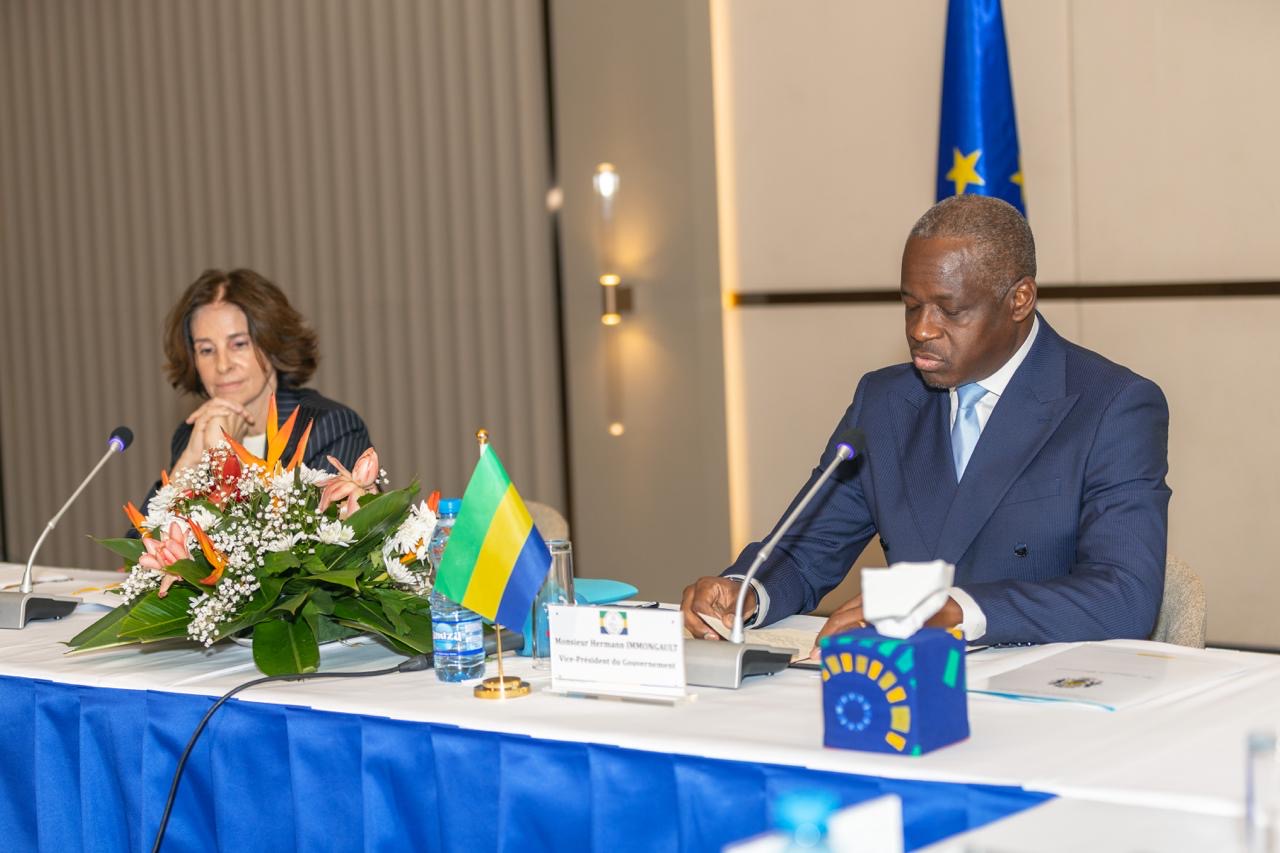
The 2026 session of the strategic partnership dialogue between Gabon and the European Union commenced on Monday, June 8, 2026, at the Palais des Congrès Omar Bongo Ondimba. This pivotal meeting, co-chaired by Vice-President of the Government Hermann Immongault, representing the Head of State, and European Union Ambassador to Gabon Cécile Abadie, signifies a crucial evolution in the enduring relationship between these two partners. Occurring two years after the 2024 discussions and set against the backdrop of the 5th Republic, established following the April 2025 presidential election, Libreville aims to reinforce its institutional stability and champion a new cooperation paradigm rooted in sustainable co-investment. The comprehensive discussions, involving EU ambassadors and members of the Gabonese government, delved into significant areas including political reforms, economic outlook, governance frameworks, environmental initiatives, and both regional and multilateral cooperation.
“We have conclusively moved beyond the Transition phase and, since the presidential election of April 12, 2025, embarked on a fresh institutional trajectory marked by the establishment of the 5th Republic,” Hermann Immongault articulated in his opening address. He emphasized “Gabon’s intent to progressively shift from a model primarily reliant on aid and support towards a structuring economic partnership, underpinned by investment, local value creation, knowledge transfer, and human capital development.” In line with this vision, the Samoa Agreement is now poised to serve as the foundational framework for this revitalized cooperation.
Investment and ecological transition priorities
The Vice-President further highlighted the global significance of safeguarding Gabon’s rich natural heritage. He asserted that “the preservation of this invaluable asset transcends mere national policy. It represents a global imperative that demands a more equitable acknowledgment of the concerted efforts undertaken by nations committed to its effective protection.” He advocated strongly for “strengthening international financing mechanisms dedicated to ecological transition,” a crucial step to harmonize economic growth, industrialization, and environmental preservation. Furthermore, Gabon reaffirmed its unwavering commitment to multilateralism, fostering stability across Central Africa, and enhancing security within the Gulf of Guinea.
Ambassador Cécile Abadie, representing the European Union in Gabon, commended the high caliber of dialogue established between the two entities. She underscored the necessity “to adapt the cooperation instruments between Gabon and the European Union,” advocating for “a renewed partnership” that effectively addresses evolving common priorities. Expressing an openness to “free and candid exchanges,” the European diplomat reiterated the European Union’s steadfast resolve to support Gabon in cultivating a more balanced cooperation, strategically focused on investments, impactful reforms, and delivering tangible outcomes beneficial to both partners.