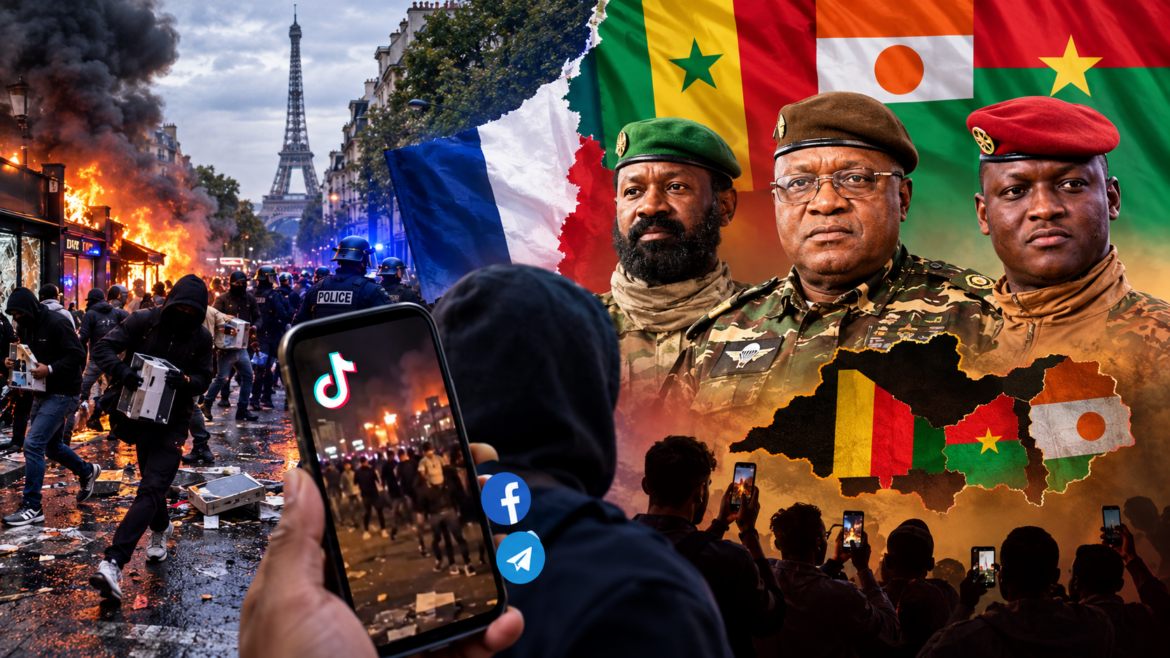
The recent urban unrest in France has transcended national borders, becoming a geopolitical football in the Sahel region. While the riots themselves sparked domestic debate, their visual spectacle amplified across digital platforms has been systematically repurposed by military-led governments in Mali, Burkina Faso, and Niger to critique France’s democratic credibility and historical influence. This phenomenon reveals deeper mechanisms of narrative warfare, where real events are filtered through ideological lenses to serve strategic political ends.
From digital amplification to geopolitical narratives
The rapid sharing of riot imagery across TikTok, Facebook, and Telegram has provided fertile ground for anti-France propaganda among pro-AES (Alliance of Sahel States) audiences. By juxtaposing footage of looting and clashes with police against France’s own human rights and governance rhetoric, junta-aligned commentators seek to expose contradictions in Paris’s policy narrative. This approach doesn’t merely critique governance failures; it weaponizes them as evidence of systemic decline a narrative that conveniently aligns with the AES’s broader project of distancing itself from former colonial powers.
The dual role of foreign actors in the crisis
Amid this information battle, another layer demands scrutiny: the presence of non-French nationals among those accused of participating in the disturbances. Investigative reports indicate that individuals from Mali, Burkina Faso, and Niger including some in irregular administrative status may have been involved in acts of vandalism and looting. Such cases raise critical questions about individual responsibility versus collective perception, particularly when national identity intersects with legal jeopardy.
French authorities have made clear that nationality does not confer immunity. Any individual, regardless of origin, who violates national laws faces judicial consequences. For irregular migrants, violations further compound their legal vulnerabilities, potentially leading to deportation proceedings alongside criminal charges. These outcomes underscore a fundamental principle: the rule of law transcends borders and citizenship.
The anatomy of propaganda: distortion vs. documentation
While the AES-aligned digital ecosystem exploits the unrest to depict France as collapsing under its contradictions, the selective presentation of evidence reveals systematic distortions. A single video of looting, for instance, becomes ‘proof’ of nationwide dysfunction when stripped of context and paired with misleading captions. The same footage might be recycled with altered timestamps to imply contemporaneity with ongoing events. These tactics exploit cognitive biases where emotional resonance outweighs factual verification to embed predetermined political messages.
Establishing whether such manipulations constitute a coordinated campaign requires rigorous scrutiny beyond anecdotal observations. Researchers must trace the origin of viral content, analyze linguistic patterns across multiple accounts, and identify structural overlaps in dissemination networks. Without such methodological discipline, accusations of orchestrated disinformation risk becoming self-fulfilling prophecies, diluting public trust in all forms of digital evidence.
Individual accountability in a climate of collective suspicion
The intersection of legal proceedings and political narratives creates a precarious balance. While authorities investigate individual crimes, propagandists both domestic and foreign exploit legal uncertainty to advance broader agendas. This dynamic risks conflating isolated incidents with systemic failures, undermining both justice and geopolitical coherence.
It is essential to distinguish between legitimate criticism of France’s Sahel policies and the instrumentalization of legal cases involving specific foreign nationals. The former represents a valid political discourse; the latter becomes propaganda when it converts judicial proceedings into indictments of an entire population. The French justice system’s independence ensures that guilt, if established, remains individually attributable not inherited through nationality.
Beyond the spectacle: what the unrest reveals about Sahel-France relations
The aftermath of the riots offers a window into the evolving dynamics between Paris and post-coup Sahel governments. Where France once framed itself as a guarantor of regional stability, today’s military regimes emphasize sovereignty through distance and confrontation. The repurposing of French turmoil into propaganda underscores this shift a conscious move from partnership to opposition in the diplomatic and informational arenas.
Yet this strategy carries inherent contradictions. By selectively highlighting French disorder, AES-aligned narratives inadvertently reveal their own vulnerabilities. If junta leaders equate civil unrest in democratic states with systemic failure, what standard do they hold themselves to when suppressing dissent domestically? The enforcement of security in Mali, Burkina Faso, and Niger is increasingly scrutinized by international observers, with documented cases of extra-judicial violence. The selective moral lens applied to France thus risks exposing ideological inconsistencies in junta-led governance narratives.
Conclusion: separating justice from ideological warfare
The French judicial system now faces a dual challenge: prosecuting criminal acts while navigating a landscape where evidence is weaponized before verdicts are rendered. Investigators must maintain impartiality, ensuring that prosecutions address verifiable crimes not predetermined political narratives.
For their part, Sahel juntas and their digital amplifiers must confront the ethical weight of their rhetorical strategies. To condemn France’s human rights discourse while ignoring individual accountability among their own nationals abroad is a contradiction that neither propaganda nor opportunism can erase. In the end, the riots in France may have been hijacked as a geopolitical tool, but their resolution will remain a matter of domestic justice one that transcends the noise of ideological conflict.
By Pierre Tchuente — Journalist