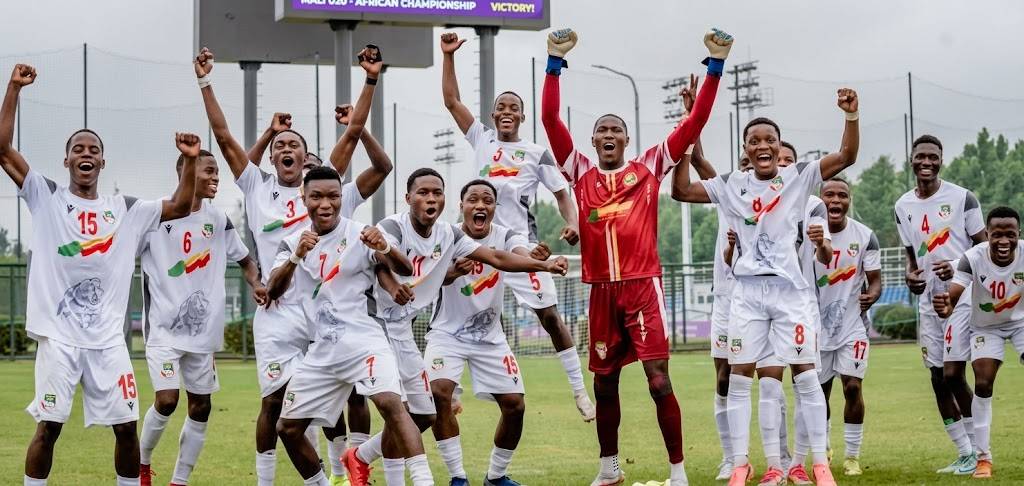
The Bénin U-18 school football team—the ‘Guépards Scolaires’—has not just won; they’ve rewritten the script in Suzhou. Their 27-0 dismantling of India is less an upset and more an acceleration of a quietly unfolding evolution in African schoolboy football. This isn’t a flash in the pan. It’s a calculated rise backed by tactical discipline, squad depth, and a philosophy that transforms individual talent into team devastation. After a 7-0 thrashing of Qatar in their opener, this second demolition sealed six points and provisional top spot in Group B—six days before the group stage even concluded. No goals conceded. Thirty-four scored. A statement etched in yellow, red, and green.
More than luck: The blueprint behind the record-breaking wins
The scoreboard tells part of the story, but the numbers only expose what’s visible above the surface. Behind the 27-0 scoreline lies a structured, multifaceted offensive system that values positional rotation over isolated brilliance. Coach Séverin Danha has cultivated a unit where depth is weaponized—every attacker is a scoring threat, and every goal flows from coordinated build-up rather than isolated dribbles.
Unlike traditional schoolboy tournaments where one prolific forward monopolizes goals, Bénin’s success is distributed. In the match against India, four players—John Ethan Hountinmé, Izoudine Boukary, François Adissa, and Osvaldo Sèmèvo Loko—each struck four times. Dona Silvanix Negui, Géovani Eclou, and Abdoul Hadirou Hassim added further layers, supported by Jérémie Zannou, Carlos Junior Fanou, Tahabou Ognandon, and Gilchrist Promise Kpanou. Two own goals by Indian defenders padded the total, but they only highlighted the pressure applied from every direction.
The man shaping the machine: Séverin Danha’s philosophy
Danha’s approach reframes school football from recreational play to high-performance development. Training involves small-sided games, positional interchange drills, and set-piece rehearsals that mirror professional standards. Recovery, nutrition, and mental conditioning are embedded from day one. This creates a squad that doesn’t just perform—it dominates.
The team’s 34-goal, zero-conceded record over two matches reflects a coaching vision that values collective intelligence over isolated genius. It’s a philosophy rooted in local education systems, where football is used not just to win trophies, but to cultivate discipline, resilience, and strategic thinking—skills that stay with players long after the final whistle.
Group B: The chess game behind the 6-point fortress
With six points and a +34 goal difference, Bénin sit atop Group B. But they aren’t alone. China 2, also with six points and a +21 difference, trail closely after a 6-0 demolition of Qatar. Both teams have mathematically sealed their places in the knockout rounds—but the final group match is far from ceremonial. Scheduled for Wednesday at 2:30 AM Bénin time, it will decide who topples the group and who finishes second.
For Danha, the real value lies not in the standings, but in the learning. Facing a team that mirrors Bénin’s own relentless style offers a chance to test adaptability, substitutions under pressure, and tactical adjustments in real time. Can the Guépards maintain composure against a rival playing the same high-tempo game? Can they adjust if China 2 switches to a more physical approach? The answers will shape how far this team can go.
The tournament paradox: Dominance on weak opposition?
Looking across the 2026 World Cup school football landscape, lopsided results are becoming the norm. Germany’s 35-0 rout of Bangladesh in Group C followed a 27-0 defeat of Bangladesh by the Czech Republic in the opening round. Such scorelines expose not only the quality gap between some African and Asian teams, but also the uneven development pathways in international school football tournaments.
Bénin’s wins must be contextualized. India, though competitive at youth level, is not among the continent’s traditional heavyweights. Qatar, while improving, remains an emerging force. The real test lies ahead in the knockout stages, where every match will demand greater tactical nuance, defensive compactness, and mental endurance against teams that won’t fold under pressure.
Beyond the scoreboard: What the 27-0 really means for Bénin
For a nation ranked outside the global elite in youth football, this unbeaten streak is more than a sporting achievement—it’s a cultural inflection point. School football in Bénin is often under-resourced, played in makeshift pitches, and supported by community-driven initiatives. Yet, it’s precisely that grassroots foundation that has produced a team capable of such clinical execution on the world stage.
Local academies are reporting surges in enrollment, with young players inspired by the Guépards’ journey. Corporate sponsors, previously hesitant, are now investing in equipment and travel. The government has signaled plans to integrate football development into national education policy, with school leagues set to expand nationwide. The 27-0 is not just a result—it’s a catalyst.
As Bénin prepares for the final group match and the impending knockout rounds, the question is no longer whether they belong—it’s how far they can go. With a squad built on depth, discipline, and a shared vision, the Guépards are not dominating by accident. They’re dominating by design.
Looking ahead: The road to the quarter-finals and beyond
Qualification secured, the focus now shifts from survival to excellence. Playing styles are fine-tuned, set-pieces rehearsed, and mental resilience drilled. The knockout stage demands not just skill, but composure under pressure, quick decision-making, and the ability to adapt mid-game.
The knockout draw likely awaits teams like Brazil Schoolboys, France U-18 Academies, or Japan East, all of which have shown ability to combine technical skill with tactical flexibility. Bénin’s route to the quarter-finals will require them to elevate their performance once more—from dominant to unstoppable.
As the Guépards step onto the pitch in Suzhou one final time in the group stage, they carry more than points and pride. They carry the hopes of a nation slowly realizing that school football isn’t just a game—it’s a gateway to greatness.