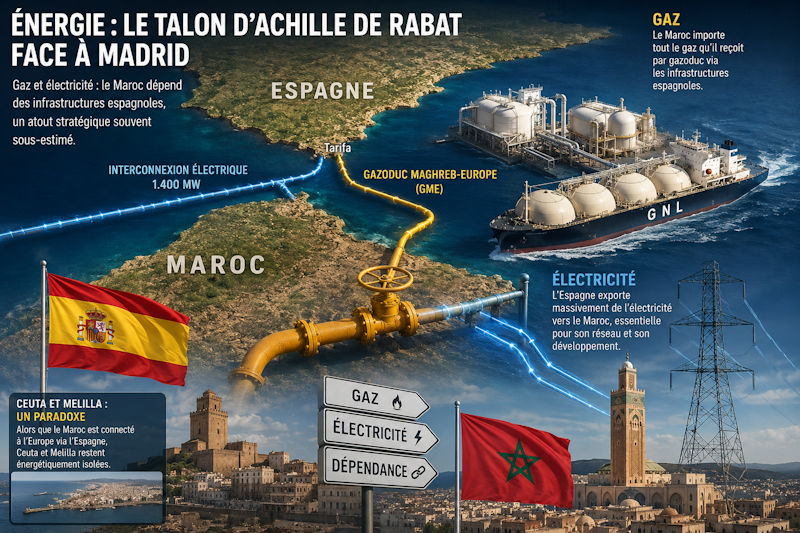

When tensions flare between Morocco and Spain over migration, territorial disputes, or geopolitical ambitions, one critical dimension often slips under the radar: energy. Despite Rabat’s assertive stance on Ceuta and Melilla, the Moroccan energy grid remains deeply entwined with Spanish infrastructure, revealing a strategic vulnerability.
Rabat’s diplomatic maneuvers and border standoffs with Madrid frequently dominate headlines. Yet, beneath these headline-grabbing disputes lies a quieter but equally decisive power dynamic—one where Spain holds significant leverage through gas and electricity networks that power Morocco’s economy.
With no end in sight to recurring disputes, this energy interdependence is reshaping the very foundations of their bilateral relationship.
How Morocco became dependent on Spanish gas
The rupture in Morocco’s gas supply chain came in 2021, when Algeria abruptly halted exports through the Maghreb-Europe pipeline (GME), a conduit that had long carried Algerian gas across Moroccan soil to Spain. The diplomatic fallout between Algiers and Rabat severed this critical link, forcing both countries to rethink their energy strategies.
In a twist of geopolitical irony, the GME pipeline reversed direction. Once a transit route for Algerian gas bound for Europe, it now carries Spanish gas back into Morocco. According to official data, Rabat received approximately 10.3 TWh of natural gas in 2025—nearly a quarter of Spain’s total gas exports for the year—valued at roughly €400 million.
This shift underscores a paradox: while Morocco contests Spain’s control over Ceuta and Melilla, its energy security depends on infrastructure operated by Madrid.
Rabat’s push for energy autonomy
Morocco has not remained passive in the face of this dependence. The government is advancing major projects to reduce reliance on Spanish energy sources. Among them is the Nador West Med LNG terminal, a strategic facility designed to allow direct maritime gas imports and integration into the Maghreb-Europe pipeline network. The goal is clear: diversify supply routes and minimize exposure to political leverage.
Another pillar of Morocco’s energy diversification strategy is the Nigeria-Morocco gas pipeline, a proposed transnational project aiming to link West African gas reserves with European markets. If realized, this 7,000-kilometer infrastructure could redefine regional energy flows.
Yet, these long-term solutions remain years away from full operational capacity. For now, Morocco’s short-term energy needs continue to rely on Spanish infrastructure.
Electricity links add another layer of interdependence
The energy relationship extends beyond gas. Two undersea cables connect Spain’s electrical grid to Morocco, with a combined capacity of 1,400 MW. In 2025, Spain exported a record 3,743 GWh of electricity to Morocco—a 47.5% surge from the previous year and the highest since 2017.
The flow of electricity overwhelmingly favors Morocco, accounting for nearly three-quarters of the available interconnection capacity. This connection is not merely commercial; it provides Morocco with much-needed stability as its energy demand rises and renewable capacity expands.
Plans for a third subsea cable are already underway, signaling deeper integration and mutual reliance between the two nations.
Ceuta and Melilla: a paradox in energy access
The contrast is striking: while Morocco benefits from direct access to Europe’s energy network via Spain, two Spanish territories—Ceuta and Melilla—have historically operated as isolated energy enclaves.
Ceuta is set to break free from this isolation in 2026 with the completion of a €300 million undersea cable linking it to mainland Spain. However, Melilla remains disconnected due to geographical constraints, maintaining its status as a self-sufficient energy island.
This disparity highlights a broader irony: Spain exports energy to Morocco while parts of its own territory remain energy-dependent.
Energy as a silent geopolitical lever
Energy infrastructure has long been seen as an economic asset. But in today’s tense Mediterranean and North African landscape, these networks carry unspoken strategic weight. Although Spain has no public record of using energy as political leverage, the very structure of this interdependence creates a latent vulnerability.
Rabat has historically held the upper hand in areas like migration control and counter-terrorism cooperation. Yet, on the energy front, the tables may be turning. Spain’s control over pipelines and electricity cables gives Madrid a subtle but powerful bargaining chip in any future dispute.
This silent interdependence adds a new dimension to the Morocco-Spain relationship—a dimension where energy flows can influence geopolitical outcomes without a single word being spoken.
Madrid’s strategic advantage
Morocco is racing to reduce its energy dependence through ambitious projects like Nador West Med and the Nigeria-Morocco pipeline. Still, these alternatives are not yet operational at scale.For now, Spain remains indispensable: it is both the gateway for Moroccan gas imports and the bridge connecting Morocco’s grid to the European energy market. In a region marked by territorial disputes and shifting alliances, this energy reality may prove to be the most consequential factor in the evolving balance of power between the two kingdoms.
Morocco wields considerable influence in its dealings with Spain. Yet, the reverse is equally true. And in the realm of energy, Rabat’s reliance on Spanish infrastructure may well be one of the most underestimated factors in their complex relationship.
You may also like
Will Senegal’s local elections break Bassirou Diomaye Faye’s presidency before it truly begins?
Senegal’s budget: can Ousmane Sonko afford to block Bassirou Diomaye Faye’s 2026 plan?
Senegal electoral reform: Khalidou dit Mbaye Sokoma’s full proportional representation push
Senegal’s local elections: Bassirou Diomaye Faye still won’t set a date
Alain-Georges Moukoko takes over Libreville prosecutor general’s office