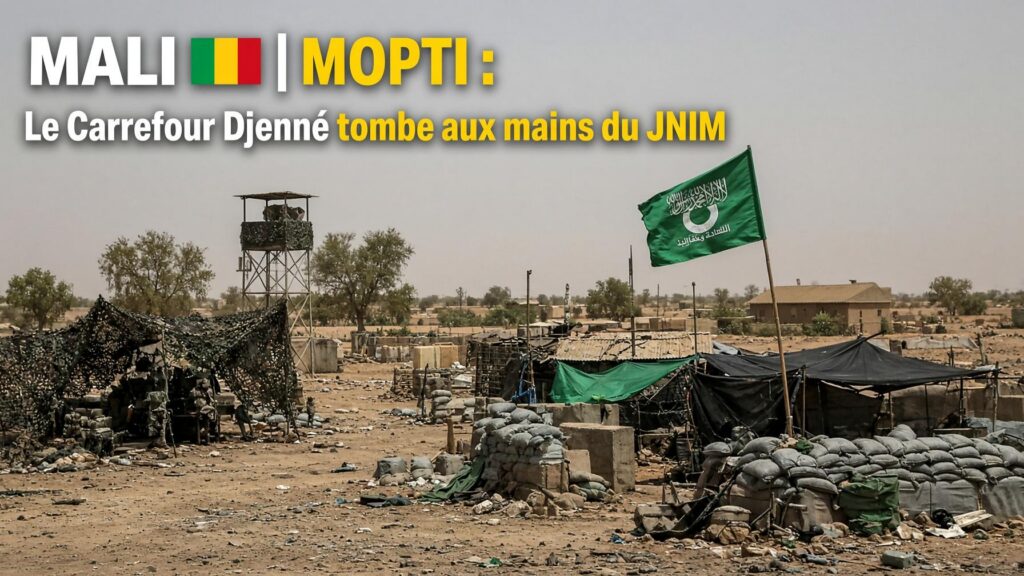
Mopti, Mali — The strategic crossroads at Djenné, a vital junction on the RN6 highway linking southern and northern Mali, was overrun on Thursday, September 24, at around 12:10 p.m. local time. Fighters from Jama’at Nusrat al-Muslimin (JNIM), an Al-Qaeda-affiliated group, launched a swift and deadly assault.
Within minutes of the initial gunfire and explosions, the military post at Djenné fell to the insurgents, according to multiple local accounts. While the army’s general staff in Bamako has not yet released an official casualty toll, indications suggest heavy losses. The attackers seized a significant cache of military equipment, including tactical vehicles, heavy weapons, and ammunition.
This latest security failure exposes deep vulnerabilities in a military apparatus already strained by JNIM’s tactics of economic and military asphyxiation.
A lightning assault in the heart of the Mopti region
Witnesses describe the insurgents arriving in large numbers, swiftly encircling the military position before launching their attack. “The violence was unprecedented. Gunfire came from every direction, and the defense forces could not hold their support line for long,” said a resident, speaking on condition of anonymity.
After the loyalist forces abandoned the post, videos released by the terrorist group show armed men parading through the smoking camp, displaying captured equipment as war trophies.
The blockade trap: fuel as a weapon of war
While the camp’s rapid fall raises questions, analysts point to the logistical crisis paralyzing operations in the area. For months, JNIM has tightened its economic and military grip on the Mopti region. By intercepting fuel tanker convoys on major trade routes connecting Mali to neighboring countries, the armed group has imposed a de facto fuel blockade.
This energy strangulation severely undermines the rapid response capabilities of the Malian Armed Forces (FAMa) and their auxiliaries. Without gasoline, reconnaissance patrols are reduced to a minimum, armored vehicles remain stationary in bases, and air support suffers major engagement delays.
Africa Corps pushes for adjusted allocations
As this creeping paralysis sets in, tensions are rising within the high command. According to regional security sources, the Russian paramilitary contingent Africa Corps has urgently requested the transitional authorities in Bamako to immediately increase their allocations of gasoline and aviation fuel.
Russian officers complain they cannot conduct effective counter-offensives or provide logistical coverage for forward posts without an emergency, secure, and dedicated supply. However, with national reserves of refined products at their lowest due to the blockade on road axes, meeting these demands is a strategic headache.
The attack on the Djenné crossroads dramatically illustrates JNIM’s attrition strategy: depriving the adversary of mobility to better strike isolated weak points. As central Mali sinks deeper into isolation, the transitional government faces a dual challenge: breaking the energy siege imposed by the insurgents and maintaining the cohesion of its military alliance on the ground.
You may also like
As donor fatigue spreads, can Benin’s €544,042 UNAIDS pledge keep the HIV response on track?
Who pays the price when Burkina Faso’s public payroll contracts? Households weigh the cost of 1,917 fewer agents
Libya pushes for direct Tripoli-Yaoundé flights as Cameroon sets up working groups
JNIM seizes three Burkinabè positions in a single day as Traoré’s security record faces hard questions
Chad condemns Ennedi-East airstrikes at un general assembly, warns of retaliation