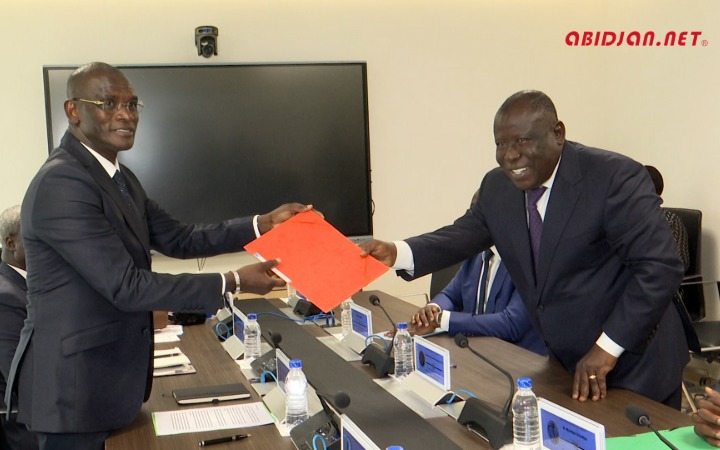
The announcement by Côte d’Ivoire’s ruling party (RHDP) to submit a comprehensive proposal for a new electoral body to the Interior Ministry has sent ripples through the political landscape, revealing deeper strategic motivations beyond mere procedural adjustments. Insiders suggest the move is not just about addressing past election controversies but about reshaping the foundation of Ivorian democracy for the next decade.
Behind the proposal: what the RHDP’s electoral reform is really about
The RHDP’s submission to the government isn’t just another administrative formality—it represents a calculated political maneuver with long-term implications. Sources close to the negotiations indicate three key objectives driving this reform: first, to institutionalize a system that minimizes postelection disputes; second, to preempt opposition strategies that have historically exploited electoral controversies; and third, to create a framework that aligns with the government’s vision for stable, predictable governance ahead of the 2026 electoral cycle.
The proposed reforms seek to address persistent criticisms of election management, including concerns about voter registration accuracy, transparency in vote tabulation, and the neutrality of election officials. But beneath these technical improvements lies a strategic imperative: building a system that can withstand future political pressures while maintaining the ruling party’s electoral dominance.
The missing pieces: what’s not included in the RHDP’s proposal
The opposition’s unaddressed concerns
While the RHDP’s proposal focuses on structural changes to the electoral commission, it conspicuously avoids addressing some of the opposition’s most pressing demands. Notably absent are guarantees for opposition representation in the new body’s leadership and provisions for independent international observation—a pillar of previous election monitoring efforts that many believe is essential for restoring public trust.
Critics argue that without these safeguards, the reform risks reinforcing perceptions of a system designed to favor the ruling party. Political analysts point out that previous election controversies in Côte d’Ivoire were not only about process failures but also about perceptions of unfairness—a challenge this proposal may not fully resolve.
Technical gaps in the proposal
Experts reviewing the RHDP’s submission have identified several technical deficiencies that could undermine the reforms’ effectiveness. Key among these is the lack of clear mechanisms for auditing voter rolls, which have been a flashpoint in past elections. Additionally, the proposal does not outline specific penalties for electoral fraud or procedural violations, leaving enforcement vague and potentially toothless.
Another area of concern is the timeline for implementation. While the RHDP has committed to submitting these proposals, there is no detailed roadmap for how quickly the new body could be operationalized nor clear benchmarks for measuring its success in restoring public confidence.
The government’s dilemma: balancing reform with political stability
The Interior Ministry now faces a delicate balancing act: how to implement reforms that address legitimate concerns without triggering political instability. Government officials privately acknowledge that this proposal represents a compromise between the RHDP’s desire for comprehensive change and the need to maintain political equilibrium.
The challenge lies not just in passing the reforms through parliament but in ensuring that opposition parties perceive the process as fair. Historically, Côte d’Ivoire’s electoral reforms have been contentious, with opposition groups often alleging that changes were designed to consolidate power rather than improve democracy.
This dynamic has created a paradox: while the RHDP pushes for structural reforms to prevent future disputes, opposition leaders may interpret these changes as steps toward entrenching one-party dominance rather than genuine democratic progress.
What’s next for Côte d’Ivoire’s electoral future?
The submission of these proposals marks only the beginning of what promises to be a contentious legislative process. Parliamentary debates are expected to focus on three critical questions: the composition of the new electoral commission, the mechanisms for ensuring its independence from political interference, and the safeguards against potential abuse of the new system.
For Ivorian citizens, the outcome of this reform effort will have far-reaching consequences. A credible electoral system could restore confidence in governance, attract investment, and reduce the risk of postelection violence. Conversely, a flawed implementation could deepen political divisions and undermine economic prospects in a country that has struggled to achieve lasting stability since its civil conflict.
The coming months will reveal whether this reform effort represents a genuine attempt to strengthen Ivorian democracy or another chapter in the country’s ongoing struggle to balance political ambition with democratic integrity.