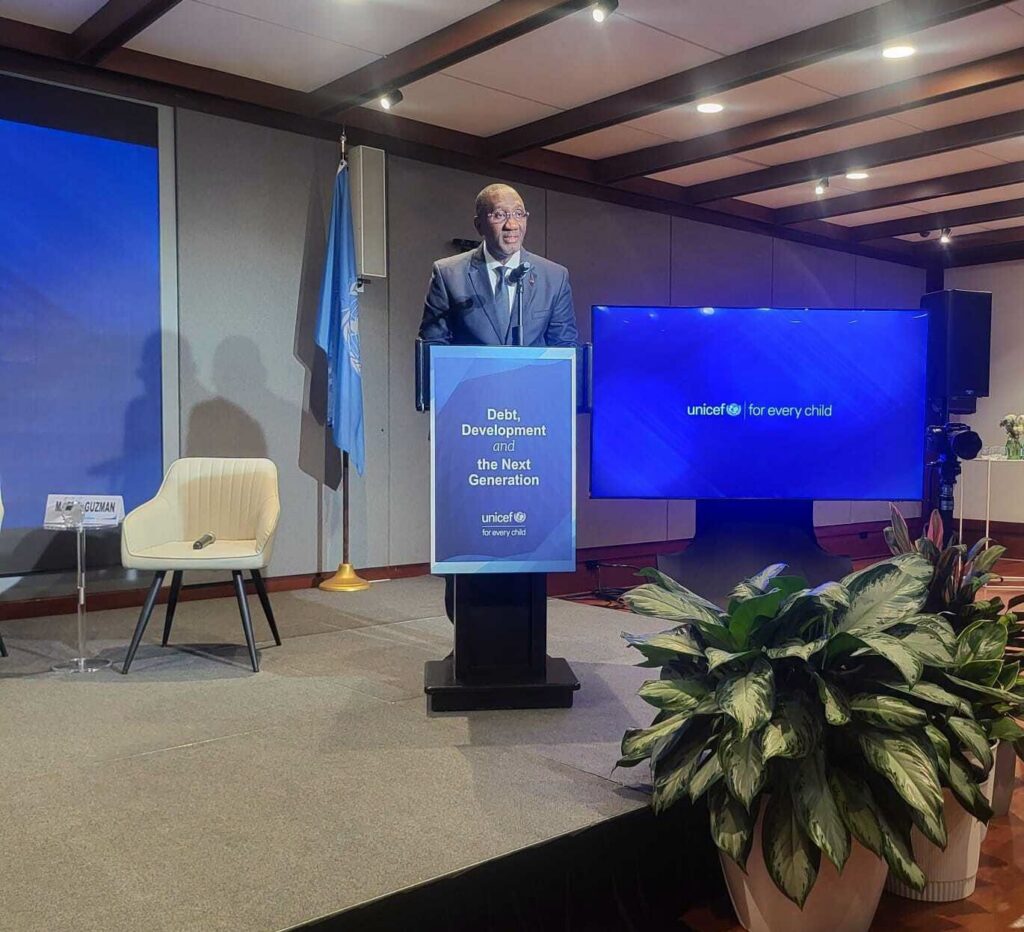
At the UNICEF high-level meetings held in New York on 21 and 22 September 2026, Côte d’Ivoire’s Minister of Planning and Development, Dr Souleymane Diarrassouba, presented the country’s approach to financing education and managing debt. The two sessions examined artificial intelligence in education and the impact of debt on future generations.
Artificial intelligence and sustainable financing in focus
On 21 September, the Minister joined the Learn AI Global Compact, a UNICEF initiative themed “Responsible AI for every learner.” He outlined Côte d’Ivoire’s experience with sustainability-linked financing.
In 2025, the country adopted a dedicated framework and secured a €433.3 million loan whose financial terms adjust based on results in renewable energy and forest restoration. The operation benefits from a joint guarantee by the International Bank for Reconstruction and Development (IBRD) and the Multilateral Investment Guarantee Agency (MIGA). It is the first sovereign sustainability-linked loan in West Africa.
In New York, the possibility of extending this model to human capital through a sustainability-linked bond was explored. Under such a mechanism, the loan’s financial conditions would be tied to learning outcomes measured at the national level.
Such a scheme requires reliable and verifiable learning indicators, along with prudent management of financial risks. The loan’s duration must align with that of the investments it finances. Côte d’Ivoire also emphasized principles such as protecting children’s data and ensuring the accountability of states and teachers in pedagogical choices.
The National Development Plan (PND) 2026-2030 foresees greater use of digital technology and artificial intelligence, particularly in education and training. Côte d’Ivoire expressed its readiness to continue working with UNICEF and Learn AI Global Compact partners on verifiable learning indicators and a suitable guarantee mechanism.
Debt, development, and future generations
On 22 September, the Minister spoke at a second UNICEF high-level meeting on debt, development, and future generations.
According to UNICEF, nearly 400 million children live in countries where debt burdens are growing faster than investments in health, education, and nutrition.
The Minister reiterated Côte d’Ivoire’s position: the impact of debt on populations depends on its allocation, structure, and cost.
The PND 2026-2030 provides the reference framework for this policy. It prioritizes human capital, skills, and employment, and sets targets for maternal and child health, universal health coverage, social protection, and improving the human capital index.
Côte d’Ivoire simultaneously pursues debt management based on risk control, fiscal sustainability, and securing better financing terms.
In 2024, with support from the World Bank Group, the country carried out a debt-for-development swap. Nearly €400 million of commercial debt was refinanced. The operation is expected to generate around €330 million in fiscal resources over five years, a significant portion of which is allocated to education through national budget mechanisms.
“A human-faced debt is not an erased debt. It is a debt whose allocation, structure, and cost serve health, education, and child protection,” said Dr Souleymane Diarrassouba.
Through these two interventions, Côte d’Ivoire presented the choices guiding its development financing policy: preserving debt sustainability, directing resources toward national priorities, and exploring new instruments when they can contribute to the goals of the PND 2026-2030. Education, health, social protection, and more broadly, human capital development remain at the heart of these priorities.
You may also like
As donor fatigue spreads, can Benin’s €544,042 UNAIDS pledge keep the HIV response on track?
Who pays the price when Burkina Faso’s public payroll contracts? Households weigh the cost of 1,917 fewer agents
Libya pushes for direct Tripoli-Yaoundé flights as Cameroon sets up working groups
JNIM seizes three Burkinabè positions in a single day as Traoré’s security record faces hard questions
Chad condemns Ennedi-East airstrikes at un general assembly, warns of retaliation