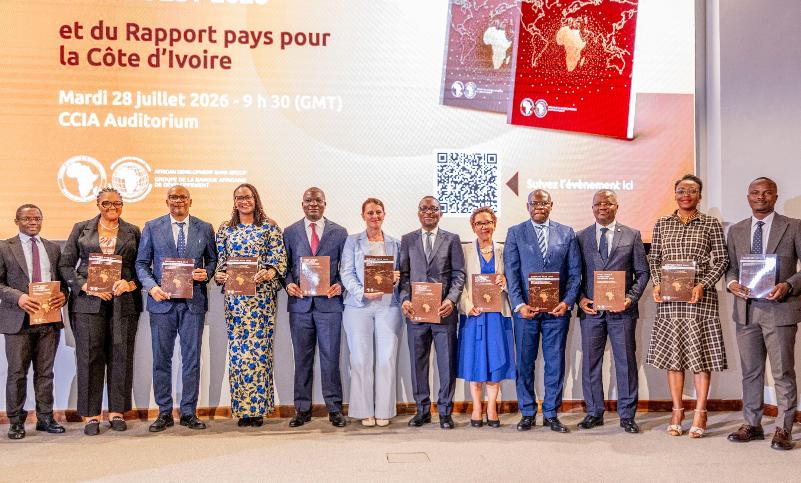
Ivorian Government Highlights Development Financing Model at African Development Bank Event
Under the leadership of Dr Souleymane DIARRASSOUBA, Minister of Planning and Development, Professor Loesse Jacques ESSO, Cabinet Director, led the official launch of the 2026 Country Report Côte d’Ivoire and the West Africa Economic Outlook during a high-level event in Abidjan. The session, held under the theme « Mobilizing large-scale resources for Africa’s development in a fragmented world », brought together representatives from the African Development Bank (AfDB), national and international financial institutions, the private sector, and Ivorian government officials.
Côte d’Ivoire Aligns National Priorities with Regional Economic Transformation
Championed by Alassane Ouattara, President of the Republic, the Ivorian Government has made resource mobilization a cornerstone of its economic transformation agenda. This strategic focus is embedded in the National Development Plan (NDP) 2026–2030, which aims to accelerate sustainable growth through increased mobilization of both public and private financing. The NDP’s ambitious financing target of 114,838.5 billion FCFA (approximately 209 billion USD) underscores the scale of investment required to achieve these goals.
The successful outcomes of the July 2026 Consultative Group meeting, where over 80 billion USD (47,820 billion FCFA) was mobilized, reflect strong international confidence in Côte d’Ivoire’s development vision and its capacity to attract substantial financing for national priorities.
African Development Reports Serve as Strategic Policy Tools
Speaking on behalf of the Minister of Planning and Development, Professor Loesse Jacques ESSO emphasized the critical role of the AfDB reports in shaping public policy and guiding dialogue with development partners. These publications provide essential data and analysis that inform strategic decision-making across the continent.
He noted that with Africa’s projected economic growth of 3.9% in 2025, several countries—including Côte d’Ivoire, which is on track to grow by 6.5%—are advancing toward the targets set in the African Union’s Agenda 2063. This sustained growth trajectory highlights the importance of robust financing mechanisms to support structural transformation.
Regional Collaboration Key to Financing Africa’s Future
Beyond national achievements, regional cooperation emerged as a central theme. The discussions highlighted the need for stronger domestic resource mobilization, deeper private sector engagement, and financial system strengthening across Africa. Initiatives such as the Pan-African Payment and Settlement System (PAPSS) and the African Continental Free Trade Area (AfCFTA) were identified as vital tools to enhance regional integration and accelerate economic transformation.
Professor Loesse Jacques ESSO urged participants to engage deeply with the insights and recommendations presented in the reports. He called for collective reflection on the responsibilities of public administrations, the private sector, financial institutions, and civil society in building more effective development financing frameworks—both in Côte d’Ivoire and across West Africa.
You may also like
Sevilla vs Barcelona: kick-off time, tv channel and odds for the Sánchez-Pizjuán clash
Mali prison overcrowding: Bamako jail holds 10,000 in space built for 600 as mass arrests surge
World Bank brings education, jobs and entrepreneurship open days to Abidjan on 21-22 September 2026
At Tougan, Burkina Faso’s maize farmers sell at a loss and face debts as food sovereignty falters
Niger’s FPL opens its ranks to youth as security crisis deepens