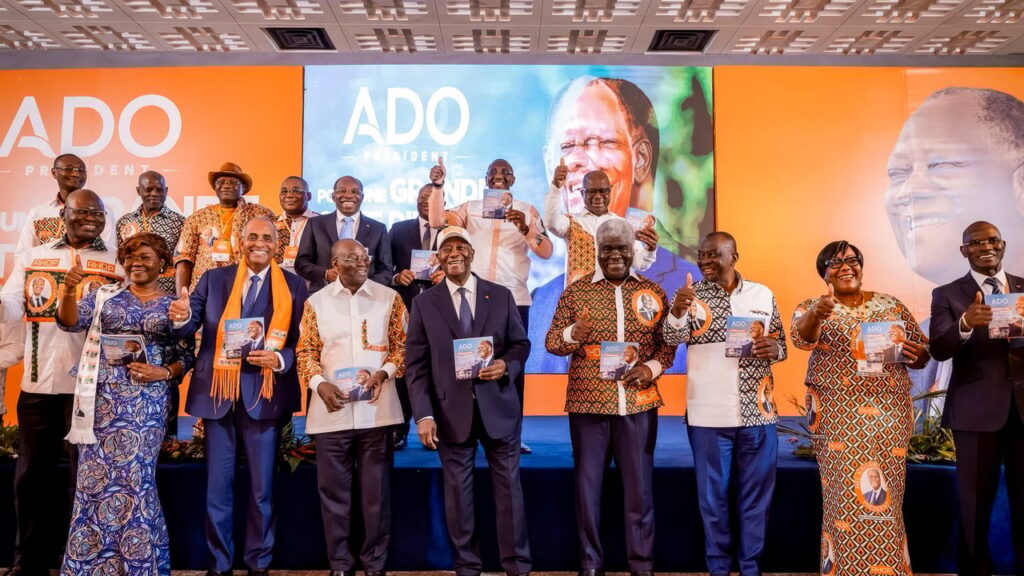
In Côte d’Ivoire, the Rally of Houphouëtists for Democracy and Peace (RHDP) has undergone a remarkable transformation over the past two decades. What began as a fragile coalition between former rivals has steadily grown into the country’s most influential political machine, reshaping the nation’s democratic landscape.
Born from the uneasy alliance between President Alassane Ouattara and former President Henri Konan Bédié, the RHDP emerged as a united front against a common adversary: Laurent Gbagbo. Yet its evolution has been far more dramatic than a simple political regrouping. Through strategic alliances, internal reforms, and a disciplined electoral machine, the party has cemented its dominance in Ivorian politics, leaving competitors struggling to keep pace.
The birth of the RHDP: from opposition to ruling party
The RHDP’s origins trace back to the early 2000s, a period marked by deep political fractures in Côte d’Ivoire. The country was divided between supporters of Ouattara and Bédié, both of whom claimed legitimacy as heirs to the legacy of Félix Houphouët-Boigny, the nation’s founding father. Their rivalry threatened to destabilize the fragile peace following years of civil conflict.
In an unexpected turn, Ouattara and Bédié set aside their differences to confront Gbagbo, whose presidency had become increasingly contentious. This pragmatic alliance laid the foundation for the RHDP, which was officially formed to consolidate their political strength. Initially perceived as a temporary coalition, the party soon demonstrated its resilience, adapting to shifting political winds and emerging as a unified force.
The rise of a political juggernaut
Over the years, the RHDP has evolved from a grassroots movement into a highly organized and efficient electoral structure. Its transformation reflects a deliberate strategy to centralize power, streamline decision-making, and mobilize voter support across the country. Key to this success has been the party’s ability to absorb smaller political factions, co-opt opposition figures, and maintain a cohesive narrative around national unity.
Under Ouattara’s leadership, the RHDP has not only won successive elections but has also positioned itself as the dominant force in Ivorian politics. Its dominance is evident in local governance, where party-aligned officials frequently secure key administrative positions, and in national institutions, where the party’s influence extends across branches of government.
Challenges and controversies
Despite its dominance, the RHDP has not been immune to criticism. Some observers argue that its consolidation of power has come at the expense of political pluralism, with opposition voices often sidelined or marginalized. Others point to internal tensions, including disputes over leadership succession and ideological direction, which have occasionally surfaced within the party’s ranks.
Yet the RHDP continues to adapt, reinforcing its electoral machinery and expanding its base of support. Whether through policy initiatives, grassroots mobilization, or strategic alliances, the party remains a formidable presence in Côte d’Ivoire’s political arena, shaping the nation’s future trajectory.
You may also like
Senegal’s local elections: Bassirou Diomaye Faye still won’t set a date
Alain-Georges Moukoko takes over Libreville prosecutor general’s office
Bénin : le Sénat tient sa séance inaugurale sous la conduite de Patrice Talon
Gabon : le citoyen au cœur de la nouvelle donne démocratique
Gabon : l’association Force lance sa rentrée citoyenne à Akanda