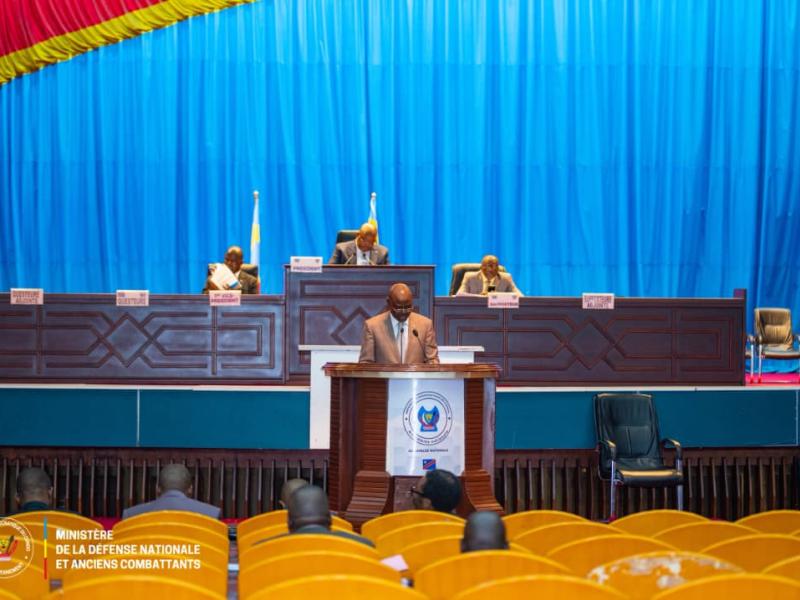
The Democratic Republic of Congo’s National Assembly has begun examining the military programming law for 2027-2030, a critical legislative initiative aimed at modernizing and strengthening the country’s defense capabilities. This landmark session, convened on Tuesday, July 14, 2026, marks a pivotal step in the government’s broader efforts to restructure and professionalize the Armed Forces of the Democratic Republic of Congo (FARDC).
The newly introduced bill, presented by Vice Prime Minister and Minister of National Defense Guy Kabombo Muadiamvita, follows the expiration of the previous military programming law (2022-2025), which served as a foundational framework for defense sector reforms. The outgoing legislation, while instrumental in initiating modernization efforts, left gaps in operational adaptability and resource allocation efficiency.
key objectives of the new military programming law
The 2027-2030 military programming law is designed to address critical deficiencies in defense infrastructure and operations. Its core objectives include:
- institutional strengthening: placing human capital at the center of national defense through improved training and administrative efficiency;
- operational enhancement: expanding military training, intelligence capabilities, and operational readiness to counter both internal and external threats;
- infrastructure modernization: upgrading military facilities and equipment to meet contemporary defense standards;
- defense industry development: fostering a domestic defense manufacturing sector to reduce reliance on foreign suppliers and support economic resilience;
- financial sustainability: establishing a multi-year budgetary framework to ensure consistent funding and prevent ad-hoc resource allocation.
The bill is structured around six strategic programs, each aligned with the vision of President Félix Tshisekedi, who serves as Commander-in-Chief of the FARDC. These programs are designed to create a cohesive, responsive, and technologically advanced defense apparatus capable of addressing the nation’s evolving security challenges.
funding and institutional support
In his address to legislators, Minister Kabombo highlighted the creation of the Support Fund for FARDC Development (FSD-FARDC), a dedicated financial mechanism aimed at mobilizing additional resources for defense modernization. The fund seeks contributions from public and private donors, including international partners, to accelerate the implementation of critical defense initiatives.
The fund’s establishment reflects a broader government commitment to prioritize national security amid persistent regional instability. The ongoing conflict in the eastern provinces—particularly the resurgence of the M23 rebel group—has intensified pressure on the FARDC, underscoring the urgent need for robust and sustainable defense reforms.
regional context and diplomatic efforts
The timing of this legislative initiative coincides with ongoing diplomatic efforts to stabilize the eastern DRC. The recently signed Washington Peace Agreement, mediated by the United States, aims to de-escalate tensions between the DRC and Rwanda and facilitate the withdrawal of foreign armed groups from Congolese territory. However, despite these diplomatic advances, the security situation in North Kivu and South Kivu remains volatile, with rebel forces maintaining control over key urban centers such as Goma and Bukavu.
Parallel peace talks in Doha, facilitated by Qatar, have yet to yield significant breakthroughs, leaving the region in a precarious state. The persistent disconnect between diplomatic commitments and ground realities highlights the critical importance of strengthening the FARDC’s operational capabilities through legislative and institutional reforms.
The review of the military programming law represents a decisive move toward aligning the country’s defense strategy with both immediate security imperatives and long-term developmental goals. By prioritizing professionalization, technological advancement, and financial stability, the DRC is positioning itself to better safeguard its sovereignty and protect its citizens in an increasingly complex regional landscape.