Recent judicial appointments in Senegal have ignited intense discussions about their potential impact on the nation’s political landscape. Political analyst Mamadou Wane, widely known as Mao, suggests that President Bassirou Diomaye Faye’s strategic moves aim to prevent opposition leader Ousmane Sonko from running in the 2029 presidential election—yet this approach may underestimate the resilience of the Senegalese population.
Controversial shifts in judicial leadership
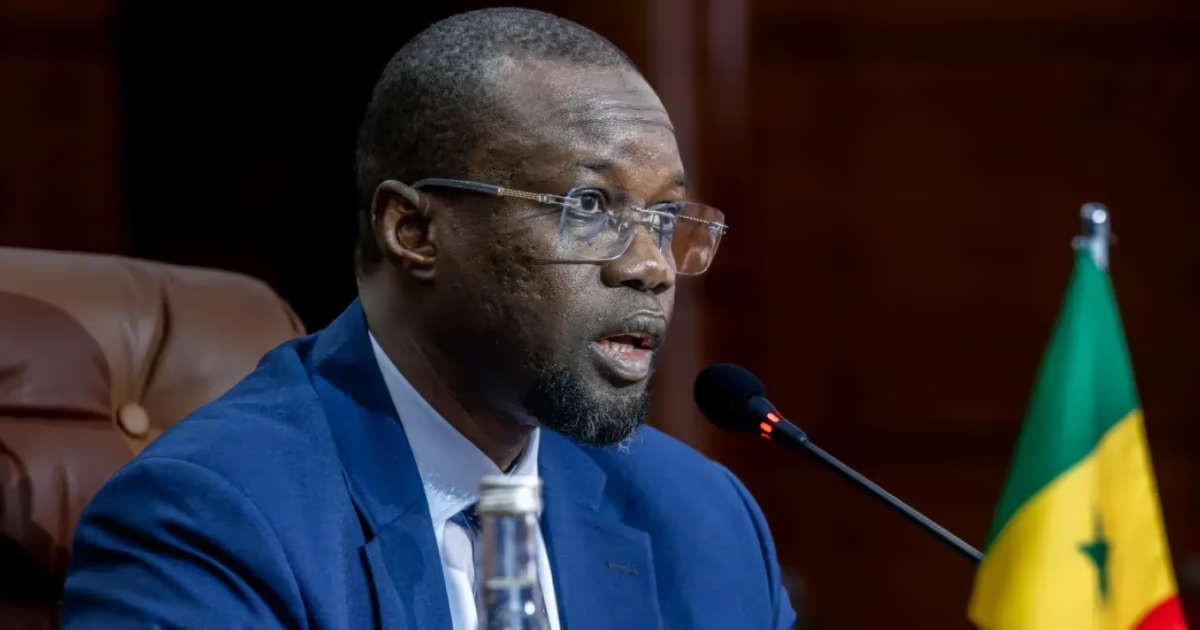
In a significant reshuffle, President Faye has nominated magistrates to key judicial positions, including the Constitutional Council and the Saint-Louis Court of Appeal. According to Mao Wane, this marks a deliberate attempt to restore elements of the former neocolonial order while systematically weakening Sonko’s political influence. The analyst argues that such maneuvers will ultimately fail, given the deep-rooted public support for the PASTEF leader, which has repeatedly thwarted past efforts to sideline him.
Magistrates with a history of conflict
Among the appointees is Ousmane Diagne, a former justice minister, now president of the Constitutional Council. His relationship with Sonko has been fraught with tension, particularly over Sonko’s accusations that Diagne’s predecessor, Mamadou Badio Camara, deliberately delayed accountability processes. Serigne Bassirou Guèye, appointed as Advocate General at the Saint-Louis Court of Appeal, has also faced sharp criticism from Sonko. Sonko has publicly accused Guèye of doctoring a gendarmerie investigation report in a politically motivated attempt to incriminate him during a high-profile case.
Mao Wane reserves judgment on Diagne’s new role but strongly condemns Guèye’s past actions: « A magistrate who resorts to such unethical practices has no place in the judiciary. His actions were not just questionable—they were criminal. »
Neocolonial restoration or democratic erosion?
The analyst frames the appointments as part of a broader revisionist agenda—a deliberate effort to reverse democratic gains and reinstall the political elite of the pre-2020 era. Wane describes this as a stark divide between those seeking to restore a neocolonial system and those advocating for sovereignty, patriotism, and democratic renewal.
He warns President Faye and his allies that attempting to exclude Sonko politically would be a grave miscalculation: « The Senegalese people have demonstrated over decades that they will not tolerate manipulation. The strength behind Sonko is not just his party—it is the collective will of a nation that has repeatedly defended its democracy. Those who believe they can suppress his influence are making a historic error. »
PASTEF’s growing influence and the power of Senegalese youth
Wane highlights the unprecedented surge in PASTEF membership sales as proof of the party’s grassroots dominance. « The PASTEF stands today as the most organized, dynamic force in Senegalese politics, anchored by Ousmane Sonko’s leadership, » he states. This momentum, he argues, is a direct result of the Senegalese people’s irreversible democratic maturity—honed through pivotal moments like the 2000 and 2012 elections, and solidified during the intense three-year struggle between 2021 and 2024.
« The Senegalese people did not just resist for days—they held firm for years. They have learned how to challenge entrenched power, no matter the obstacles. This collective memory makes any attempt to politically eliminate Sonko a doomed strategy from the start. »