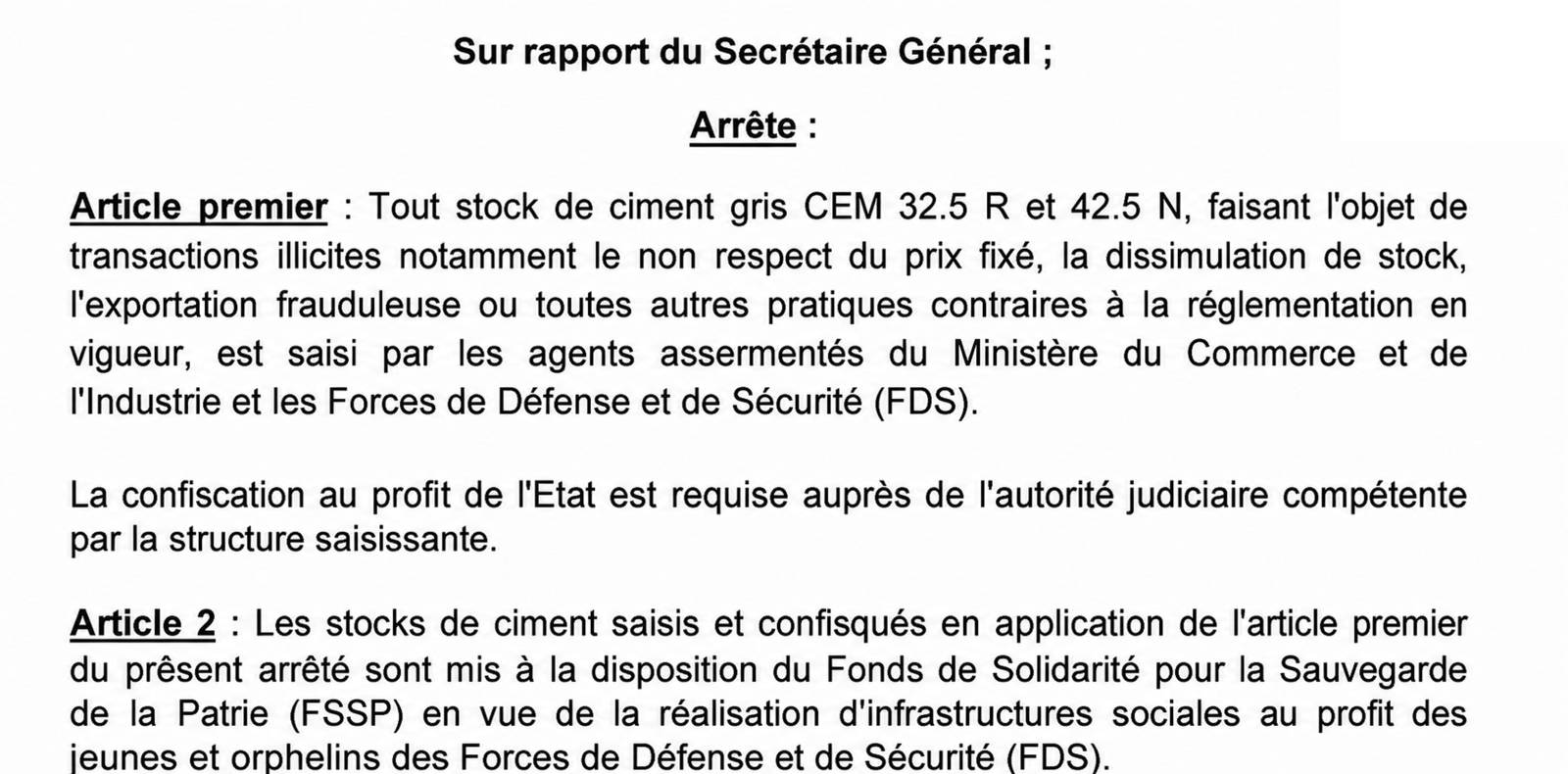
The Nigerien government has taken decisive action to address the escalating cement prices and reported shortages across multiple regions by implementing price controls. On 13 July 2026, the Ministry of Trade and Industry issued two decrees capping the price of 42.5 N cement and introducing penalties for non-compliant operators, including the confiscation of illicitly held stocks.
Government intervention to curb speculative practices
The authorities justified these measures as essential to safeguard consumers from commercial speculation, where certain traders allegedly exploit high demand to inflate prices or artificially restrict supply. The stated goal was to prevent abuse and protect household purchasing power. However, while speculative behaviour warrants intervention, administrative price controls may prove to be a short-term fix rather than a sustainable solution.
Potential unintended consequences of price controls
History has shown that price ceilings, when not paired with policies to boost supply and secure distribution channels, can lead to adverse market reactions. If production, transportation, or import costs exceed the imposed price limits, distributors may opt to slow sales, reduce orders, or divert products to unregulated markets where prices evade oversight entirely.
The decree also empowers authorities to confiscate stocks deemed fraudulent. While this measure may deter some unscrupulous traders, it raises concerns about its implementation. Without transparent oversight and robust legal safeguards, such actions risk fostering disputes between regulators and businesses or even enabling arbitrary enforcement.
Structural weaknesses in the cement sector
Beyond addressing individual malpractice, the current crisis highlights deeper vulnerabilities within Niger’s cement market. Persistent supply challenges, elevated logistics costs, import constraints, and limited local production capacity cannot be resolved by ministerial decrees alone. Industry stakeholders emphasize that stable pricing hinges on a well-supplied market, which requires enhanced production capabilities, streamlined import processes, and improved distribution networks.
The government’s swift response reflects mounting public pressure, yet the measure appears more as an administrative reaction to a complex economic issue. While enhanced oversight may curb immediate abuses, it cannot substitute for the structural reforms necessary to ensure long-term market stability and supply reliability.
Rebuilding trust in the cement market
The critical challenge ahead lies in restoring confidence among authorities, producers, distributors, and consumers. Without a comprehensive strategy that tackles the root causes of speculation and shortages, price controls may offer only temporary relief while potentially introducing new distortions—with ordinary Nigerien citizens bearing the brunt of the consequences.