In the face of persistent terrorist threats plaguing border areas, Bénin and Burkina Faso have reached a pivotal moment. Cotonou’s long-anticipated revitalization of bilateral military cooperation is now tangible on the ground, with the deployment of joint patrols in the strategically vital Koualou region. Driven by an assertive defense diplomacy under the impetus of Bénin’s new president, Romuald Wadagni, this operational alliance aims to decisively neutralize armed groups and bring lasting peace to a zone critical for regional stability in the West Africa Sahel.
a new diplomatic surge: the romuald wadagni shift
Securing Bénin’s northwestern frontier, which borders Burkina Faso, has consistently been a top national security priority. While former President Patrice Talon initiated rapprochement with a special visit to Ouagadougou to advocate for concerted military action, significant progress has truly accelerated in recent months.
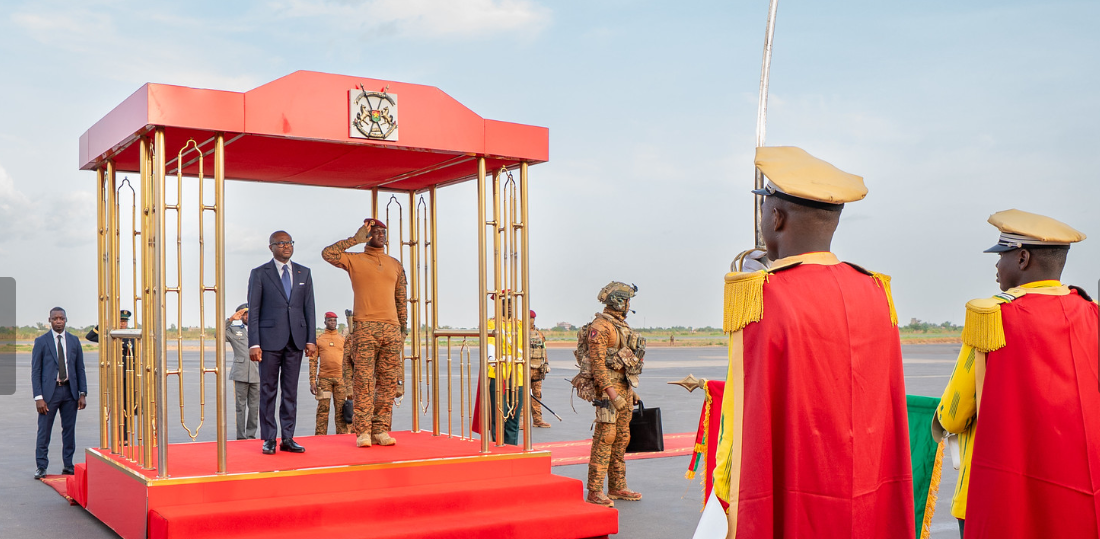
Upon assuming office, Bénin’s new president, Romuald Wadagni, immediately positioned security diplomacy as the cornerstone of his foreign policy. To formalize this warming of relations and inject decisive momentum into discussions, the Béninese head of state personally traveled to Ouagadougou. This presidential visit to Burkina Faso was instrumental in forging the essential mutual trust needed to translate political intentions into operational realities. Cotonou’s message was unequivocal: no single nation can overcome an asymmetric adversary that disregards charted borders. Bénin’s outstretched hand found a favorable and pragmatic response from Burkina Faso’s transitional authorities.
koualou at the heart of action: forces deployed on the ground
The Koualou region, historically a point of administrative friction and a vulnerable corridor for incursions by armed terrorist groups, now stands as a symbol of this re-established unity. A substantial delegation from the Forces Armées Burkinabè (FAB) recently crossed the border to officially commence joint patrols alongside Bénin’s Forces de Défense et de Sécurité (FDS).
On the ground, this coordinated deployment fundamentally alters the dynamic. It moves beyond merely monitoring one’s own territory from a demarcation line to planning synchronized tactical movements. Units from both nations are now jointly sweeping the Koualou area. This visible and proactive military presence aims to saturate the border space, thereby depriving terrorist networks of their refuge and retreat zones, while simultaneously providing full reassurance to local populations—the primary victims of atrocities—by reaffirming the authority of both states over these peripheral territories.
the ultimate weapon: intelligence sharing and interoperability
Beyond troop movements and foot or motorized patrols, the core of this renewed cooperation lies in information sharing. Sahelian terrorism thrives on porous borders and a lack of communication between neighboring armies. By dismantling these silos, Bénin and Burkina Faso are strategically disarming their adversaries.
Direct collaboration between the military intelligence services of both countries now facilitates real-time transmission of data concerning suspicious movements, weapons caches, and the logistical flows of armed groups. This fluidity of information ensures unprecedented tactical responsiveness: a threat identified on one side of the border can be immediately addressed or intercepted on the other by the partner army. Interoperability, meaning the capacity of both armies to communicate on shared frequencies and utilize common tactical procedures, is emerging as the cornerstone of this asymmetric struggle.
towards a broader regional dynamic
The success of this bilateral security integration model is already inspiring others in the sub-region. Niger is expected to follow Burkina Faso’s lead by accepting the hand extended by Béninese authorities. By joining this dynamic of cross-border cooperation, Niamey can lay the groundwork for a genuine tripartite security lock. This adherence by Niger is crucial for coordinating the fight in the so-called “three borders” zone and along the Niger River, thereby suffocating criminal networks attempting to establish themselves in the region. This is vital news for West Africa Sahel and impacts Sahel politics today.
the hope for lasting peace
The deployment of joint patrols in Koualou undeniably marks a historic turning point in military relations between Bénin and Burkina Faso. Thanks to President Romuald Wadagni’s renewed leadership and the receptiveness of his Sahelian counterparts, West Africa is demonstrating its capacity to formulate robust, localized responses to terrorism.
The battle has only just begun, but the foundations are now solid. It is fervently hoped that this operational cooperation will further strengthen, extend to other sectors such as the development of border zones, and succeed in completely eradicating the criminal elements that threaten the peace of citizens and the integrity of our states.