Over the past two decades, the landscape of Senegal’s major public contracts has undergone a dramatic shift. While French corporations once held sway over key sectors such as ports, stadiums, and industrial zones, they now find themselves in a distant second place behind Chinese firms, which have secured over 30% of public tenders. Emerging players from Turkey, Tunisia, and the United Arab Emirates are also staking their claims in this evolving market.
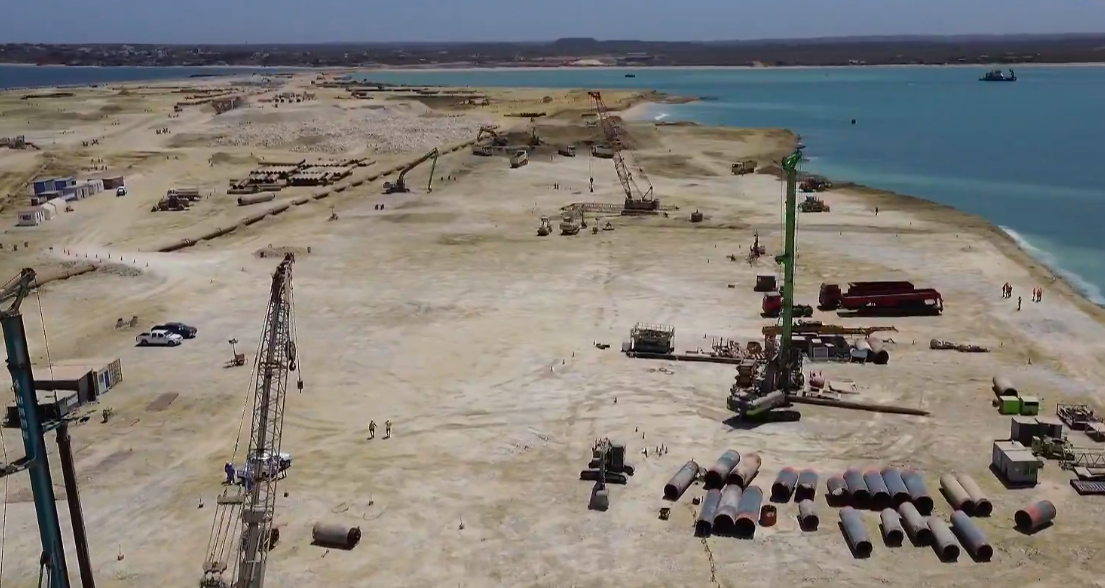
Construction of Senegal’s first deep-water port in Ndayane, south of Dakar, exemplifies this transformation. Valued at over $2 billion, this strategic project is designed to accommodate the largest container ships in the Atlantic. Although the contract is managed by the Emirati company DP World, the construction is led by an international consortium dominated by Chinese firms. David Gruar, DP World’s project director, confirms that while competitors from around the world—including many French firms—applied, none were selected.
The reasons behind this shift are rooted in both cost efficiency and adaptability. Gruar explains that the winning bid was approximately 20% cheaper than the proposal submitted by a French-led consortium that included Eiffage. The price advantage, combined with a deeper understanding of local needs, has made Chinese contractors the preferred choice.
new urban centers and industrial platforms: Turkish and chinese firms lead the way
Just a few kilometers from the port, the construction of Diamniadio, a new urban center designed to ease congestion in Dakar, tells a similar story. Here, Turkish companies have secured the majority of contracts for the stadium, railway station, hotels, and residential buildings. Bohoum Sow, Secretary-General of APROSI, a local business association, points out that he is not aware of any French firms operating within the industrial zone, highlighting the dominance of Turkish and Chinese enterprises in this space.
Bohoum Sow emphasizes that Chinese companies have demonstrated a keen ability to align with Senegal’s development priorities. He cites a local cardboard packaging factory where Chinese technicians are training Senegalese employees—a sector that did not previously exist in the country. This adaptability and responsiveness to specific market needs have set Chinese firms apart.
China’s strategic investment in africa
For the past 20 years, China has made Africa a cornerstone of its economic diplomacy, pouring billions into infrastructure projects across the continent. In Senegal, the results are visible: Chinese flags fly over major construction sites, and their presence is undeniable. Bohoum Sow acknowledges this shift, stating, “It’s a win-win situation. Senegal needs infrastructure, and China understands that. The times have changed, and so have our partners.”
While French firms once dominated sectors such as energy, banking, and large-scale infrastructure, their share of public contracts has dwindled to just 5%. Meanwhile, Chinese companies now account for over 30% of the market. The rise of other international players, including those from Turkey, the UAE, and Tunisia, has further reshaped the competitive landscape.
can french firms reclaim their position?
Despite these challenges, some French companies are finding success by adapting to the new realities of the Senegalese market. The Ragni Group, a family-owned French company specializing in public lighting, secured a contract to deploy 36,000 next-generation solar streetlights in Senegal. The project, worth approximately €70 million, is partly financed by the French Development Bank.
To win this bid, Ragni established a local subsidiary managed by Senegalese executives, rather than relying on expatriates. Birama Diop, director of Ragni Senegal, explains that flexibility, quality, and cost efficiency were key factors in their success, along with a commitment to local job creation.
Caroline Richard, Head of Proparco’s Senegal office, believes French firms still have opportunities to grow—provided they embrace this new model. “French companies have a strong competitive edge when high standards are required. Senegal offers significant potential for growth in labor-intensive and high-expertise sectors.”
As solar streetlights illuminate Senegalese cities, a new paradigm emerges: one where French firms must demonstrate agility, forge local partnerships, and prove their competitiveness against entrenched rivals from China, Turkey, and the UAE.