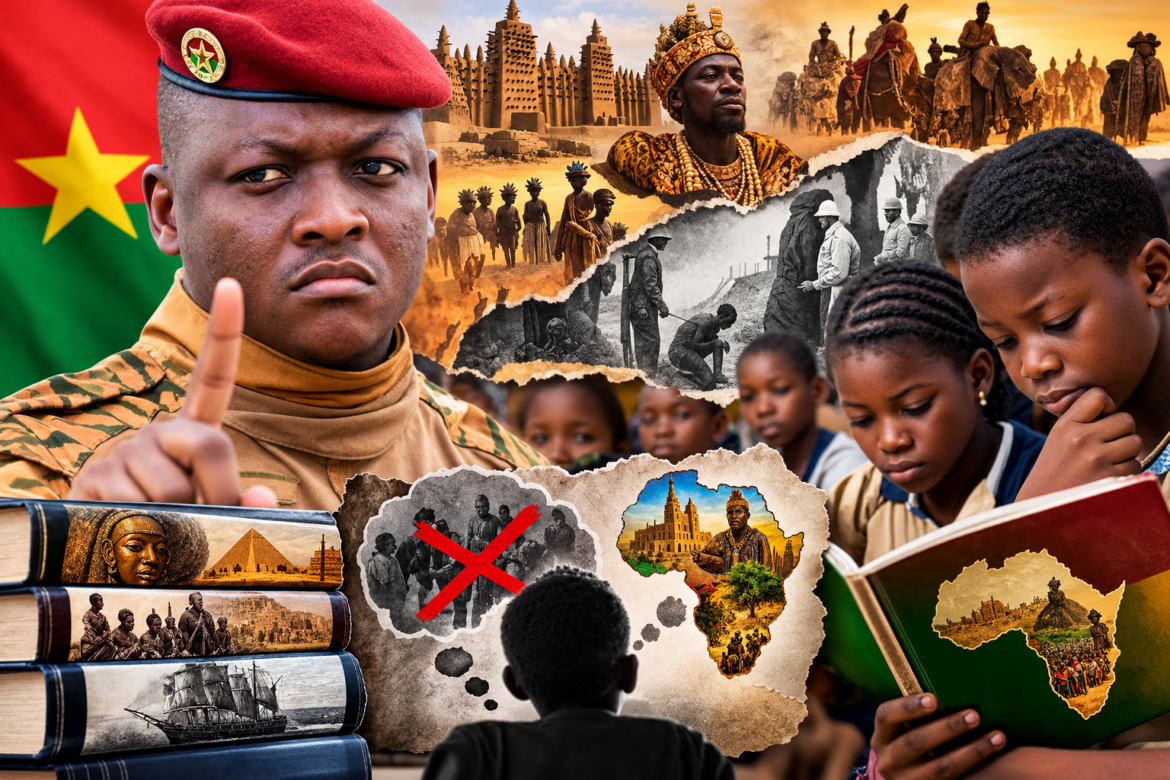
The Burkina Faso government’s overhaul of its history and geography curricula aims to “decolonize” school textbooks a move that raises critical questions about how the nation’s past should be taught to future generations. While the initiative seeks to address historical gaps and injustices, it also underscores a fundamental dilemma: can a nation heal without confronting the full complexity of its history, and what risks emerge when education becomes a tool for ideological reshaping?
The limits of ideological reform in historical education
At its core, the reform’s objective is to correct perceived imbalances in how Burkina Faso’s history is presented. However, the danger lies in replacing one narrow narrative with another. History is not a monolithic story of oppression or resistance it is a tapestry woven from civilizations, empires, trade, innovation, and social evolution. Reducing it to a single lens whether colonial or anti-colonial risks distorting the very truth the reform seeks to uphold.
For instance, while acknowledging the injustices of colonization is essential, an education system that frames history exclusively around victimhood or resistance may inadvertently cultivate a generation ill-equipped to understand the broader forces that shape societies. Education must not serve as a mirror reflecting only grievances; it should be a window through which students examine the past in all its nuance.
Beyond Burkina Faso: what a balanced history curriculum requires
The challenge extends beyond national borders. A well-rounded history curriculum must integrate multiple perspectives without succumbing to the temptation of ideological purity. Countries like Côte d’Ivoire have demonstrated that teaching history is not about choosing between competing narratives but about presenting a coherent, contextualized account that allows students to draw their own conclusions.
National narratives: Highlighting Burkina Faso’s pre-colonial kingdoms, such as the Mossi Empire, and post-independence developments ensures students understand their own heritage.
African contributions: Emphasizing the role of African civilizations, trade networks, and intellectual achievements fosters pride in continental identity.
Global contexts: Connecting Burkinabè history to wider historical events such as the transatlantic slave trade or the Scramble for Africa helps students grasp the interconnectedness of historical processes.
Critical engagement: Encouraging debate over historical events, rather than imposing a single interpretation, prepares students to think critically about the past and its legacy.
This approach does not imply ignoring injustices or minimizing the impact of colonialism. Instead, it places them within a broader historical framework, enabling students to see patterns, consequences, and responsibilities more clearly.
Education as a tool for healing, not division
The ultimate goal of any history curriculum should be to empower students not to trap them in cycles of resentment or nostalgia. By presenting history as a subject of inquiry rather than indoctrination, education can become a bridge between past and future. Students should learn not only about the harms inflicted by historical forces but also about the resilience, ingenuity, and cultural richness that define Burkina Faso’s trajectory.
Reforms that prioritize ideological correctness over pedagogical rigor risk creating a generation disillusioned by oversimplified narratives. A history curriculum that balances truth with complexity equips students to navigate the present and shape a more informed future. The question for Burkina Faso, then, is not just how to teach history, but how to teach it in a way that fosters understanding rather than division.
What students truly need: a curriculum that informs, not indoctrinates
To achieve this balance, curricula must:
Resist single narratives: Avoid framing history as a binary struggle between oppressors and the oppressed. Instead, present multiple viewpoints to encourage critical thinking.
Address contradictions: Colonialism’s legacy cannot be reduced to a single narrative. Its economic, social, and cultural impacts varied across regions and communities. Acknowledge these complexities to provide a fuller picture.
Highlight agency: Emphasize the roles played by Burkinabè individuals and communities not just in resistance but in adaptation, innovation, and nation-building.
Encourage dialogue: History should be taught as a subject open to debate, not a series of fixed truths. Encourage discussions on colonialism’s lasting effects, the successes of independence, and the challenges of nationhood.
The path to reconciliation lies not in erasing parts of history but in teaching it with honesty, context, and humility. Only then can Burkina Faso’s youth inherit a past they can understand, and a future they can shape.
By Pierre Tchuente — Journalist