The Hidden Logic Behind Niger’s Mass Exclusion of the Mohamid Community
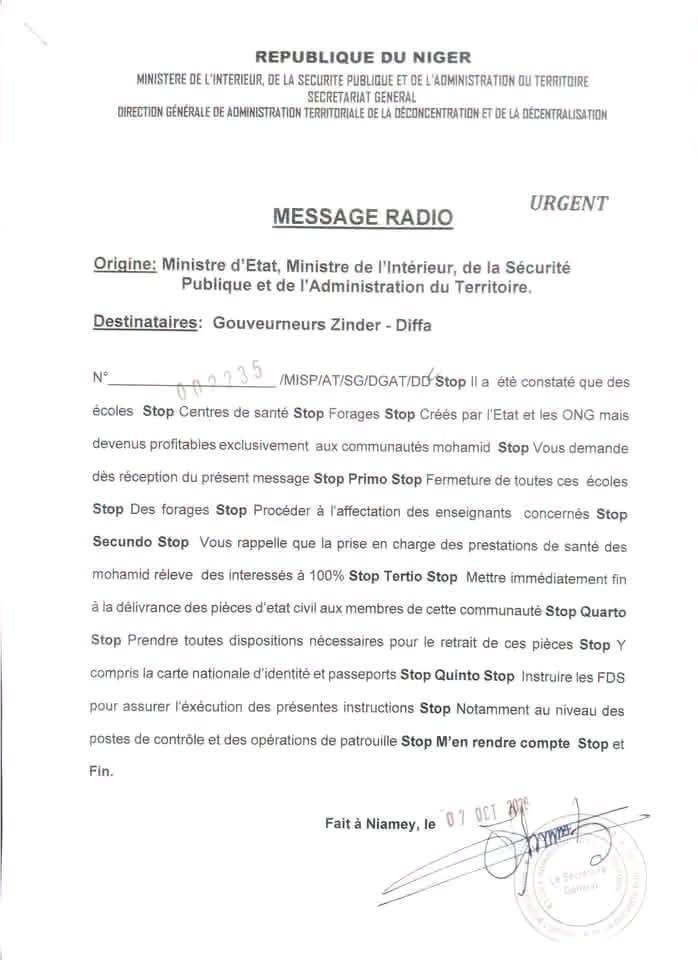
On October 7, 2026, a radio message from Niger’s Ministry of Interior sent shockwaves through the nation. Addressed to governors in Zinder and Diffa, it outlined sweeping measures targeting the Mohamid Arab community: school closures, water pump shutdowns, suspended healthcare subsidies, and a halt to civil document issuance. Behind these actions lies a troubling evolution in Nigerien governance—one that frames exclusion not as a security tactic, but as a structural response to perceived threats. At its core, this policy forces a reckoning: can a state protect its people while systematically stripping entire communities of fundamental rights?
What began as administrative instructions is now a lived crisis. The closure of schools cuts off education for hundreds of children. The halt to water access endangers families and livestock in the arid Sahel. Denial of healthcare disrupts routine medical care. And the suspension of birth certificates, identity cards, and passports erodes legal personhood. These are not isolated bureaucratic moves—they represent a coordinated assault on the conditions necessary for dignity, citizenship, and survival.
From Administrative Decree to Human Rights Crisis: Decoding the Mechanisms of Exclusion
The October 7 directive didn’t emerge in a vacuum. It is the latest escalation in a broader shift under Niger’s military-led regime, which has increasingly used administrative power to marginalize perceived threats—whether political opponents or ethnic communities. While the message cites security concerns, close examination reveals a troubling pattern: blanket sanctions applied not to individuals based on evidence, but to entire groups based on identity.
First, the education sector is weaponized. Schools serving the Mohamid are closed under the pretext of “exclusive access,” yet no individualized review of misuse is conducted. Teachers are reassigned, classrooms shuttered, and educational futures disrupted. In Diffa, where state presence is already fragile, this move deepens educational inequality and leaves children with no alternatives.
Access to water—a critical resource in the Sahel—is the second target. By cutting off access to boreholes, authorities deny entire communities the most basic survival need. For pastoralists, this isn’t just inconvenient; it’s existential. Livestock perish, food security crumbles, and livelihoods vanish overnight. The irony is stark: a government that claims to protect national security is denying people the means to live.
Third, health services are suspended under collective suspicion. Routine vaccination campaigns, maternal care, and emergency treatment—all are halted for Mohamid populations. The message is clear: if you belong to this group, even healthcare is conditional. This is not prevention. It is punishment.
Finally, the withdrawal of civil documents—birth certificates, identity cards, passports—is the most insidious blow. Without these papers, individuals cannot register land, access courts, travel, or prove their citizenship. They become ghosts in their own country. Worse, authorities reserve the right to revoke already issued documents, rendering people stateless in all but name.
How Collective Punishment Became State Policy
The justification proffered—national security—does not hold under scrutiny. Terrorism persists in the Sahel, but the response has strayed far from law enforcement. Instead of identifying and prosecuting individuals linked to violence, authorities impose collective sanctions. This violates a core principle of justice: responsibility is personal, not inherited.
Even if misuse of public services is suspected—an unproven claim—the appropriate remedy is investigation, not closure. If individuals misuse infrastructure, the state must prove it and sanction accordingly. To close a school or a water point is to punish the innocent for the guilt of a few. It is not security. It is scapegoating.
Moreover, the lack of transparency is alarming. No public justification has been offered for targeting the Mohamid specifically. No evidence linking the group to security threats has been presented. No legal framework justifying such drastic measures has been cited. The opacity itself reveals a policy rooted not in law, but in fear and political expediency.
The Human Toll: Education Denied, Water Blocked, Identities Erased
The consequences of these measures are not abstract. They are immediate and devastating. In a region already strained by climate change and conflict, each closure compounds existing crises.
Education under siege: Young Mohamid children are being denied schooling. Without access to formal education, their future prospects vanish. They are cut off from chances to escape poverty, to join the workforce, to engage with society. The state’s role as an educator is reversed—it has become an enforcer of exclusion.
Water as a weapon: In Diffa, where temperatures soar and rainfall is scarce, water is life. Denying communities access to boreholes forces families to travel long distances to fetch unsafe water. Children are pulled from school to carry water. Women face greater security risks. Livestock die. Crops fail. The region’s fragile economy—dependent on herding and trade—collapses further.
Healthcare turned away: Medical clinics shut down. Vaccination programs halted. Pregnant women go without prenatal care. Patients with chronic illnesses are abandoned. The immediate effect is measurable: rising preventable illnesses, higher maternal and infant mortality, and a surge in untreated trauma.
Identity revoked: Without documents, Mohamid individuals cannot open bank accounts, register births, obtain marriage licenses, or inherit property. They cannot vote, run a business, or travel legally. Some face the nightmare of having their identity cards torn away arbitrarily—leaving them in a bureaucratic void. The risk of statelessness looms large, a stain on Niger’s international reputation.
Economic Fallout: When Exclusion Hurts Everyone
The Mohamid are not an isolated community. They are woven into the fabric of Niger’s economy. As traders, transporters, and herders, they contribute to local markets in Diffa and Zinder. When their access to water and markets is cut, the ripple effects are felt by all.
The disruption in trade flows already affects food prices. The shutdown of schools reduces household purchasing power as parents struggle to support children without education. The halting of healthcare contributes to labor shortages and lowers productivity. The withdrawal of identity papers complicates commerce, banking, and property transactions across the region. In short, the policy doesn’t just harm the Mohamid—it destabilizes the entire regional economy.
Local traders report canceled orders, delayed shipments, and lost contracts. Herders are forced to sell livestock at a loss. Small business owners shutter their shops as customers disappear. The state is not protecting security—it is undermining economic resilience.
Under Tiani: A Pattern of Rights Erosion and Democratic Backsliding
Since the military takeover on July 26, 2023, Niger’s trajectory has shifted. The regime of General Abdourahamane Tiani has prioritized control over accountability. Political opposition is suppressed. Civil society is silenced. Journalists are detained. Opposition leaders in exile face nationality revocation.
These measures are not isolated. They form a pattern: the use of administrative power not to govern, but to punish. The Mohamid directive fits into this framework. It signals a new phase where rights are no longer protected—they are conditional. Citizenship itself is negotiable, depending on perceived loyalty or ethnicity.International observers warn that such policies erode public trust and fuel resentment. When the state abandons the principle of equality before the law, it invites chaos. When it uses identity as a basis for exclusion, it risks radicalizing communities and driving some toward armed groups—not out of ideology, but out of desperation.
What International Law Says About Collective Punishment
Under international law—including the African Charter on Human and Peoples’ Rights and the International Covenant on Civil and Political Rights—states are prohibited from imposing collective punishment. Such measures violate the prohibition of discrimination (Article 2), the right to a fair trial (Article 14), and the right to education, health, and due process.
Niger is a signatory to both instruments. Yet the October 7 directive appears to contravene these commitments. By targeting an entire community without individualized proof of wrongdoing, the state is engaging in what amounts to ethnic or racial discrimination—a grave breach of its international obligations.
What’s Next? Accountability, Review, and Reparative Justice
The government must act swiftly to reverse these measures. Schools must reopen. Water access must be restored. Healthcare services must resume. Identity documents must be reissued without delay. And all individuals affected must have access to transparent appeals and reparations.
An independent commission should investigate the origin and implementation of the October 7 directive. Who drafted it? Who approved it? What evidence justified such drastic action? Was the regime influenced by misinformation, political pressure, or ethnic bias? The findings must be made public, and those responsible for human rights violations must be held to account.
Civil society organizations, religious leaders, and community elders must be included in dialogue. No solution imposed from above will restore trust. The voices of the Mohamid—and all affected Nigeriens—must guide the path forward.
A Call for Leadership: Security Cannot Come at the Cost of Rights
Niger needs security. But real security is built on justice, inclusion, and the rule of law. It cannot be achieved by stripping rights from vulnerable populations. It cannot be sustained through fear and exclusion.
General Tiani’s regime has a choice: double down on coercion and watch society fracture, or recommit to constitutional principles and rebuild trust. The treatment of the Mohamid is not just a humanitarian issue—it is a litmus test for Niger’s future as a unified, lawful, and dignified nation.
History will judge harshly any state that trades justice for control. The Mohamid crisis is not just about one community. It is about whether Niger remains a nation where all citizens—regardless of ethnicity—are protected by the law, not targeted by it.