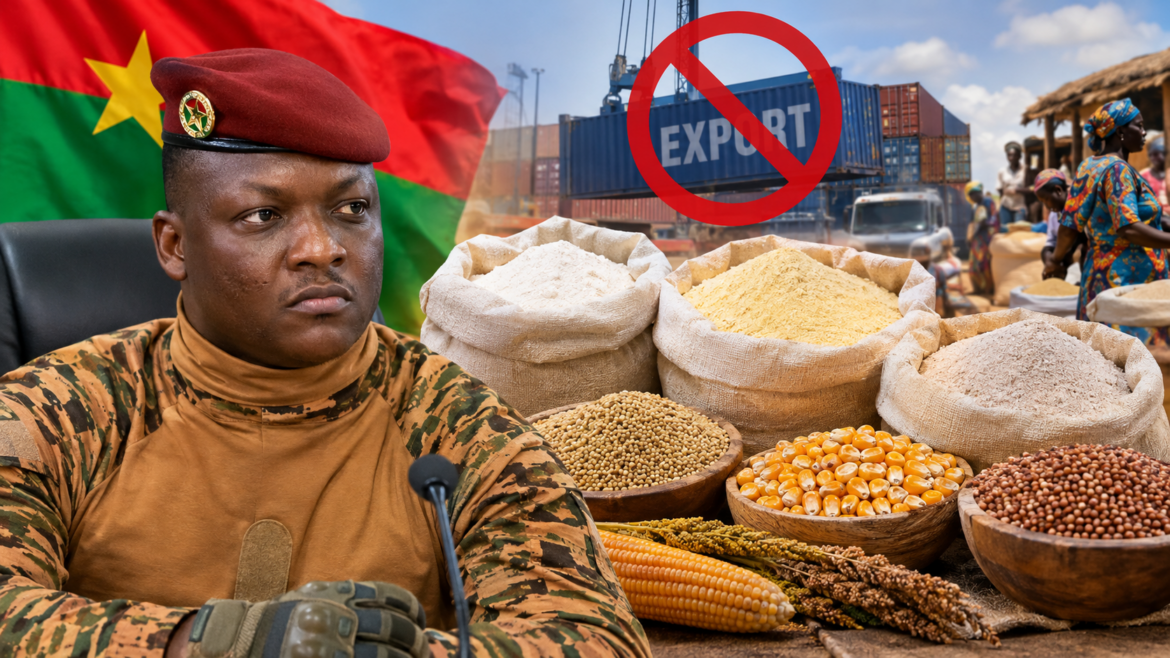
In Burkina Faso, the government has resolved to ban the exportation of certain flours until further notice. According to a directive from the Minister of Commerce, the prohibition applies to millet, maize, and sorghum flours, along with their derivatives. Special export authorizations previously granted for these goods have also been suspended.
For the Burkinabè authorities, this measure is intended to ensure the availability of these staples on the domestic market a goal that may appear justified in a context where food security remains a paramount concern. Yet beneath this rationale, a critical question arises: to what extent may a government restrict economic activities in the name of protecting the national market?
Are we operating within a state governed by the rule of law, where citizens and economic actors can voice their concerns, or within a system where governmental decisions are imposed without genuine deliberation?
Halting exports may indeed retain more goods domestically. However, such a step does not automatically guarantee lower prices or improved consumer access to these foodstuffs. The outcome will hinge on actual stock levels, production capacities, and how authorities oversee distribution networks.
Another consideration emerges: do all Burkinabè consumers share identical dietary habits? Can everyone rely exclusively on locally produced flours? By limiting export opportunities, does the government not also risk weakening producers and traders who depend on those outlets to sustain their livelihoods?
The issue thus extends beyond the flour trade. It also touches on the space afforded to economic freedoms, consultation with relevant stakeholders, and the right of citizens to question their leaders’ choices.
Burkina Faso is gradually giving the impression of a nation where state decisions play an expanding role in daily life. Comparisons with North Korea often associated with particularly stringent societal control may seem exaggerated, yet they reflect a growing anxiety: that restrictions will multiply under objectives set by authorities, without citizens always having adequate room to debate them.
Today, it is millet, maize, and sorghum flours that are affected. Tomorrow, what will be the next restriction? Should we be concerned about other products, internet access, or additional individual freedoms?
Naturally, an export ban alone does not mean a country is becoming a dictatorship. Nevertheless, in a state that claims to respect its citizens’ rights, such a coercive measure warrants explanation, oversight, and periodic reassessment. Protecting the domestic market should not serve as a pretext to shut down all discussion of the economic and social consequences of public decisions.
Beyond official rhetoric, Burkinabè citizens are entitled to expect tangible results: accessible products, affordable prices, fairly compensated producers, and traders able to continue their operations within a predictable framework.
For the real question is not merely whether the government can prohibit flour exports. It is also whether this decision will genuinely improve the population’s living conditions.
Protecting consumers involves more than restricting trade. It also requires safeguarding their purchasing power, supporting production, and being accountable for the outcomes achieved.