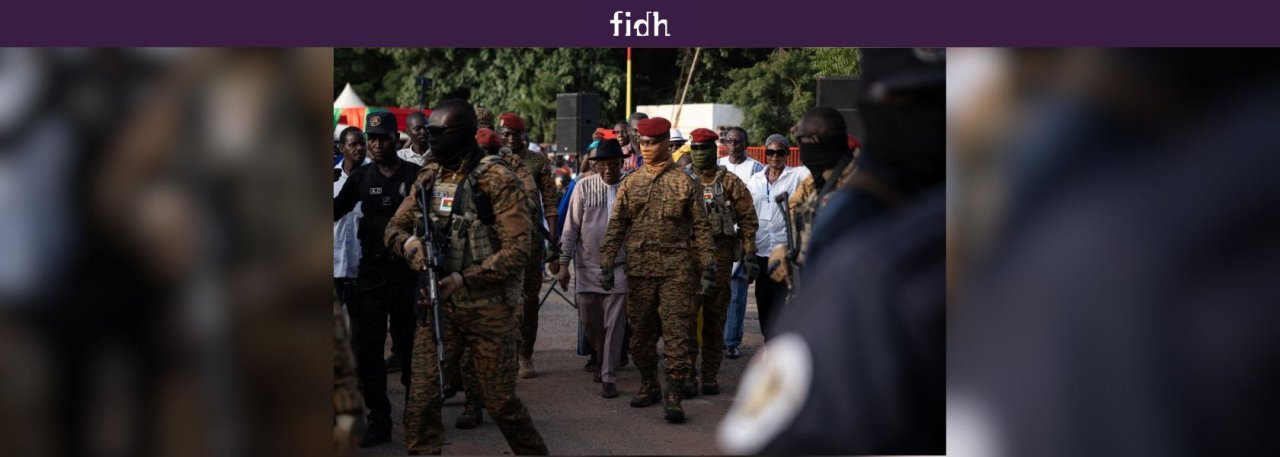
In Burkina Faso, the transitional regime is becoming more entrenched, with no clear path back to constitutional order. Despite their initial commitments, the authorities who seized power in a coup two years ago have systematically closed the civic and democratic space, silencing critical voices and obstructing fundamental freedoms. The International Federation for Human Rights (FIDH) condemns these numerous human rights violations and calls for the re-establishment of the rule of law.
The Burkinabè authorities, in power since the military coup of September 30, 2022, have progressively implemented a system of repression against any criticism or reporting of human rights abuses. Journalists, human rights defenders, and political opponents are targeted daily through attacks, arrests, abductions, forced disappearances, forced conscriptions, or threats to their families. This climate of fear is intensified by hate speech and violent rhetoric spread on social media by activists close to the government.
The FIDH therefore urges the authorities of Burkina Faso to cease these attacks immediately and to release all persons arbitrarily detained. It also calls on them to respect their national, regional, and international human rights commitments.
« The muzzling of civil society and the repression of human rights defenders, journalists, and opponents is unacceptable, especially during a transition period that claims to be rebuilding the state and promoting better governance », stated Me Drissa Traoré, Secretary General of the FIDH. « Civil society must be protected; it is essential to free public discourse by preserving the rights to freedom of expression, opinion, association, assembly, and the press ».
Although the regime had made resolving the country’s armed conflict its top priority, the FIDH notes a resurgence of violence and violations committed against civilian populations by all parties involved. On August 24, 2024, an attack claimed by the Group for the Support of Islam and Muslims (JNIM) targeted civilians, defense and security forces, and the Volunteers for the Defense of the Homeland (VDP), causing dozens of casualties. These serious crimes were condemned by the FIDH and the Citizen Coalition for the Sahel.
Forced Conscription of Defenders, Journalists, and Opponents
Since late November 2023, the authorities have systematized the forced enlistment of human rights defenders, journalists, and political opponents as army auxiliaries. In retaliation for their criticism or denunciation of human rights violations, a dozen people have been abducted and sent to the front lines under the « Decree on general mobilization and warning », adopted in April 2023. Among them are Dr. Daouda Diallo, a human rights defender and civil society figure, and Ablassé Ouédraogo, a political actor.
Magistrates are also affected by conscription, in violation of the principle of separation of powers and the independence of the judiciary. In August 2024, at least five magistrates, including prosecutors, were forcibly requisitioned and enrolled. They had opened judicial investigations or taken action in proceedings involving individuals known to be close to the regime. Prosecutors from the high courts of Ouagadougou 1, Boromo, Bobo-Dioulasso, and Gaoua, as well as the senior investigating judge of the Ziniaré High Court and a deputy prosecutor from Bobo-Dioulasso, were requisitioned for the period from August 14 to November 13, 2024.
« Sending magistrates, who are law enforcement officials, to the front in retaliation for judicial decisions unfavorable to people close to the regime is inadmissible. The authorities of Burkina Faso are confirming a worrying trend: the obstruction of fundamental freedoms, which has been repeatedly condemned by the United Nations, the African Commission on Human and Peoples’ Rights (ACHPR), and our human rights organizations », declared Alice Mogwe, President of the FIDH. « The Burkinabè state is violating its own Constitution and its obligations under the African Charter on Human and Peoples’ Rights, as well as all the international instruments and conventions to which it has subscribed, particularly those protecting human rights defenders ».
The End of Press Freedom
The authorities in Burkina Faso have progressively restricted the right to information and freedom of the press. Local media outlets are controlled, and major international media are banned. Journalists are forced to adopt a « patriotic treatment » of information, meaning favorable to the government. They are subjected to constant attacks and threats, leading to widespread self-censorship. Mr. Atiana Serge Oulon, an investigative journalist and publication director of the respected bimonthly L’Événement, was abducted from his home by the National Intelligence Agency (ANR) on June 24, 2024. His family has had no news of him since. His newspaper had been suspended for a month on June 20. On June 19 and 28, 2024, Kalifara Séré and Adama Bayala, a commentator and columnist for BF1 television, were abducted after the suspension of the program « 7 Infos ». The ACHPR had expressed « its deep concern over this situation, which constitutes a serious threat to the physical and moral integrity of journalists and is likely to remove them from the protection of the law and infringe upon their freedom of expression and opinion ».
Relatives of Exiled Opponents Targeted
In recent weeks, family members of former dignitaries have been harassed, subjected to violence, and abducted. Between September 11 and 16, 2024, at least two family members of Djibril Bassolé, former Minister of Foreign Affairs under Blaise Compaoré, were assaulted and abducted in Ouagadougou. These abductions are directly instigated by calls for violence from activists close to the regime.
« We call on the African Union and the United Nations to coordinate their efforts to urge the authorities of Burkina Faso to end this climate of violence, to release the abducted persons, and to respect their physical and moral integrity », stated Professor Mabassa Fall, FIDH representative to the African Union.