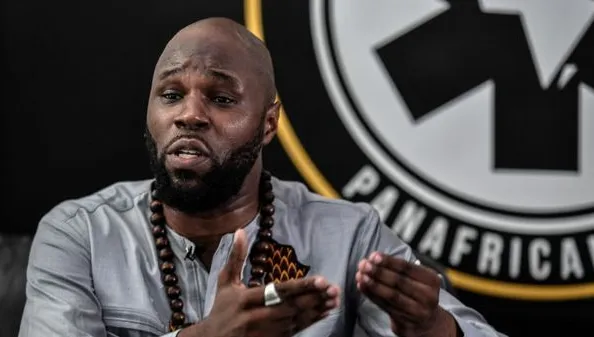
In the realm of Francophone Africa, few names spark as much debate as Kémi Séba. The 42-year-old Beninese activist and social media personality has carved out a prominent place in the digital landscape, amassing over a million followers across platforms. His fiery rhetoric against Western influence and vocal support for anti-colonial movements have made him both a polarizing figure and a sought-after speaker at conferences worldwide.
Recently, Séba’s relationship with France took a dramatic turn. On July 9, French authorities revoked his French citizenship through an official decree published in the Journal officiel. This decision followed years of legal battles and controversial statements, including his infamous tweet celebrating the loss of his nationality: “No more French nationality, glory to God. Freed from this burden.”
From Pan-Africanism to alleged Russian ties
Kémi Séba’s rise to prominence began with his unapologetic stance against neocolonialism, particularly targeting structures like the Françafrique and the CFA franc, which he labels as colonial monetary tools. His activism, rooted in panafricanist ideals, gained traction among disillusioned youth across Africa. Yet, his methods and alliances have drawn sharp criticism.
Investigations, including a 2023 report by Jeune Afrique, suggest direct financial and operational links between Séba and Russian interests. These connections allegedly date back a decade, when Vladimir Putin tasked Evgueni Prigojine—the late founder of the Wagner Group—with expanding Moscow’s influence in Africa. Wagner’s operations on the continent, spanning mercenary activities, resource extraction, and propaganda networks, reportedly intersected with Séba’s campaigns, particularly in amplifying anti-French sentiment.
Global outreach and controversial alliances
Séba’s influence extends far beyond Africa. Through his NGO, Urgence Panafricaines, he has organized high-profile conferences in countries like Brazil, Iran, Russia, and Venezuela. His appearances at events such as the Russia-Africa Summit in Saint Petersburg have further cemented his role as a bridge between African activists and Moscow’s geopolitical agenda.
French officials have openly accused him of serving as a mouthpiece for Russian propaganda. In 2023, the president of the National Assembly’s Defense Commission labeled Séba a “relay of Russian propaganda” and a tool for “a foreign power fueling anti-French sentiment.”
Controversial stances and political reactions
Séba’s rhetoric often aligns him with African nations that have distanced themselves from France, such as Niger, Mali, and Burkina Faso. His public support for coups in these countries—couched in anti-colonial narratives—has amplified his notoriety. In recent months, he has hinted at a broader shift, stating: “More countries will join this movement—we’re working on it.”
While Séba denies being under Moscow’s sway, his actions tell a different story. His systematic backing of regimes turning to Russia, his participation in pro-Kremlin events, and his financial ties paint a picture of an activist deeply embedded in a network with clear geopolitical objectives.
As debates rage over foreign interference in Africa, Séba remains at the center of the storm—a digital revolutionary, a pan-African voice, and, according to critics, a pawn in a larger propaganda war.