Government Accusations Spark Controversy Over Online Communication Battalion
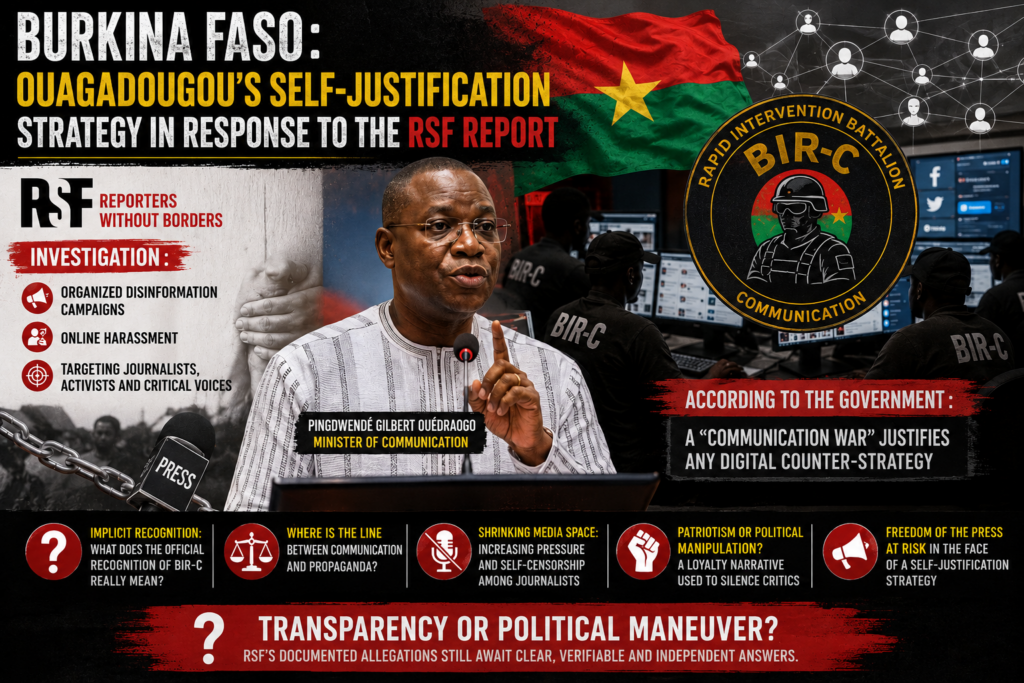
The Burkinabè authorities continue to face criticism for their approach to addressing allegations rather than embracing transparency. During the national flag-raising ceremony on August 3, Minister of Communication Pingdwendé Gilbert Ouédraogo publicly praised the “Rapid Intervention Battalion – Communication” (BIR-C), a unit described as a defensive tool for handling digital narratives. However, the move appears to have deepened concerns rather than resolved them.
The government’s endorsement of the BIR-C implicitly acknowledges its role in Burkina Faso’s digital ecosystem. This recognition coincides with a recent investigation revealing a coordinated network of online accounts allegedly engaged in disinformation campaigns, harassment, and targeted attacks against journalists, activists, and critics of the military-led transition. Instead of launching an independent inquiry or directly refuting the findings, the authorities chose to publicly endorse the BIR-C, further fueling doubts about its actual purpose.
The Alleged Role of the BIR-C in Digital Warfare
According to the investigation, the BIR-C or an affiliated structure operates by mobilizing coordinated social media accounts to push specific narratives, discredit dissenting voices, and exert constant pressure on media professionals. While the government dismisses these claims, its public defense of the unit raises questions about the line between institutional communication and political propaganda.
The official narrative frames the situation as Burkina Faso facing a “communication war” orchestrated by external actors seeking to destabilize the country. In this context, any digital strategy aimed at countering such threats is framed as a patriotic duty. Yet, this reasoning prompts a critical question: where does legitimate crisis communication end, and where does the suppression of pluralistic debate begin?
Press Freedom Under Strain Amid Political Polarization
In a climate marked by intense political and security divisions, combating manipulative campaigns is a valid concern for any state. However, international principles on freedom of expression stipulate that such efforts must not involve targeted harassment, smear campaigns, or intimidation of journalists. When criticism is systematically equated with national betrayal, public discourse risks collapsing into self-censorship.
This controversy unfolds against a backdrop of suspended international media outlets, reports of increasing pressure on journalists, and a shrinking media landscape in Burkina Faso. Observers warn that these developments foster an environment where self-censorship becomes a survival strategy for information professionals. Against this backdrop, the existence of an organized digital communication unit if it extends beyond mere government messaging raises serious concerns about the balance between national security and fundamental freedoms.
Patriotism as a Shield Against Accountability
The minister’s rhetoric appears less like a transparent response and more like a political counteroffensive. By emphasizing the patriotism of the BIR-C members, the authorities shift the debate from factual scrutiny to national loyalty. This tactic reframes criticism as an attack on the state rather than an inquiry into its methods.
A democracy, even under severe security challenges, must also prove its resilience by tolerating scrutiny from the press and human rights organizations. Responding to allegations with a show of support for the accused unit does not dispel doubts; rather, it may reinforce perceptions of a deliberate political endorsement of its role within the government’s communication apparatus.
Transparency as the Only Path Forward
The situation extends beyond the BIR-C controversy, highlighting how Burkina Faso manages information in the digital age. While social media has become a new battleground for political confrontation, its use by power-aligned structures must adhere to transparency, respect for fundamental rights, and compatibility with press freedom standards.
Rather than addressing documented accusations with precise, verifiable, and independent responses, the authorities continue to rely on patriotic mobilization. Until credible clarifications are provided, official statements risk being perceived not as denials but as self-justifications for a communication system whose contours only deepen concerns about press freedom in Burkina Faso.
You may also like
Will Benin’s AEO exporters finally crack the Chinese market?
Northern Niger’s unanswered question: can Tiani’s government deliver water and power where it matters most?
Can Air Sénégal survive the Interpol smuggling probe? The stakes for crew, passengers and the airline’s future
As donor fatigue spreads, can Benin’s €544,042 UNAIDS pledge keep the HIV response on track?
Who pays the price when Burkina Faso’s public payroll contracts? Households weigh the cost of 1,917 fewer agents