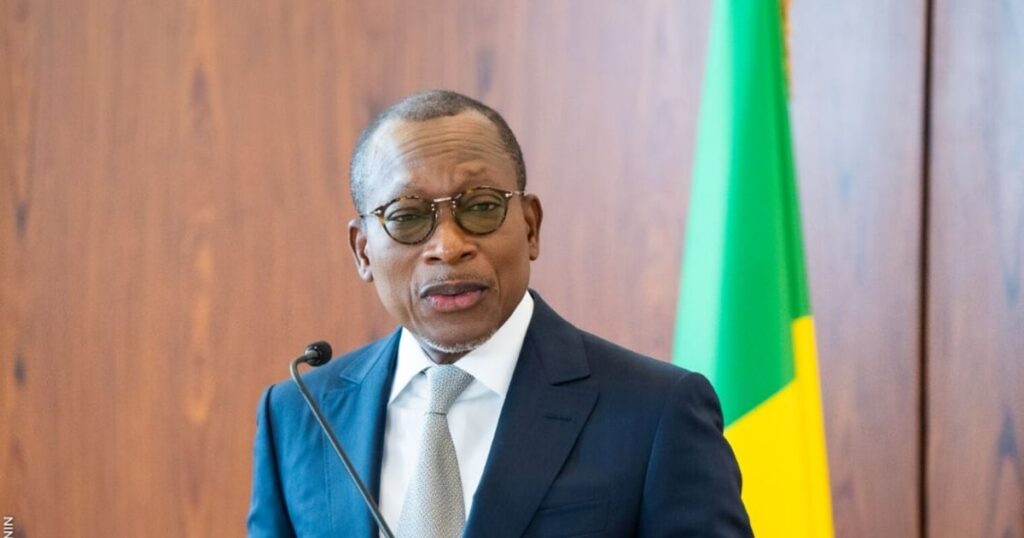
The creation of the Senate followed a constitutional revision passed in November 2025, designed to strengthen political governance in the country.
Comprising 25 members, the Senate includes former presidents by right, along with appointees chosen by the Head of State. None of the senators are elected through direct suffrage.
Patrice Talon assumes leadership with a pledge of unity
In his inaugural address at Porto-Novo, the national capital, Patrice Talon—now 68—outlined his vision for the institution. Having served two full presidential terms (2016–2026), the constitutional limit, he reaffirmed his commitment to fostering national cohesion and political stability.
“I assure you of my full dedication to ensuring this Senate operates like a united family,” Talon declared, emphasizing priorities such as peace, democracy, and national unity.
A historic vote marks the Senate’s first leadership
Talon was elected to lead the Senate with an overwhelming majority: 24 votes in favor and only one blank ballot. His leadership election reflects broad parliamentary support for continuity and institutional stability.
Notably, the Senate also includes two former presidents: Thomas Boni Yayi (2006–2016) and Nicéphore Soglo (1991–1996), both of whom bring decades of political experience to the chamber.
Among the appointed members is Paul Hounkpè, a prominent figure who ran as the sole opposition candidate in the most recent presidential election.
Political continuity shapes the transition
The appointment of Romuald Wadagni—former Minister of Economy and long-time ally of Patrice Talon—as the new President of the Republic in April 2026 underscores a seamless transition of power within the ruling political sphere.
You may also like
Can West Africa’s peace hold without the Entente Council and UNOWAS pact?
Can Lomé’s quiet diplomacy finally deliver peace to eastern DRC?
Can Nigeria’s security forces ever shut down the kidnapping economy in the north?
Can Benin’s defense strategy survive on diversification alone?
Can the CEMAC capital market finally bankroll Cameroon’s real economy?