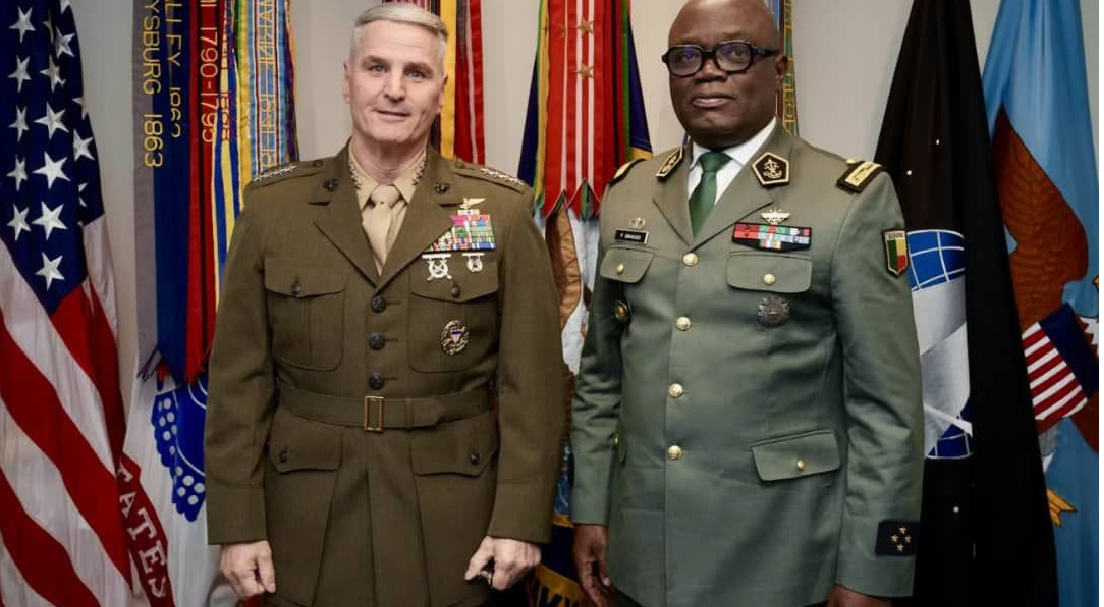
From Cotonou to Washington, a unified vision prevails: bolstering national capacities, fostering diverse partnerships, and safeguarding democratic foundations as essential pillars for regional stability. The recent visit of General Fructueux Gbaguidi to the Pentagon vividly illustrates Bénin’s proactive security diplomacy, which deliberately seeks to avoid reliance on any single international partner.
This high-level engagement held profound symbolic significance. On Tuesday, August 25, 2026, deep within the American military establishment, Lieutenant General Fructueux Gbaguidi, Chief of Staff of the Béninese Armed Forces, was received at the Pentagon by General Christopher J. Mahoney, Vice Chairman of the US Joint Chiefs of Staff. This meeting transcended mere diplomatic formality, underscoring Bénin’s increasingly central role in the United States’ security framework for West Africa.
In its official communiqué issued on August 26, the US Joint Staff emphasized the “strong and enduring” nature of the security alliance between Washington and Cotonou. Discussions notably focused on confronting regional threats, exploring joint initiatives, and coordinating security assistance, all supported by the United States Africa Command (AFRICOM). Washington reiterated its conviction that a “secure, stable, and democratic” Bénin is a crucial component of broader regional peace.
This American endorsement serves as a clear indicator of the credibility Bénin has cultivated in the realm of security.
A robust security diplomacy yields results
As armed groups expand their reach from the Sahel towards coastal nations, Bénin has adopted a decisive strategic stance: rather than passively awaiting the threat’s arrival in its major urban centers, it has systematically enhanced its military capabilities, intelligence apparatus, territorial presence, and collaborative networks.
The underlying rationale is straightforward: in an asymmetric and transnational conflict, no single nation can realistically claim to possess all necessary capacities independently. Intelligence gathering, border surveillance, troop mobility, specialized training, modern equipment, and operational cooperation have become inextricably linked.
It is precisely within this operational landscape that Bénin’s strategic approach demonstrates its full efficacy.
Cooperation with the United States is not a novel development; it is deeply rooted in a bilateral relationship spanning over six decades. However, this partnership has gained particular urgency with the escalating terrorist threat observed in northern Bénin. AFRICOM had previously designated Bénin as a strategic security partner during its commander’s visit to Cotonou in September 2025, stressing the imperative to intensify cooperation in response to evolving terrorism.
Consequently, the August 25 meeting at the Pentagon represents less a departure and more a significant new phase in this ongoing security enhancement.
The diversification gamble
Perhaps the greatest strength of Bénin’s security policy lies in its strategic diversification.
Cotonou deliberately avoids exclusive reliance on Washington. Bénin is actively cultivating military relationships with a variety of African and international partners, participating robustly in regional conflict prevention mechanisms, and diligently maintaining open channels of dialogue with its neighbors. This approach is especially vital given the profound transformations currently reshaping traditional security alliances across West Africa.
Bénin has, for instance, deepened its military cooperation with several African states. In May 2025, a joint military commission with South Africa specifically addressed experience sharing and collaborative efforts against asymmetric threats.
With Nigeria, Cotonou has also developed cross-border cooperation frameworks aimed at strengthening community resilience against insecurity and transnational crime.
This diversification is not a diplomatic luxury; it is a direct response to operational realities. Terrorism recognizes no national boundaries, and therefore, the response must similarly transcend borders.
Democratic stability: a strategic edge
The other critical element in Bénin’s equation is political.
In a region frequently destabilized by institutional disruptions, coups d’état, and military transitions, Bénin consistently highlights its institutional model and commitment to democratic alternation. For its Western partners, this institutional stability represents an added layer of trust.
The American statement is particularly revealing as it explicitly links the concepts of security, stability, and democracy. Washington thus views Bénin not merely as a military ally but also as a vital contributor to regional stability. This dimension holds considerable weight in the current competition among security models in West Africa. It enables Cotonou to maintain multiple avenues of engagement: with the United States and its Western partners, as well as with African nations and regional organizations.
In essence, Bénin is strategically leveraging its democratic foundation into significant diplomatic and security capital.
The persistent shadow of the AES rift
Yet, a significant contradiction persists: while armed groups operate fluidly across multiple national territories, security cooperation between Bénin and the states of the Alliance of Sahel States (AES)—Burkina Faso, Mali, and Niger—remains inadequate. This situation is particularly paradoxical given the deep interconnections of populations, trade routes, communities, and border areas.
Despite this, Bénin has repeatedly signaled its openness to dialogue. In June 2026, a visit by Béninese President Romuald Wadagni to Ouagadougou saw both parties reaffirm their commitment to strengthening their partnership and seeking concerted solutions to terrorism and cross-border crime. The Burkinabè government itself spoke of a “revitalization” of bilateral relations and emphasized the urgent need to consolidate security cooperation.
It would therefore be inaccurate to portray Cotonou as having closed the door to collaboration.
The core issue lies instead in the enduring political mistrust between the AES authorities and Bénin. And it is here that the cost of this lack of cooperation becomes increasingly worrisome.
It must be acknowledged that the AES states have indeed developed their own security architecture. In April 2025, for example, Burkina Faso announced the gradual establishment of a unified AES force and the continuation of joint operations among Burkina Faso, Mali, and Niger.
However, this internal dynamic should not necessarily lead to the exclusion of neighboring countries.
The fight against armed groups precisely demands the opposite: intelligence sharing, coordinated patrols, communication between general staffs, alert mechanisms, and, where legal frameworks permit, cross-border operational cooperation. In this crucial area, the absence of closer collaboration between Cotonou and its Sahelian neighbors represents a collective vulnerability. And, considering Bénin’s repeated overtures, the political responsibility for this situation largely rests with the AES authorities, who maintain a posture of distrust towards Cotonou.
A conflict demanding a shift beyond posturing
The stakes, however, transcend diplomatic disputes.
Bénin’s northern border regions remain exposed to the threat of armed groups originating from Sahelian territories. French and Dutch authorities, notably, maintain elevated vigilance levels in the country’s northern zones, particularly along its borders with Burkina Faso and Niger.
Under these circumstances, no single capital can prevail alone.
Bénin has grasped this reality by opting to diversify its partners. The United States has understood it by recognizing Cotonou as a strategic ally. Burkina Faso, Mali, and Niger have also understood it in their own way by strengthening military cooperation within the AES.
The next logical step should therefore be to converge these distinct dynamics rather than allowing them to diverge.
Cotonou, Washington, and the post-Pentagon outlook
General Fructueux Gbaguidi’s visit to Washington ultimately reveals a broader strategy: empowering the Béninese Armed Forces while maintaining multiple avenues of cooperation. The message emanating from the Pentagon is clear: the United States intends to continue its collaboration with a Bénin deemed secure, stable, and democratic, and to reinforce initiatives undertaken with AFRICOM.
For Cotonou, the challenge ahead will be to translate these partnerships into tangible capabilities: enhanced intelligence, improved surveillance, greater mobility, specialized training, and superior coordination. However, the true diplomatic triumph would be to eventually reintegrate its Sahelian neighbors into this essential security equation.
After all, terrorism does not require a visa to cross a border. While Bénin can legitimately take pride in the growing strength of its security partnerships, West Africa as a whole can only sustainably contain the threat when political disagreements cease to overshadow the critical imperative of cooperation among neighboring states.
General Gbaguidi’s visit to the Pentagon thus underscores an undeniable truth in the face of rapidly evolving threats across West Africa Sahel: the most effective strategy combines national sovereignty, robust cooperation, diversified partnerships, and institutional stability. Bénin appears to have made this choice. It is now up to its neighbors to decide whether they, too, wish to transform their divergences into cooperative strength rather than collective vulnerability.