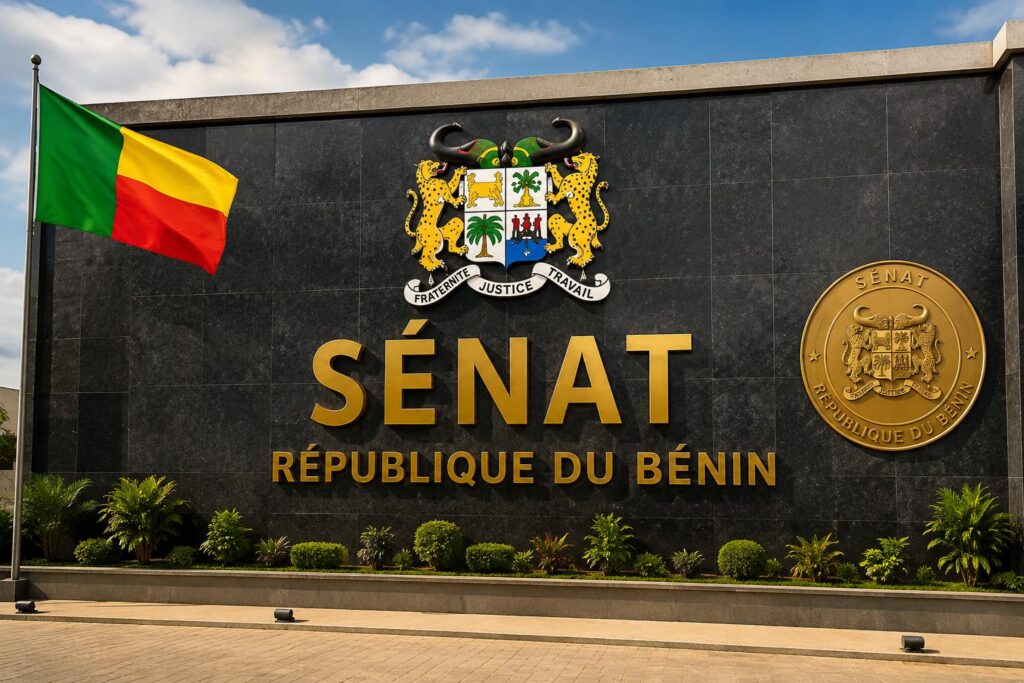
Understanding the political landscape: a clear separation of powers
The appointment of former president Patrice Talon to the presidency of the Senate has sparked lively discussions online, with many speculating about a hidden continuation of his influence over national affairs. Yet a closer look at Benin’s institutional framework reveals a different story: a strict separation of powers where the Executive retains full authority while the Legislative branch gains new strength. This structure ensures that governance remains balanced, transparent, and firmly rooted in constitutional law.
The president at the helm: executive power remains unchallenged
Under the Beninese Constitution, the president of the Republic holds exclusive executive authority. The head of state is directly elected by universal suffrage and is solely responsible for defining and implementing national policy. This includes appointing government members, assigning their roles, and overseeing public administration. The president also serves as commander-in-chief of the armed forces and ensures the smooth functioning of state institutions.
There is no ambiguity: Patrice Talon’s transition from the presidency to the Senate did not grant him any executive powers. The current president of the Republic exercises full control over the Council of Ministers, public spending, and major national projects. The Senate, by contrast, does not participate in executive decision-making or the drafting of decrees.
The Senate’s role: legislative wisdom, not executive influence
Contrary to some assumptions, the Senate is not a second government. Its mandate is purely legislative and oversight-based. As the upper house of Parliament, it reviews legislation, ensures constitutional compliance, and represents local governments. The president of the Senate presides over legislative sessions but does not influence ministerial appointments or policy direction.
Financially, while Parliament approves the national budget, the Senate’s role is limited to deliberation. It does not execute or authorize public spending. Its primary function is to refine laws, provide a second reading of bills, and uphold democratic checks and balances.
Constitutional clarity: Bénin stands apart from its neighbors
Some comparisons have been drawn between Benin’s institutional reforms and those in neighboring countries like Togo, where constitutional changes shifted power toward a parliamentary system. However, Benin’s model remains firmly presidential. The president derives legitimacy from direct elections and retains all executive prerogatives. The introduction of the Senate strengthens the legislative process without altering the fundamental balance of power.
A stabilizing force in Beninese democracy
The Senate was designed to bring stability and maturity to Benin’s political life. Its members—former senior officials, seasoned politicians, and qualified experts—serve as a moderating influence. In a landscape often driven by electoral passions, the Senate acts as an institutional forum for reasoned debate, national unity, and constitutional preservation.
While Patrice Talon’s leadership in the Senate adds prestige and institutional memory, his role is advisory rather than executive. His position ensures continuity in governance while reinforcing the Senate’s function as a guardian of democratic values.
Democracy in action: a clear path forward
The establishment of the Senate marks a significant step in Benin’s democratic evolution. Far from blurring the lines between branches of government, the constitutional framework reinforces their distinct roles: the president leads the Executive, while the Senate ensures legislative excellence and national cohesion. This clarity fosters a more informed and balanced public debate, free from misconceptions about power dynamics.
You may also like
Will Benin’s AEO exporters finally crack the Chinese market?
Northern Niger’s unanswered question: can Tiani’s government deliver water and power where it matters most?
Can Air Sénégal survive the Interpol smuggling probe? The stakes for crew, passengers and the airline’s future
As donor fatigue spreads, can Benin’s €544,042 UNAIDS pledge keep the HIV response on track?
Who pays the price when Burkina Faso’s public payroll contracts? Households weigh the cost of 1,917 fewer agents