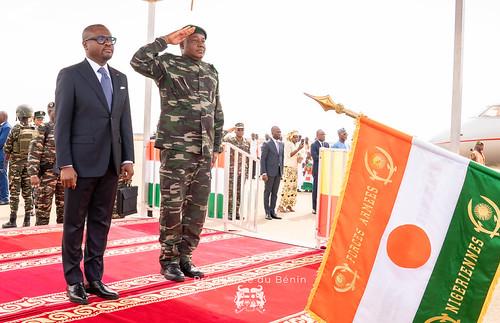
A palpable indication of renewed dialogue has emerged. This Friday, June 19, 2026, the Cotonou airport runway became the focal point of a diplomatic event keenly awaited by chanceries across West Africa. The arrival of the official Nigerien delegation, greeted with full protocol honors by Béninese authorities, signaled the formal commencement of the second round of bilateral negotiations. For international observers, this moment transcends mere diplomatic pageantry or warm handshakes; it represents a tangible sign that communication, once thought severed, is indeed re-established between these two neighboring states.
This recommencement of official discussions is not an isolated incident. It directly follows the trajectory initiated in Niamey during the historic tête-à-tête between Béninese President Romuald Wadagni and Nigerien transitional leader General Abdourahamane Tiani. Both leaders had previously agreed on the absolute necessity of breaking the existing deadlock. Leading up to today’s pivotal meeting, technical experts, career diplomats, and high-ranking military officials from both nations engaged in two consecutive weeks of closed-door sessions. Their mandate was to smooth over the sharpest points of contention, catalog mutual grievances, and lay the groundwork for political decision-makers. The ultimate objective of these concerted efforts is now unequivocally stated: to finalize a comprehensive and enduring agreement for the reopening of their shared border, which was closed following significant political shifts in Niamey.
Beyond its symbolic weight, there is a clear commitment from both administrations to accelerate progress and deliver concrete solutions. The era of hostile rhetoric and distrustful stances appears to be giving way to a phase of rigorous pragmatism. In Cotonou, those close to the negotiations describe the atmosphere as simultaneously weighty, given the gravity of the stakes, and profoundly constructive, reflecting the immense expectations of citizens and economic operators weighing on the negotiators.
Bilateral economic strangulation
For external analysts assessing the significance of this summit, the urgency of these discussions is primarily evident in the macroeconomic indicators, which have become dire for both nations over months of border closure. The historical intertwining of the Béninese and Nigerien economies meant that the prolonged blockade acted like a double noose, simultaneously stifling both sides of the frontier.
Niger has borne the full brunt of its geographical predicament. As a landlocked country, devoid of direct sea access, it has historically relied almost vitally on the infrastructure of the Autonomous Port of Cotonou for the majority of its imports and exports. The extended disruption of this traditional logistical artery has plunged Nigerien road transporters and Niamey traders into a critical situation. To circumvent the Béninese blockade, supply chains were completely re-routed towards other sub-regional ports, necessitating interminable journeys across often impassable or highly perilous routes. The immediate consequence of this forced logistical overhaul has been an exponential surge in transport costs, directly translating into rampant inflation on everyday consumer markets in Niamey, further eroding purchasing power already weakened by international sanctions.
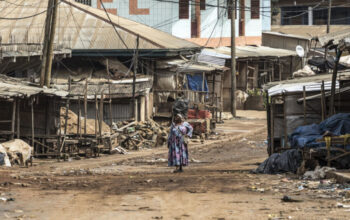
On the Béninese side, the economic repercussions definitively refute any notion that the nation could emerge unscathed from this crisis. The corridor connecting Cotonou to Niamey represents Bénin’s vital economic and financial artery, fueling a substantial portion of its port platform’s activity. The abrupt slowdown in goods transit resulted in a significant drop in state customs revenues, drying up a crucial funding source for national development projects. More critically, the forced halt of truck traffic crippled an entire socio-economic ecosystem directly dependent on cross-border flows. From major logistics companies deprived of contracts to informal sector players like street vendors, roadside restaurateurs, and transport hub porters, an entire subsistence economy found itself abruptly without income. Far removed from cold macroeconomic statistics or serene ministerial chambers, the reopening of this crucial route has, over months, become a matter of daily survival for thousands of families on both sides of the border.
Security and sovereignty at the heart of the impasses
While financial imperatives and economic distress compel both delegations toward compromise, the true Gordian knot of this bilateral dispute remains deeply rooted in matters of national security and state sovereignty. Since the establishment of the National Council for the Safeguard of the Homeland in Niamey, the new Nigerien military authorities have maintained an unyielding doctrine: no economic imperative, however pressing, will come at the expense of territorial security and the stability of transitional institutions.
In this context of heightened vigilance, the ongoing discussions in the Béninese economic capital are concentrating on highly sensitive geopolitical technical dossiers. Negotiators must imperatively agree on stringent control of the Niger River, a natural border that has occasionally been a site of complex infiltrations. Another significant point of contention involves establishing joint surveillance protocols along the land frontier to prevent the movement of armed terrorist groups that regularly inflict tragedy upon the Sahel region. Niamey has repeatedly voiced concerns that this permeable border could be exploited by hostile elements to destabilize its territory. To reassure the Nigerien side, the Béninese delegation must propose robust guarantees, including a mechanism for real-time military and security intelligence sharing.
The formidable challenge for the experts convened in Cotonou is therefore to devise a novel model for border management. This entails designing a demarcation line that is completely impervious to asymmetric threats and illicit trafficking, while simultaneously ensuring the necessary fluidity for legitimate commercial flows. Striking this perfect balance between the jealous sovereignty of states and the economic pragmatism essential for the survival of populations constitutes the true keystone of these negotiations.
Analysis: charting a new regional course
This extended face-off in Cotonou vividly demonstrates that realpolitik and geographical realities invariably supersede ideological stances and regional solidarity impulses sometimes detached from ground realities. The crisis originated from stringent sanctions adopted after the regime change in Niamey, but the persistence of the blockade ultimately underscored the fundamental interdependence linking these two West African nations.
However, seasoned observers of West African politics concur that a simple return to the prior situation is highly improbable. Mutual trust having been profoundly shaken, the signing of an agreement will not signify a resumption of relations on the same footing as before. If the two delegations manage to forge a solid and lasting compromise, this document will lay the foundations for a deeply redefined bilateral relationship. This new partnership will undoubtedly be characterized by increased mutual vigilance, stricter controls, and residual distrust, yet it will also be guided by the acute awareness that neither nation can sustainably prosper by turning its back on its neighbor.
Beyond the strict bilateral framework between Bénin and Niger, the outcome of these negotiations is being closely monitored by international partners, financial institutions, and neighboring countries. The Cotonou-Niamey axis is a central link in regional economic integration. The resolution of this crisis will serve as a barometer for assessing the capacity of states in the region, whether they belong to the Economic Community of West African States or the new Alliance of Sahel States, to overcome their political differences to preserve what is essential: the economic stability and social peace of the sub-region. On the ground, populations weary from months of uncertainty now await concrete actions and the effective lifting of barriers to swiftly confirm the official smiles captured by photographers, bringing much-needed Sahel breaking news to an anxious populace.