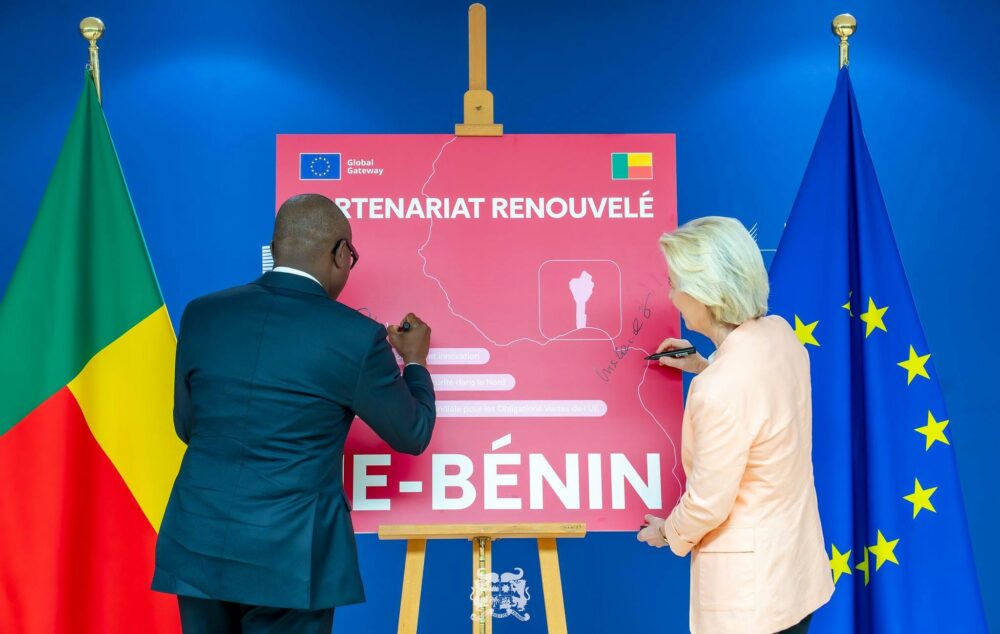
On Wednesday, 24 June, Bénin’s President Romuald Wadagni paid a working visit to the headquarters of European Union institutions in Brussels, Belgium, to lay the groundwork for a modernised partnership between his nation and the EU, designed to address emerging development challenges.
He held successive meetings with key EU leaders, including European Council President António Costa and European Commission President Ursula Von Der Leyen.
During talks with António Costa, both sides explored the main pillars of bilateral cooperation, aiming to inject fresh momentum into a relationship built on trust, stability and shared objectives, according to a statement from the Bénin presidency.
The discussions between Wadagni and Von Der Leyen focused on deepening the EU-Bénin partnership. The two senior officials reaffirmed their commitment to accelerating cooperation across several strategic sectors.
They identified three major priorities. The first centres on economic transformation and innovation, with an emphasis on industrialisation, job creation, development of economic corridors around the Port of Cotonou, local processing of agricultural products and vocational training for young people.
Territorial development and security in northern Bénin constitute the second priority, with increased support for local communities to combat violent extremism through improved basic infrastructure and access to economic opportunities.
The third priority, sustainable finance, ties into the Global Green Bond Initiative — a mechanism designed to facilitate funding for sustainable infrastructure in renewable energy, transport and agriculture.
European Commission President Ursula Von Der Leyen stressed that “Bénin is a key partner of the European Union in West Africa. This relationship is founded on mutual trust and a shared desire to improve quality of life for everyone.”
According to the Bénin presidency, the strengthened partnership also aims to position Bénin as a regional hub for growth, connectivity and investment in West Africa.
You may also like
Senegal’s December 2, 2026: will Diomaye Faye dissolve parliament or play the long game?
Senegal’s 2026 budget revision: can Dakar still rescue its growth and investment agenda?
Senegal’s 2026 revised budget: a trap vote for Pastef or a necessary evil?
Burkina Faso’s armored vehicles: can Faso Armored’s 300-unit claim survive the scrutiny?
Can Senegal and Azerbaijan turn a New York memorandum into a lasting political partnership?