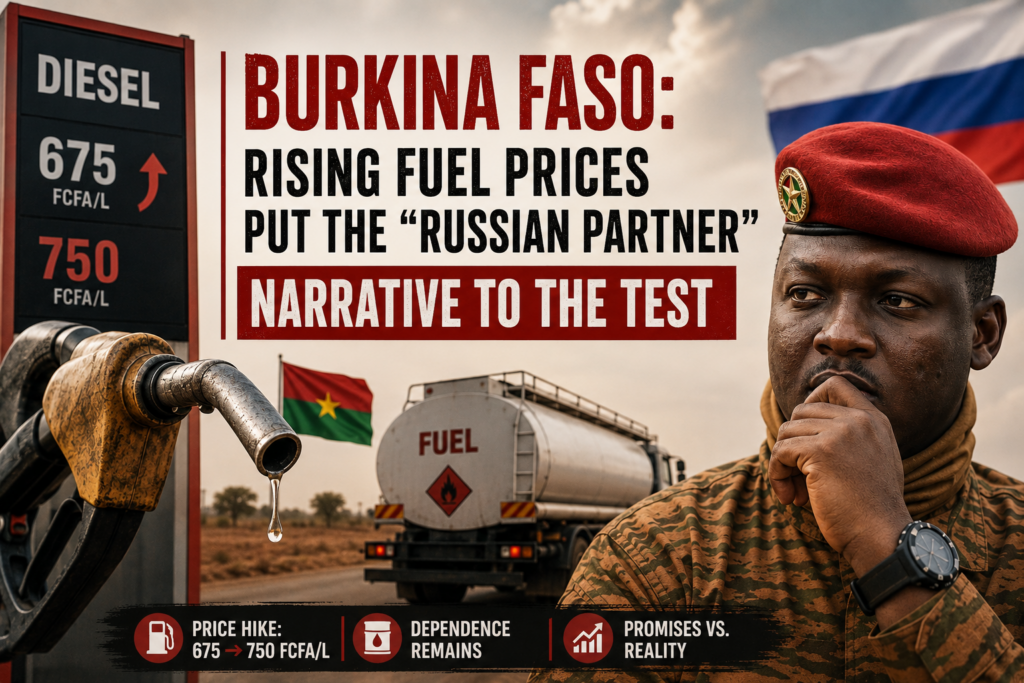
In Burkina Faso, economic realities are increasingly challenging prevailing geopolitical narratives. The issue of fuel prices stands as a particularly revealing illustration of this dynamic. For several years, the administration of Captain Ibrahim Traoré has presented Russia as a pivotal strategic partner capable of supporting the nation in its pursuit of sovereignty. However, the ongoing pressures concerning hydrocarbon supply underscore a fundamental truth: when it comes to energy, political alliances alone are insufficient to alleviate financial burdens.
The proposed increase in diesel prices, from 675 to 750 FCFA per litre, if implemented as discussed, occurs amidst a regional landscape characterized by escalating petroleum product costs. Several West African nations have already adjusted their prices in 2026. For instance, in Côte d’Ivoire, diesel rose from 675 to 700 FCFA per litre in May, while in Bénin, it reached 750 FCFA.
This regional comparison is significant, demonstrating that the Burkinabè price hike cannot be exclusively analyzed through the lens of relations with Moscow. Nevertheless, it raises a crucial political question: if the renewed collaboration with Russia was intended to reduce Burkina Faso’s external dependence, why does the nation remain so susceptible to the constraints of the international hydrocarbon market?
Proclaimed sovereignty versus market realities
Since Captain Ibrahim Traoré assumed power, economic and political sovereignty have been central tenets of Burkina Faso’s discourse. The disengagement or distancing from certain Western partners has been accompanied by a dramatic rapprochement with Russia.
Politically, this strategy can be framed as a deliberate effort to diversify partnerships. Economically, however, sovereignty cannot simply be declared. It is meticulously constructed through robust infrastructure, sufficient storage capacities, refining capabilities, secure transportation routes, and, critically, a supply chain diversified enough to absorb external shocks.
Burkina Faso, regrettably, remains a landlocked country. This geographical reality severely restricts its operational flexibility, necessitating reliance on regional corridors for a substantial portion of its petroleum product imports. No shift in diplomatic alliances can erase this inherent constraint.
It is precisely at this juncture that geopolitical rhetoric confronts its limitations.
Russia is not a “disinterested” supplier
Portraying Moscow as a partner capable of mechanically replacing former Western powers also constitutes a perilous oversimplification.
Russia primarily champions its own economic, commercial, and strategic interests. Like any exporting power, it negotiates contracts based on production costs, transportation logistics, insurance, geopolitical risks, and anticipated profitability.
Therefore, a romanticized interpretation of the Russo-Burkinabè partnership should be approached with caution.
A strategic partnership does not automatically guarantee preferential commodity prices, much less a permanent assumption of a partner country’s economic challenges. Moscow may provide equipment, expertise, investments, or open new trade channels, but this does not automatically transform Russia into a supplier operating at a loss.
It is precisely on this point that political narratives can diverge from commercial realities.
Fuel, a stark indicator of dependence
Fuel is a particularly sensitive commodity because it underpins the entire economy.
A rise in diesel prices affects more than just motorists. It progressively impacts road transport, goods, agricultural activities, businesses, services, and ultimately, household purchasing power.
For a nation like Burkina Faso, where terrestrial transport plays a central role in the distribution of products, every increase in fuel costs can trigger a cascading effect.
The truck transporting cereals, construction materials, or merchandise to various regions consumes diesel. When its cost rises, transporters inevitably pass a portion of that increase onto their tariffs. Merchants, in turn, adjust their prices. Consumers ultimately bear the cost.
The energy question thus rapidly transforms into an issue of purchasing power.
The paradox of indispensable neighbors
Here, Ouagadougou’s diplomatic strategy reveals another contradiction.
Burkina Faso has significantly hardened its rhetoric towards several countries and organizations within the sub-region. Yet, its landlocked status compels it to maintain functional relationships with its neighbors.
Regional ports remain vital for its supply chain. The road corridors traversing neighboring states constitute essential arteries for its economy.
Côte d’Ivoire, notably, holds a major logistical position in the West African sphere. Nigeria, for its part, wields considerable influence in the regional energy sector. This implies that a truly sovereign strategy should not involve choosing between Moscow, Abidjan, or Lagos, but rather diversifying partners and supply routes.
Genuine energy sovereignty, therefore, is not autarky. It is the capacity to avoid dependence on a single supplier, a single corridor, or a single foreign power.
The risk of an overly dependent sovereignism
The paradox is ultimately quite straightforward.
Ouagadougou aims to reduce its reliance on certain Western powers, which can certainly be a legitimate sovereign strategy. However, replacing one form of dependence with another does not necessarily constitute independence.
If Burkina Faso progressively exits certain Western economic circuits only to become heavily dependent on a new partner, the structural problem persists.
The question, therefore, is not whether Russia is inherently “good” or “bad” for Burkina Faso. It is about determining whether this partnership tangibly enhances the country’s capacity to produce, transport, process, and distribute its own resources.
In other words, sovereignty must be measured by results, not by slogans.
The political cost of an unfulfilled promise
It is also on this basis that Captain Ibrahim Traoré’s administration will be judged.
Populations can comprehend a fuel price increase when it is clearly attributed to an international crisis or evolving supply costs. However, they will be far more critical if they perceive that promises of new partnerships were specifically intended to shield them from such difficulties.
Political communication generates expectations. When a government presents a new partner as an alternative capable of liberating the country from former dependencies, every price hike becomes politically more sensitive.
The Burkinabè authorities must therefore address a simple question: what concrete economic benefits does the Russian partnership currently provide to the average Burkinabè consumer?
It is no longer sufficient to speak solely of military cooperation, sovereignty, or diplomatic rapprochement. Citizens demand to know how these choices impact their daily lives: fuel prices, product availability, transport costs, employment, investments, energy access, and purchasing power.
The true test will be economic
Russia can indeed be an important partner for Burkina Faso. It can even contribute to diversifying the nation’s alliances. However, it cannot, by itself, resolve the structural constraints of a landlocked economy exposed to international fluctuations.
Burkina Faso would therefore benefit from refining its approach: maintaining its new partnerships with Moscow while preserving pragmatic economic relations with its neighbors.
This does not entail reverting to old dependencies, but rather understanding that effective diplomacy is not a diplomacy of permanent rupture. It involves defending national interests with all available partners.
The fuel price increase, in this regard, serves as a warning. It reminds us that economic sovereignty is not measured by the number of foreign flags displayed at official ceremonies, but by a state’s capacity to secure its supplies, control its costs, and protect the purchasing power of its population.
The true test of the Russo-Burkinabè partnership will therefore not be the volume of friendship declarations between Ouagadougou and Moscow. It will be far more tangible: what does this partnership cost, what does it yield, and, crucially, what does it genuinely deliver to the ordinary Burkinabè citizen?
You may also like
Can Washington force third-country deportations? Ivory Coast’s refusal raises the stakes
Will Benin’s AEO exporters finally crack the Chinese market?
Northern Niger’s unanswered question: can Tiani’s government deliver water and power where it matters most?
Can Air Sénégal survive the Interpol smuggling probe? The stakes for crew, passengers and the airline’s future
Senegal’s December 2, 2026: will Diomaye Faye dissolve parliament or play the long game?