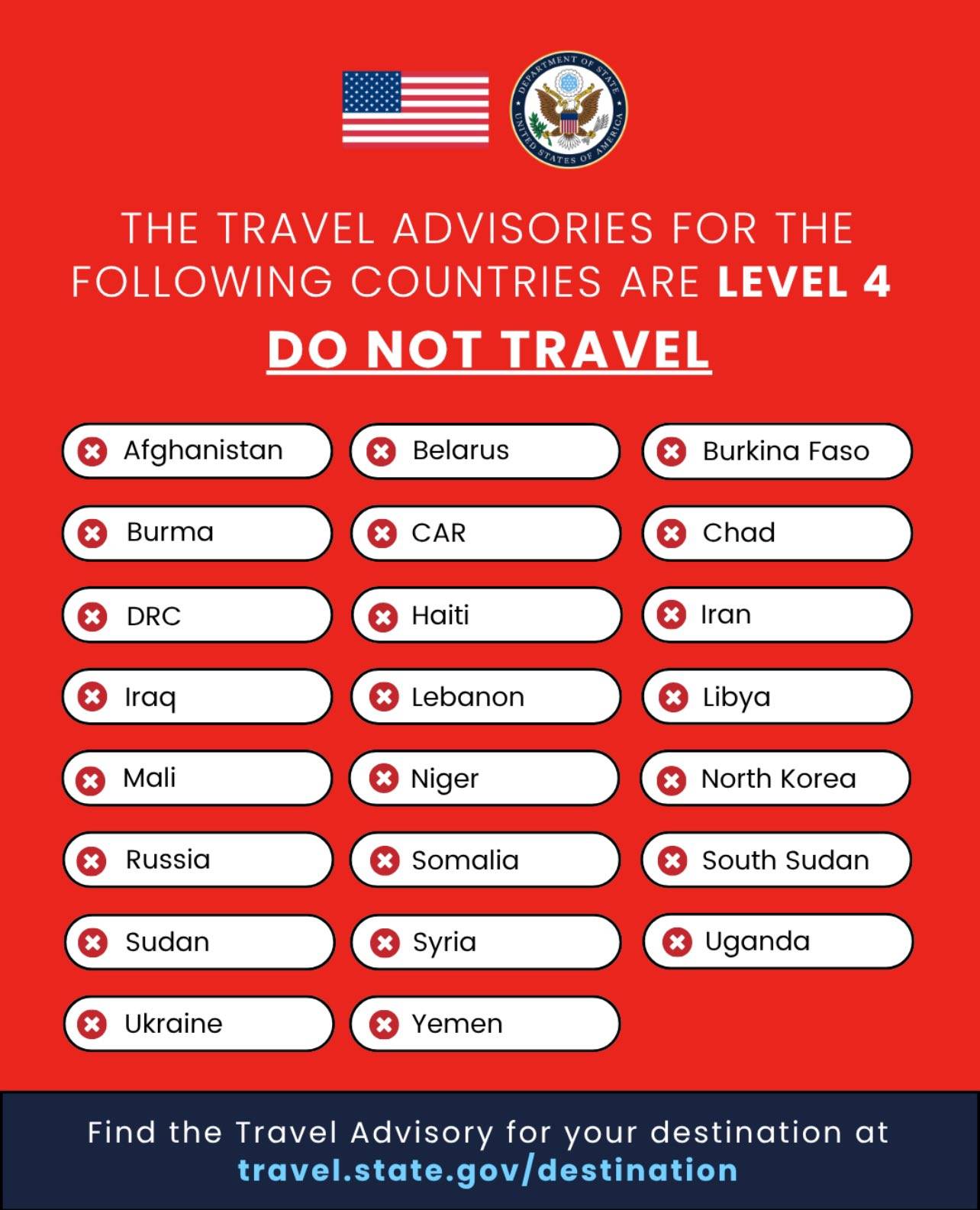
The United States has once again updated its global travel advisory system, designating 23 countries as Level 4: Do Not Travel, the most severe warning level. Among the nations facing this stark classification are Russia, the Democratic Republic of the Congo, Chad, and—most notably—the three founding members of the Alliance of Sahel States (AES): Burkina Faso, Mali, and Niger. The driving force behind this decision is an unprecedented surge in security threats and the relentless expansion of terrorist networks across the Sahel region, now widely regarded as a global hotspot for instability.
Washington’s sternest warning: what a Level 4 advisory entails
For American authorities, the safety of citizens abroad is non-negotiable, reflected in a four-tiered travel advisory system. Reaching Level 4 signifies the highest possible alert, effectively discouraging any travel to the affected countries. The U.S. government has emphasized that emergency consular or medical assistance is either severely limited or entirely unavailable in these zones, primarily due to the withdrawal of non-essential diplomatic staff. This move underscores a broader geopolitical reality where vast territories have slipped beyond state control, leaving Western nationals vulnerable to kidnappings, bombings, and hostage situations.
The AES nations bear the brunt of escalating violence
The joint placement of Burkina Faso, Mali, and Niger under the highest alert level comes as little surprise to regional analysts. These countries, united under the AES banner, are grappling with deep-rooted crises fueled by military takeovers, a strategic rift with long-standing Western allies like France and the European Union, and an alarming deterioration in security.
The roots of this crisis run deep: state presence has eroded in remote and border areas, systemic poverty has made populations susceptible to recruitment by armed factions, and a dramatic shift in military alliances—marked by the departure of Western forces and the embrace of new partnerships, including with Russia—has left a power vacuum on the ground. The effectiveness of these new partnerships remains unproven, leaving communities in a precarious state of limbo.
Terrorist networks push beyond traditional strongholds
The primary justification for the U.S. travel warning in the Sahel is the rapid geographic expansion of terrorist organizations. Groups linked to Al-Qaeda, such as the Support Group for Islam and Muslims (JNIM), and the Islamic State in the Greater Sahara (EIGS), are no longer confined to isolated desert sanctuaries. They are now launching coordinated offensives and steadily extending their influence across the region.
Burkina Faso: a nation under siege
Burkina Faso has become the epicenter of this asymmetric warfare. Armed groups now control or encircle large portions of the country, enforcing strict blockades that sever entire towns from the outside world. Daily attacks on military outposts and supply convoys have triggered massive internal displacement, leaving communities stranded and cut off from essential services.
Mali: instability spreads southward
In Mali, the security landscape has worsened since the withdrawal of the UN peacekeeping mission (MINUSMA) and the resurgence of hostilities between government forces and northern rebel factions. Terrorist groups are exploiting this security void to intensify violent incursions. The threat has now crept into the southern regions, encroaching upon the outskirts of Bamako, which was once considered a relatively safe haven for civilians.
Niger: triple-front pressure intensifies
Niger faces a dual military challenge: in the west, along the volatile “tri-border” zone shared with Mali and Burkina Faso, and in the southeast, near the Lake Chad basin, where Boko Haram and ISWAP continue to wage insurgency. Despite efforts to restructure the national armed forces, insecurity persists, compounded by regional diplomatic tensions that hinder cross-border cooperation.
A world marked by fragmentation and conflict
While the Sahel remains the focal point of concern, the U.S. advisory extends its warnings globally. Russia remains at Level 4 due to the war in Ukraine, the arbitrary detention risks for American citizens, and the unpredictable enforcement of local laws. Meanwhile, the eastern Democratic Republic of the Congo remains a battleground for dozens of armed factions, including the M23, where civilian massacres and abductions are tragically common. Chad, sandwiched between the Sahel and war-torn Sudan, faces spillover threats from terrorism, border conflicts, and the looming specter of civil unrest.
Economic and humanitarian fallout of the red alert
The repercussions of a Level 4 designation extend far beyond tourism. For the already fragile economies of the AES nations, this classification acts as a powerful deterrent to foreign direct investment. Multinational corporations, wary of exorbitant insurance premiums for their staff, are freezing or scrapping infrastructure and resource exploration projects. Similarly, humanitarian organizations face stringent security protocols that severely restrict access to vulnerable populations, depriving civilians of critical food, medical, and educational aid.
The Sahel’s security deadlock and the road ahead
The U.S. decision to maintain the AES nations at the highest alert level lays bare the shortcomings of a decade-long stabilization strategy. Despite political upheavals and geopolitical realignments in Bamako, Ouagadougou, and Niamey, the security situation continues to deteriorate. Civilians remain the primary victims, caught in a cycle of violence with no end in sight.
Military solutions alone have proven inadequate. Without addressing governance failures, social justice, economic development, and access to basic services, the Sahel’s map—drawn by Western chancelleries—will likely remain drenched in red for the foreseeable future.