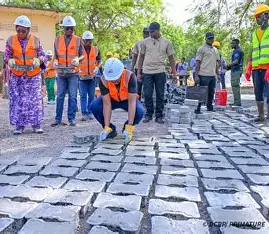
Championed by Burkina Faso’s transitional authorities as an emblem of national renewal and rediscovered sovereignty, the “Faso Mêbo” agency, initiated under the impetus of Captain Ibrahim Traoré, is now at the center of considerable inquiry. While the official narrative emphasizes patriotism, collective endeavor, and visible projects across several cities, some observers express concerns about an opaque system governing public resources and citizen contributions.
Despite governmental communications stressing transparency and rigorous project execution, various analyses from economic experts suggest significant financial irregularities, reportedly benefiting individuals closely connected to the ruling administration.
The strategy of visible projects
Faso Mêbo’s accomplishments are undeniably tangible. Street paving, drainage system rehabilitation, and urban enhancements project an image of swift environmental transformation in cities such as Ouagadougou, Bobo-Dioulasso, and Koudougou. By mobilizing the nation’s youth, students, and diaspora, the authorities have cultivated a compelling narrative centered on popular participation in the pursuit of national sovereignty.
However, some specialists contend that this pronounced visibility may also serve to divert attention from more fundamental issues.
“While these labor-intensive projects remain relatively inexpensive when compared to the substantial sums declared for the national endeavor,” explains a Burkinabè economist, who spoke anonymously, “the emphasis on highly visible infrastructure often overshadows the critical inquiry into the actual allocation of the funds mobilized.”
Suspicions regarding resource management
The primary focus of criticism revolves around the agency’s control mechanisms. Although Faso Mêbo asserts the complete traceability of its operations, several observers express apprehension regarding the absence of independent entities capable of scrutinizing the utilization of both state budgetary allocations and public contributions.
Internal documents and various alerts that have surfaced suggest potential irregularities. These include the awarding of contracts without competitive bidding, purportedly inflated costs for certain materials, and ambiguous budgetary classifications. Such practices, it is alleged, disproportionately benefit a select group of civil and military functionaries.
A climate that constrains criticism
A recurring question pertains to the apparent silence from established oversight institutions and a segment of the local media. This phenomenon is often attributed to the prevailing political climate, characterized by significant pressure exerted upon dissenting voices.
Journalists, activists, and judicial officials who have voiced reservations concerning certain governmental decisions have reported experiences ranging from intimidation to forced deployment in conflict zones. Furthermore, human rights organizations have documented instances of disappearances and infringements upon liberties, collectively fostering an atmosphere of apprehension that impedes investigative initiatives.
Between patriotism and the imperative of accountability
For some analysts, the Faso Mêbo initiative exemplifies what they term “infrastructural populism.” They argue that while the tangible and visible accomplishments garner popular endorsement, they simultaneously provoke serious questions regarding governance standards and transparency.
The extensive engagement of citizens in community projects receives widespread commendation. Nevertheless, numerous voices assert that this surge of patriotic fervor must not compromise the imperative for accountability. For these proponents, advancements in living conditions cannot serve as a substitute for stringent demands concerning transparency and the sound stewardship of public finances.
You may also like
Burkina Faso: what does Ibrahim Traoré’s four-year record truly mean for the displaced and the silenced?
Cameroon’s Vision 4 suspension: does silencing a broadcaster protect the Martinez Zogo trial or undermine press freedom?
Thali oil permit: can Prime Global Energies’ $15 million rescue finally unlock Cameroon’s stalled Njom-3 well?
Can West Africa’s peace hold without the Entente Council and UNOWAS pact?
Can Lomé’s quiet diplomacy finally deliver peace to eastern DRC?