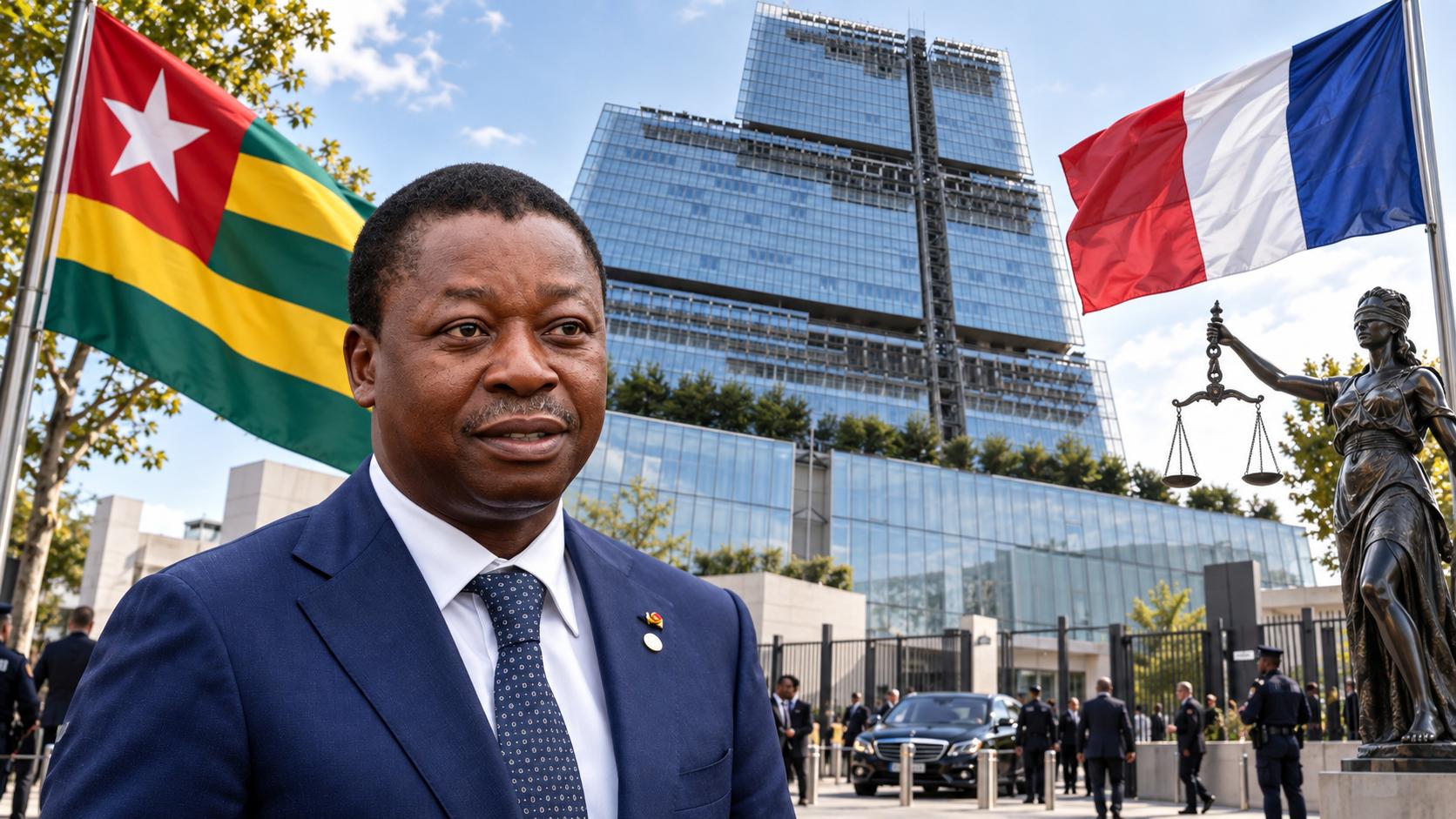
As France’s National Financial Prosecutor’s Office (PNF) intensifies its scrutiny of foreign leaders’ wealth within French borders, attention has firmly shifted to the extensive real estate portfolio held by Togolese President Faure Gnassingbé and his close circle. This complex financial affair, intertwined with Franco-Togolese diplomatic relations, involves opaque civil real estate companies (SCIs), opulent private mansions, and ongoing money laundering investigations.
This judicial saga, a recurring topic in the exclusive salons of Paris’s sixteenth arrondissement and within the Palais de Justice’s investigative chambers, has long simmered beneath the surface. While high-profile cases targeting Central African executives like Teodorin Obiang and the Bongo family have frequently dominated headlines, Faure Gnassingbé now finds himself directly confronting the legal ramifications concerning numerous assets allegedly acquired through the misappropriation of Togolese state funds. At the heart of this inquiry are several prestigious properties situated in Paris and the Île-de-France region, all under suspicion of being purchased with illicit public money.
A high-stakes preliminary investigation
In France, the PNF is spearheading a preliminary investigation aimed at meticulously tracing the origins of funds used by members of the Gnassingbé clan and their business associates to acquire several exceptional assets. The financial labyrinth under the microscope of investigators from the Central Office for the Repression of Major Financial Delinquency (OCRGDF) encompasses:
- Intricate real estate dealings: This includes eight Haussmannian apartments and five private mansions, structured through complex Civil Real Estate Companies (SCIs) and involving the use of nominee accounts.
- Sophisticated financial mechanisms: The probe highlights the utilization of two offshore bank accounts located in the Fiji Islands and the involvement of financial intermediaries based in low-tax jurisdictions.
- Allegations of money laundering and corruption: The PNF’s French investigation delves into the provenance of funds that facilitated the acquisition of multiple luxury properties, collectively valued at tens of millions of euros, by President Faure Gnassingbé’s entourage. Magistrates are meticulously verifying whether these real estate investments in Île-de-France, managed via SCIs, are disproportionately large when compared to the head of state’s official salary, estimated at approximately 70 to 80 million FCFA annually. They are also examining whether these assets derive from the embezzlement of public funds. Observers are also focusing on the President’s personal fortune, which independent investigations and the investigative press have estimated at over 3,000 billion FCFA. Finally, the inquiry scrutinizes financial flows channeled through long-standing associates and intermediaries, such as former Minister of State Barry Moussa Barqué, alongside arrangements identified in related cases, including concessions for the Autonomous Port of Lomé linked to the Bolloré group.
An enduring property legacy and inheritance disputes
The Togolese presidential family’s property holdings in France are not a recent phenomenon. Their origins trace back to the era of Étienne Eyadéma Gnassingbé, the father of the current head of state. Following his passing in 2005, the management of this extensive real estate portfolio ignited fierce family disputes, further complicated by seizure proceedings and challenges to property ownership.
Among the addresses frequently cited by investigative journalists and anti-corruption non-governmental organizations are three buildings situated on Avenue du Maréchal-Maunoury, high-end residential properties within the Hauts-de-Seine department, and apartments more recently acquired during official visits to Paris.
Togo confronts French legal precedents
For over a decade, the French dimension of “ill-gotten gains” primarily targeted the Bongo family of Gabon, the Nguesso family of Congo-Brazzaville, and the Obiang family of Equatorial Guinea. However, recent developments in French legislation, particularly the establishment of a mechanism for restituting confiscated assets to defrauded populations, has significantly heightened judicial vigilance. This increased scrutiny now extends to all leaders whose assets in France appear to exceed their theoretical financial capacities.