Togo’s education ministry terminates costly SMS result service
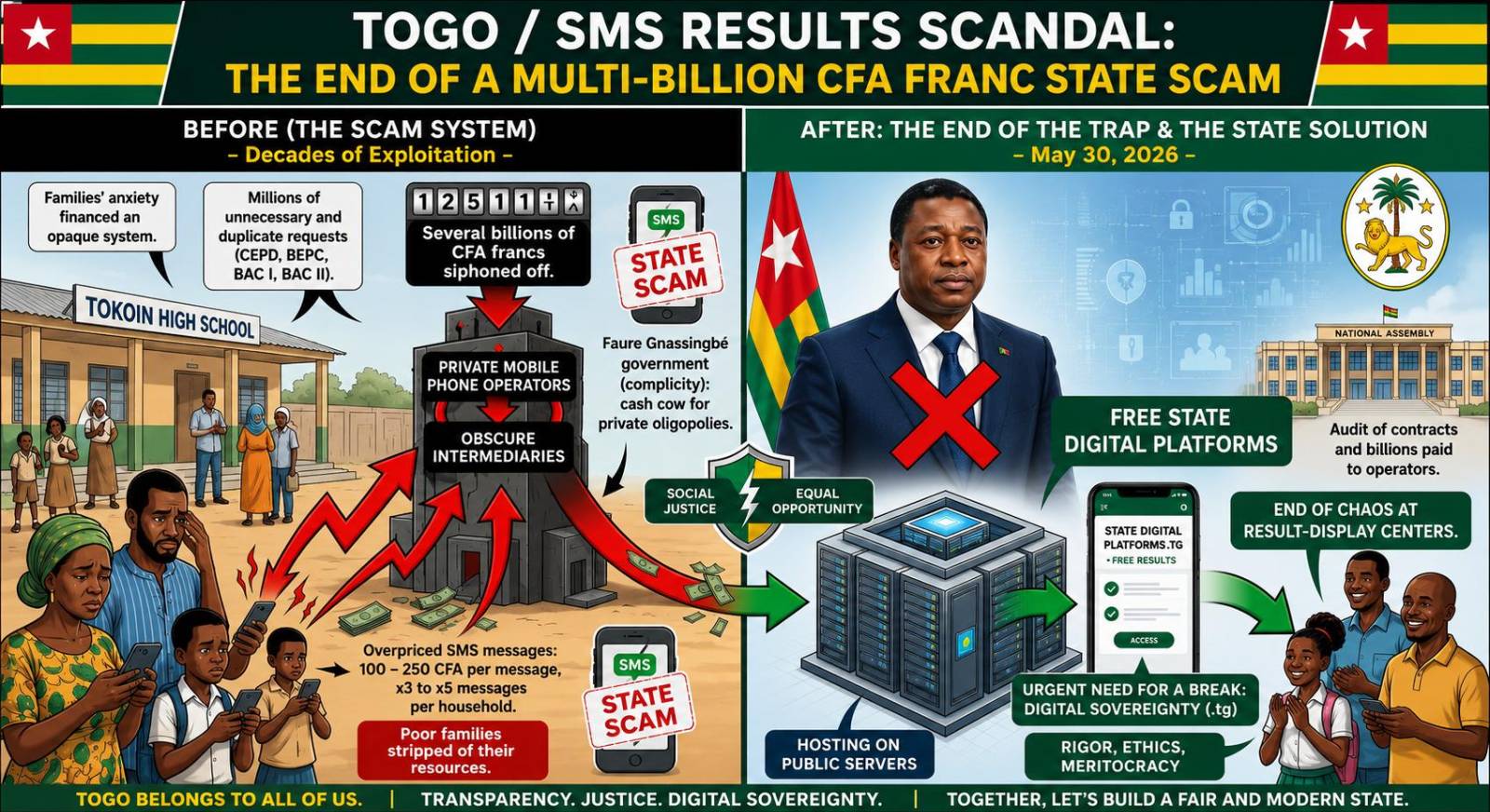
For years, Togo’s education system operated what officials now describe as a state-sponsored financial drain, siphoning funds from struggling families through a deceptive SMS-based examination result system. The abrupt announcement by Education Minister Mama Omorou to abolish this practice has exposed a decades-long scheme that enriched private telecom operators while burdening households with unnecessary costs.
A system built on anxiety and exploitation
The controversial mechanism came to light during a surprise inspection of BAC I exam correction centers in Tokoin and Agoè-centre on May 30, 2026. Minister Omorou condemned the practice as a calculated exploitation of parental desperation, where families—under pressure to secure their children’s results—sent multiple overpriced text messages (costing between 100 and 250 francs CFA each) to the same number. This redundant system generated millions in revenue from redundant queries, all at the expense of parents.
Financial hemorrhage: The scale of the fraud
While no official audit has yet been released, estimates reveal staggering losses. With annual exam candidates numbering in the hundreds of thousands—and each household often sending three to five duplicate messages—the total volume of SMS requests reached tens of millions per session. Over 15 to 20 years of this practice, the financial toll likely exceeded several billion francs CFA.
The diverted funds did not bolster public education. Instead, they flowed primarily to private telecom firms and shadowy intermediaries, operating under state-granted concessions that went unchallenged for decades. This amounted to a systematic transfer of wealth from vulnerable families to corporate entities, with tacit approval from successive governments.
Charting a new path: Transparent, digital alternatives
Minister Omorou’s decision to halt SMS-based result dissemination is a critical first step, but it demands immediate action to prevent a return to chaotic, in-person result displays. Togo, which has championed digital integration through its Ministry of Digital Economy, now faces an urgent obligation to deploy secure, state-managed online platforms.
Key requirements for a sustainable solution include:
- Public infrastructure: Exam results must be hosted on government-controlled servers (.tg domain) to ensure sovereignty and security.
- Zero-cost access: Funding should come from the national education budget, eliminating financial barriers for all families.
- Digital modernity: Results should be published via lightweight web portals and email waves, accessible even on basic mobile devices.
A shift toward ethical governance
Beyond rectifying financial malpractice, the minister used the inspection to reaffirm core educational values. Correctors were reminded that rigor, ethics, and meritocracy must guide Togo’s schools. This move signals a pivotal ideological shift—one that prioritizes social justice over institutionalized exploitation.
The next phase is critical. Will the government follow through by auditing past telecom contracts to uncover the full extent of the financial drain? The future of Togo’s youth depends on a commitment to transparency and accountability.