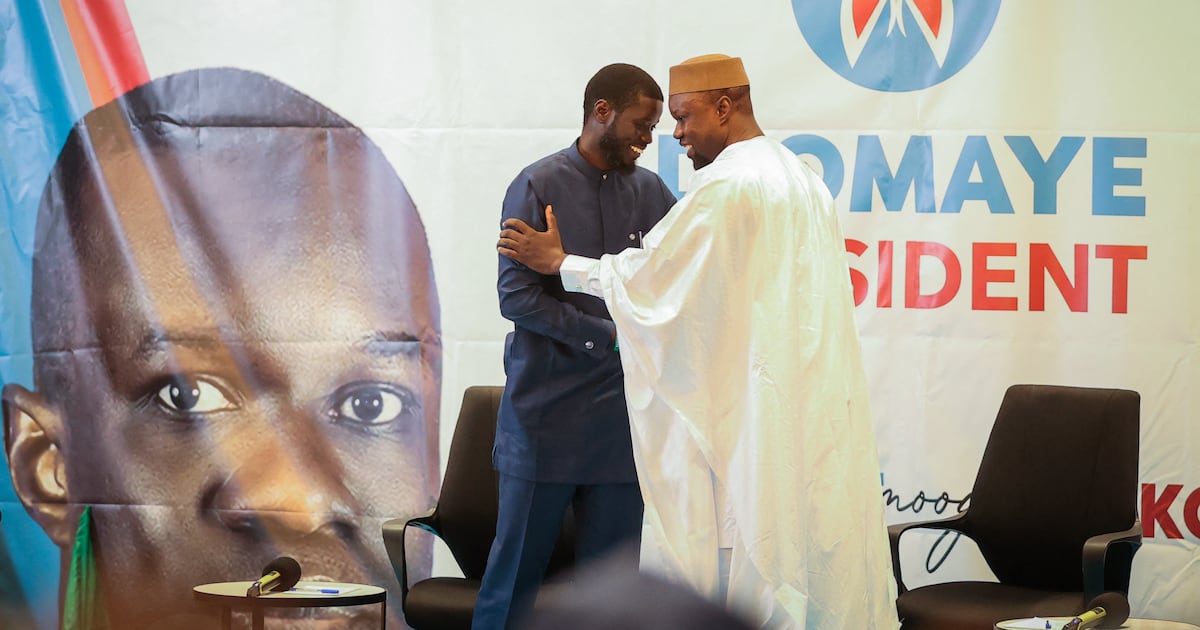
For months, a palpable truth permeated discussions across Dakar, from bustling newsrooms to the hushed corridors of ministries and vibrant popular neighborhoods: the powerful alliance that propelled Senegal’s opposition to power was faltering. The resonant campaign slogan, « Diomaye mooy Sonko, Sonko mooy Diomaye » (Diomaye is Sonko, and Sonko is Diomaye, in Wolof), had gradually lost its unifying force. As weeks turned into months, the once impactful phrase transformed into a stark realization: « Diomaye n’est plus Sonko », so little effort did the two men make to conceal their escalating disagreements.
Indeed, between President Bassirou Diomaye Faye and his Prime Minister Ousmane Sonko, points of contention had multiplied, making their shared leadership at the highest echelons of government increasingly untenable. Divergent approaches, struggles for influence, rivalries among their respective inner circles, and a clear competition for genuine leadership in the exercise of power all signaled that, eventually, one man would have to yield.
By opting to dismiss his Prime Minister, the Senegalese head of state undeniably sought to affirm his authority. However, this decisive move may also have unintended consequences.
Ousmane Sonko’s strategic maneuver
For several months, Ousmane Sonko appeared to be systematically pushing his relationship with Bassirou Diomaye Faye towards a critical breaking point. The leader of Pastef understood that he could not sustainably coexist with a president progressively seeking to fully exercise his own authority. Yet, he also recognized that in an open confrontation, the emotional and militant allegiance within the party would likely remain in his favor.
This was the core of his strategy: to compel Diomaye Faye to choose between his institutional authority and the political unity of Pastef.
By remaining in government while simultaneously demonstrating political autonomy through various actions and statements, Ousmane Sonko steadily made the situation untenable. Each ambiguous public utterance, every open divergence, and every implicit reminder of his status as the movement’s historical leader intensified the pressure on the head of state.
The Senegalese president found himself ensnared in a no-win scenario. If he accepted this form of dual leadership, he risked appearing as a weakened president, incapable of asserting his authority. But by dismissing his Prime Minister, he risked being perceived as the one who shattered Pastef’s foundational pact and, in the eyes of a segment of activists, betrayed the movement’s original spirit.
In essence, Ousmane Sonko had everything to gain from being removed. A forced departure now allows him to fully reclaim the role he never ceased to occupy for a significant portion of the base: the historical leader, the political martyr, the central figure symbolizing a break from the old system.
The lure of new courtiers
Bassirou Diomaye Faye might have fallen into a second subtle trap. Since his ascension to power, a new entourage has gravitated around the president: political operators, former supporters of the Macky Sall regime, opportunistic dignitaries, and professional turncoats. All echoed the same message: « You are the president. You must demonstrate who is in charge. »
Such rhetoric naturally flatters presidential authority. After all, within Senegal’s institutional framework, it seems anomalous for a Prime Minister to project himself as the political equal of the head of state. However, Bassirou Diomaye Faye would do well to scrutinize the true motivations of these newfound allies.
Where were these individuals when Ousmane Sonko and he confronted the judicial machinery of the Macky Sall administration? Where were they during the imprisonments, the violently suppressed demonstrations, and the campaigns to demonize Pastef? Many then quietly enjoyed the privileges of the very system they now denounce with a sudden, fervent revolutionary zeal.
These masters of political opportunism excel at detecting fractures, amplifying rivalries, and feeding competing egos. Their political survival often hinges on dividing former comrades-in-arms. African political history abounds with similar examples: movements that carried hope, came to power, then found themselves weakened less by opposition than by their own internal divisions.
The danger for Diomaye Faye is substantial: to believe that those who encouraged him to break with Ousmane Sonko are genuinely working to consolidate his power. Many may, in fact, primarily seek to weaken Pastef to better neutralize the political project it embodied.
The risk of Pastef’s fragmentation
Now, the struggle for power is openly underway. It could ultimately favor Ousmane Sonko. The current political reality in Senegal remains undeniable: Pastef largely dominates the national scene thanks to an exceptional grassroots presence, a youthful and mobilized base, and a powerful narrative forged during years of confrontation with the Macky Sall regime. Within this dynamic, Sonko remains the pivotal figure.
Even when hindered by the judiciary yesterday, even absent from the presidential election ballots, it was around him that the hope for change crystallized. Bassirou Diomaye Faye’s election was perceived by a significant portion of the public as a proxy victory for Ousmane Sonko.
Certainly, the president holds institutional legitimacy. But his former Prime Minister retains formidable popular and militant legitimacy. In any future political or electoral confrontation, this factor could prove decisive.
Should Pastef fracture into an wing loyal to Diomaye Faye and another aligned with Ousmane Sonko, there is no guarantee that the head of state would emerge victorious. Many senior figures, elected officials, and activists might be tempted to follow the one they still regard as the movement’s central figure. Bassirou Diomaye Faye does not yet possess an autonomous political apparatus sufficiently structured to counterbalance the influence of his former mentor. This represents his primary vulnerability.
The curse of political heirs
The predicament of many political heirs is their eventual desire to forge their own identity. This is a natural human inclination. No president can indefinitely accept being perceived as a mere figurehead, devoid of true authority.
Beyond the individuals involved, it is now the very coherence of the project championed by Pastef that is being questioned. The movement was born from a promise of radical change: virtuous governance, national sovereignty, social justice, and the restoration of national dignity. However, ego battles often possess this destructive capacity to divert political movements from their initial mission.
Perhaps the greatest irony in this entire affair is that Pastef’s adversaries might ultimately benefit from a crisis they didn’t even need to orchestrate themselves.