
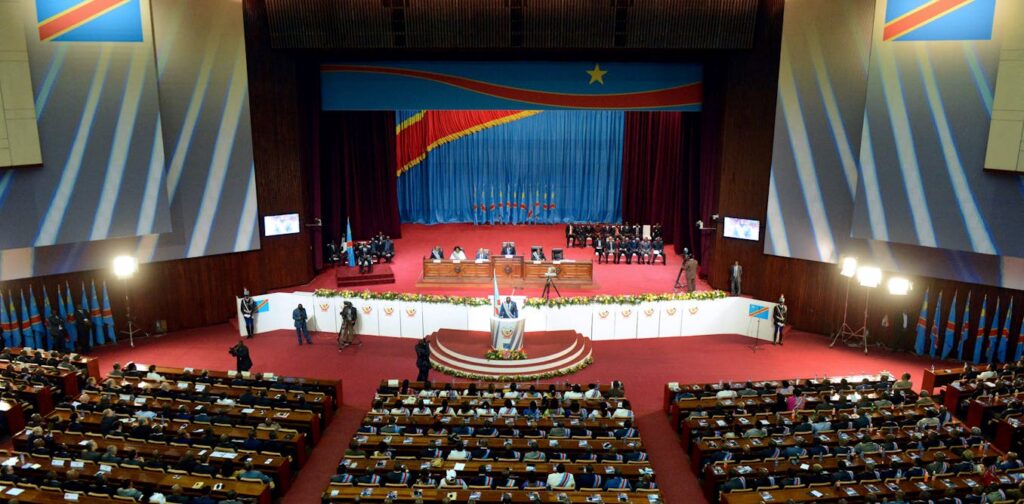
In Kinshasa, a deeply troubling moment unfolded in the national assembly when Deputy Micheline Mpundu concluded her speech and exited the podium. The session, presided over by second vice-president Christophe Mboso, took an unexpected turn as he publicly commented on her appearance, remarking, “Thank you, colleague, she is very beautiful… right?” His remarks escalated into further demeaning gestures, with him lifting his hands to mimic her body shape while laughing, adding phrases like “God made her this way” and “these are another person’s belongings.” The chamber erupted in laughter and applause, and the session continued as if nothing had happened.
Days later, under mounting pressure from political leaders, civil society, and human rights advocates, Mboso issued a belated apology—without facing any disciplinary action. This incident raises a critical question: when will African parliaments, particularly in the Democratic Republic of Congo, cease to be hostile spaces for the women they claim to represent?
a systemic issue beyond the drc
Parliamentary sexism is not an isolated incident but a persistent pattern affecting women in politics across Africa. Long before the Mboso incident, documented cases of misogyny in legislative chambers had already surfaced, revealing how deeply entrenched these attitudes are. Women’s participation in politics surged in the early 1990s during democratization waves, tripled between 1990 and 2010, and shattered the illusion that electoral mandates alone could dismantle institutional cultures of exclusion.
Yet, these gains collided with deep-seated resistance from male colleagues—whether in opposition or the same party. Many openly assert that politics is a male domain, where women are unwelcome or unfit. The Inter-Parliamentary Union, in its 2016 global survey of 39 countries, found that 65.5% of female parliamentarians reported repeated verbal abuse and insults during their terms. These statistics expose a harsh reality: women are judged not on their political contributions but on their appearance, marital status, or conformity to traditional roles.
The sexism does not stay outside parliament—it enters with the lawmakers themselves. A 2021 joint study by the Inter-Parliamentary Union and the African Parliamentary Union confirmed that this problem persists across African legislatures, with only minimal progress toward genuine gender equality in decision-making.
The applause following Mboso’s remarks was not incidental. It reflects a system that not only tolerates but normalizes such behavior, reinforcing women’s subordination in institutions that claim to be democratic. Philosopher Kate Manne describes this as a mechanism of control—one that reduces women to their bodies rather than recognizing them as legislators. The phenomenon, termed semiotic violence by scholar Mona Lena Krook, includes gestures, words, and laughter that serve as constant reminders of women’s perceived inferiority.
The concept of coloniality of gender, developed by feminist María Lugones, further explains how patriarchal hierarchies—rooted in colonial legacies—persist even in post-colonial democracies. In the DRC, where women make up 51% of the population but hold only 13% of parliamentary seats, the gap between constitutional rights and lived reality is glaring. These women are elected under the same laws as their male counterparts, yet they face systemic control that undermines their authority.
african parallels: when women’s dignity is denied
The Mboso incident echoes disturbing cases across the continent. In Senegal, Deputy Amy Ndiaye, pregnant at the time, was physically assaulted in the chamber in 2022. In Nigeria, Senator Natasha Akpoti-Uduagha was suspended in 2025—not for misconduct, but for publicly naming the sexual harassment she endured from the Senate president. These cases reveal a troubling pattern: African parliaments may tolerate women’s voices, but their dignity remains unprotected.
the drc’s long history of parliamentary misogyny
In April 2020, former Senate President Thambwe Mwamba publicly shamed Senator Bijoux Ngoya during a plenary session, alleging she had approached him for support in exchange for sexual favors. The accusation, made in a nationally televised session, sparked outrage and left the chamber in chaos.
In July 2021, Deputy Christelle Vuanga was silenced mid-debate by a male colleague who simply stated in Lingala, “You are a woman.” The implication was clear: her gender disqualified her from participating in substantive political discourse.
Against this backdrop, the Mboso affair is neither shocking nor surprising. The DRC has ratified international conventions, adopted laws, and signed commitments to gender equality—yet within the assembly, little has changed. The disconnect between policy and practice is well-documented, but today, it is met with deliberate indifference.
a call for accountability and systemic change
French feminist Simone de Beauvoir’s 1949 assertion—that women are defined as “the Other”—still holds true in the DRC parliament. Women legislators are reduced to their bodies, not their ideas, their expertise, or their contributions. This misogyny corrodes democracy from within.
Unpunished behavior sends a dangerous message: the chamber is a misogynistic space despite representing a majority-female electorate. While women hold only 13% of seats, their mere presence is treated as an affront by some male colleagues. The absence of consequences for Mboso’s actions underscores a troubling norm.
Other parliaments have taken steps to address this issue. Campaigns like #NotTheCost and #NotInMyParliament demonstrate that cultural change is possible through concrete sanctions and victim protection. The DRC possesses strong laws, such as the 2025 Senate bill on violence against women—but without enforcement, these remain hollow promises. Silence is no longer an option. Failing to hold Mboso accountable sends a clear signal to Congolese women considering political careers: their dignity is negotiable.