Ousmane Sonko urges constructive dialogue to prevent senegalese political crisis
As Senegal faces fresh political challenges following recent government reshuffles, opposition leader Ousmane Sonko has called for urgent dialogue to preserve national stability. His remarks come amid heightened tensions after his unexpected removal from the Prime Minister’s office.
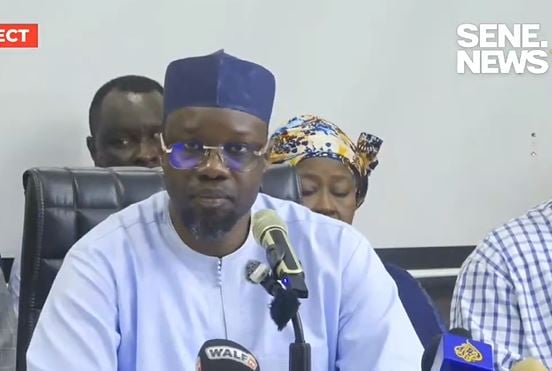
Ousmane Sonko, leader of Senegal’s largest political party and former Prime Minister, has pledged constructive cooperation with the newly formed government, warning against policies that could destabilize the nation. Speaking publicly for the first time since his dismissal on May 22, Sonko emphasized the need for open dialogue to avert a deeper crisis.
His comments follow President Bassirou Diomaye Faye’s controversial appointment of a 30-member cabinet, which Sonko’s party, the Pastef (African Patriots of Senegal for Work, Ethics, and Fraternity), has refused to endorse. The opposition leader criticized the government’s formation process, stating:
“A country is a serious matter. A government is a serious matter. I get the impression the President does not understand what it takes to form a government—this is not something done lightly.”
With his party holding 130 of 165 seats in the National Assembly, Sonko asserted that the government’s legitimacy remains fragile, lacking a solid political foundation. He framed the current situation as an inevitable cohabitation, urging President Faye to engage in meaningful discussions rather than relying on unilateral decisions.
Government formation sparks political tensions
Sonko’s removal from office marked a dramatic shift in Senegal’s political landscape, ending a long-standing alliance with President Faye. The dispute centered on debt management strategies and governance priorities, with the President citing irreconcilable differences in recent policy stances.
The new cabinet, announced on Monday, has drawn sharp criticism from Sonko, who accused the administration of prioritizing short-term political gains over national stability. He warned that:
“Yesterday, we had a government without political backing. There is no structured, credible legitimacy behind this administration.”
Despite the friction, Sonko issued a conciliatory message, stating that his party could dissolve the government within 72 hours if necessary—but chose restraint to prioritize Senegal’s long-term interests. His call for calm and restraint extends to the country’s youth, whom he urged to avoid provocations that could escalate tensions.
Historical context and risk of renewed instability
Senegal has faced recurring political unrest, particularly between 2021 and 2024, when protests against the previous administration were met with violent repression, resulting in numerous civilian casualties. Sonko cautioned that a return to such instability would deter foreign investment and undermine national progress.
In a final appeal, he stressed the need for political maturity from all stakeholders, emphasizing that “peace requires two willing parties.” His stance reflects both a warning and an olive branch, leaving room for reconciliation if the administration is willing to engage in good faith.