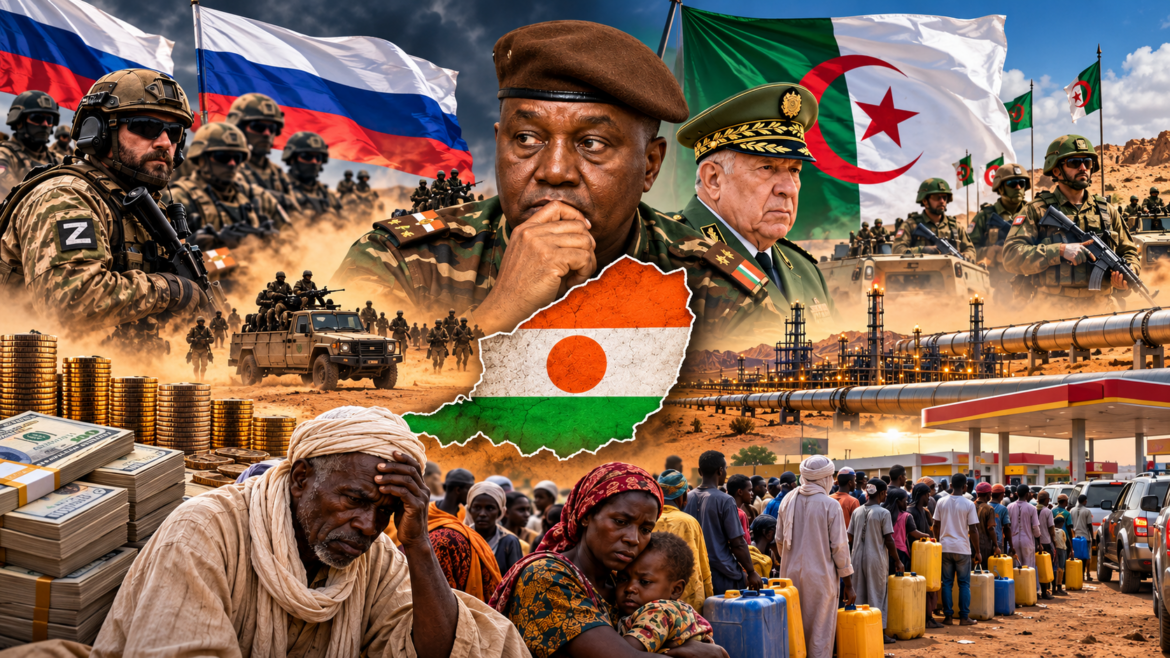
When Abdourahamane Tiani assumed power in Niger following the July 2023 coup, his administration prioritized military cooperation with Russia as a cornerstone of national security. The partnership with Moscow’s Africa Corps and similar groups was framed as essential to restoring stability in a country grappling with unprecedented insecurity. Yet, as attacks persist and state authority remains fragile, Niamey has now turned to Algeria for support raising critical questions about the motivations, costs, and long-term implications of this strategic pivot.
From Moscow to Algiers: the unspoken conditions behind Niger’s military realignment
On October 25, 2026, Algeria’s Parliament delivered a landmark decision: it approved the deployment of units from the Algerian National Popular Army (ANP) to Niger. This move marks a significant shift in Algeria’s traditionally cautious foreign military engagement policy. While the timing of this decision may suggest urgency, the motivations go beyond immediate security threats. Reports indicate that Algeria’s interests include safeguarding its energy investments, particularly oil and gas infrastructure, along with securing key transit corridors. These factors suggest that Algeria’s intervention is not purely altruistic, even if its stated goal aligns with stabilizing the region.
The Russian gambit: high costs, limited returns
The Tiani regime leaned heavily into Russian military partnerships, bringing in forces linked to Africa Corps and other entities. These deployments were presented as turning points in Niger’s security strategy. However, the absence of verifiable public contracts makes it difficult to assess the true financial burden. While some estimates suggest monthly costs exceeding $10,000 per contractor, the actual figures including the number of personnel, their roles, and covered services remain shrouded in ambiguity.
Such opacity is concerning, especially when the government’s financial resources are already stretched thin. Niger faces pressing social and developmental needs, from healthcare and education to critical infrastructure. Every large-scale military expenditure must be weighed against its tangible benefits. If security improvements do not materialize despite these investments, the population risks bearing both the direct and indirect consequences of unaccountable decision-making.
The hidden costs of outsourcing security
Financial strain: Every new security partnership absorbs substantial public funds funds that could otherwise support essential services and local economies.
Operational opacity: Without clear agreements on roles, responsibilities, and financial contributions, citizens lack the information needed to evaluate whether their government’s choices are justified.
Strategic dependency: A pattern of shifting alliances without sustainable results could erode public trust and foster a cycle of external dependency, rather than building domestic resilience.
What makes Algeria’s role different?
Unlike Russia’s mercenary forces, Algeria’s military presence backed by a sovereign national army carries a different set of expectations and demands. The formal approval from Algeria’s Parliament underscores the legitimacy of its intervention, yet it also amplifies scrutiny over its objectives. Is the primary aim to protect Niger’s borders and citizens? Or does Algeria prioritize securing its own economic interests, such as oil fields and the Trans-Saharan Gas Pipeline?
These overlapping goals are not inherently contradictory, but they must be transparently communicated. Without clarity, Niger’s citizens cannot assess whether their country is paying the full price while foreign interests gain disproportionate benefits.
Will security truly improve, or just the budget?
The most pressing question is not whether Algeria can help stabilize Niger, but whether this cooperation will deliver measurable improvements. Will the number of attacks decrease? Will rural communities feel safer? Will vital trade routes become more secure? Or will the focus remain on high-profile installations while broader insecurity persists?
The burden of proof lies with the government. It must demonstrate that the new partnership is not just another costly arrangement, but one that delivers tangible security dividends. Otherwise, the cycle of dependence will continue each new alliance offering little more than temporary relief, while the underlying structural issues remain unaddressed.
Transparency as the first line of defense
The government’s insistence on sovereign decision-making is commendable in principle. Yet sovereignty demands more than rejecting past alliances it requires accountability. Every military partnership must be subject to public scrutiny. Citizens deserve to know:
What are the specific objectives of the Algerian deployment?
How will costs be shared between the two nations?
What mechanisms ensure results rather than empty promises?
Without such transparency, the public cannot distinguish between strategic necessity and backroom deals. And without measurable improvements in day-to-day security, even the most enthusiastic diplomatic alliances will ring hollow.
The real test: security for the people, not just the state
Niger’s search for security has led it through multiple partnerships, each with its own promises and costs. Yet enduring stability will not come from signing agreements with foreign powers it will come from addressing the root causes of insecurity and building a domestic capacity that protects citizens first.
As the government navigates this new chapter with Algeria, the overriding question must be: Will this collaboration lead to real, lasting security for the people of Niger? Or will it merely add another layer to a system where external support masks systemic weaknesses, and the population continues to pay the price?
For the millions of Nigeriens living with daily threats, the answer matters more than any diplomatic announcement. Their safety, their trust, and their future depend on it.
By Pierre Tchuente — Journalist