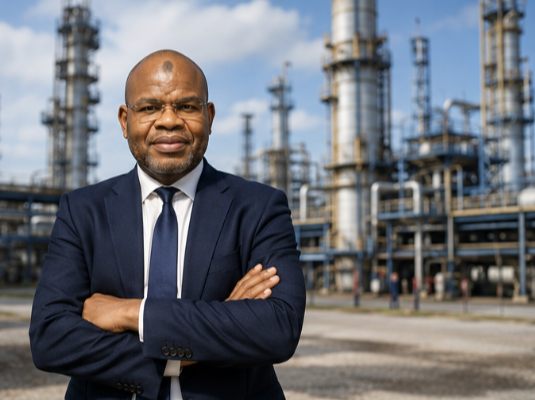
Eighteen months after the July 26, 2023 takeover in Niamey, the rhetoric of ‘Refoundation’ and radical break is crashing against the reality of oil management. At the heart of power, the newly appointed Minister of Petroleum, Hamadou Tini, is accused of holding multiple hats in defiance of the most basic ethical rules. A former executive of the Mazars firm, he now uses public authority to reactivate contracts for his private structure, demanding full access to SORAZ’s secrets. An investigation into a conflict of interest at the top of the state, where financial auditing has become a tool for purging and enrichment.
From rupture rhetoric to the return of lobbies
After seizing power, the military leaders of the National Council for the Safeguard of the Homeland (CNSP) made economic sovereignty their main battle horse. The priority target was clear: managing oil resources, especially the Zinder Refining Company (SORAZ). On state television, putschist propaganda denounced the fallen democratic system and its international ‘accomplices.’
Among them, the international consulting firm Mazars, a partner of the Nigerien state for a decade, was dramatically dismissed. Accused by the new regime — and by Chinese partners from the China National Petroleum Corporation (CNPC) — of producing biased audits, Mazars seemed permanently banned from Niger’s economic landscape. The official line was uncompromising: Niamey needed to hire a neutral, independent international firm, free from any suspicion, to thoroughly scrutinize SORAZ.
Yet behind the scenes, the reality of influence networks quickly dampened popular enthusiasm. Through intense lobbying maneuvers, one of Mazars’ key executives succeeded in entering the state apparatus. In January 2026, under the direct protection of General Mody, accountant Hamadou Tini was catapulted to the head of the Ministry of Petroleum. This appointment marked the grand return of the firm he had served just weeks earlier.
Minister Tini: client, provider, and signatory
As soon as he settled into his ministerial seat, Hamadou Tini applied the popular saying ‘charity begins at home.’ Using his official authority, the minister immediately placed the financial and management audit of SORAZ back on the agenda. But the maneuver came with a non-negotiable condition: this highly strategic mission must be entrusted to his own firm, Mazars, officially to allow it to ‘finalize its work and get paid.’
This contractual reactivation pushes the concept of conflict of interest to a rarely seen level. The Minister of Petroleum simultaneously finds himself as the client ordering the audit on behalf of the Nigerien state, the provider executing the mission through his Mazars firm, the final recipient of the audit reports, and the sole signatory of the public checks that pay for the service.
This accumulation of roles deprives the Nigerien state of any guarantee of independence. How can a firm objectively audit a public company when its own mentor and former executive is the supervising minister?
The controversial decree: race for confidential documents
The power play did not stop at signing contracts. Facing an uncertain future for the transition, time is pressing for the Tini clan. The minister has just issued a true decree — an order without reply — to SORAZ’s management.
Through a ministerial directive, Hamadou Tini demands that Mazars be given ‘without delay or restriction, all financial, accounting, technical, and operational documents within a week.’ These are precisely the strategic and confidential data that the refinery management and Chinese partners had stubbornly refused in the past to protect business secrets.
In Niamey, local observers cite another popular wisdom to sum up the situation: ‘He who has looked through the keyhole already knows what is on the table.’ By perfectly knowing SORAZ’s accounting weaknesses from his former position, the minister knows exactly where to look to get what he wants.
The mystery of the sacrificed ministers
This brutal takeover of SORAZ sheds new light on the chronic instability that has plagued the Ministry of Petroleum since the coup. In three years, three ministers have succeeded each other in this strategic post. A game of musical chairs that seems intimately linked to the secrets of the Zinder refinery.
Before Hamadou Tini’s arrival, Minister Mahaman Moustapha Barké had grandly announced in June 2024 the launch of a vast financial audit of SORAZ. A few months later, on January 13, 2025, he was arrested and held by the General Directorate for Documentation and External Security (DGDSE). Incommunicado detention lasting nearly a year, outside any judicial process, until his release on January 6, 2026. His successor, Dr. Sahabi Oumarou, appointed urgently, also tried to relaunch the audit in February 2025 before being quickly removed from his post.
Consistent sectoral sources now accuse Hamadou Tini of playing an active role in the fall of his predecessors. While still an expert for Mazars, he allegedly wrote memos and reports skillfully biased to discredit Barké and Oumarou’s management before the junta. The technical objective was twofold: eliminate obstacles to Mazars’ return and profile the ministerial post for a custom-fit candidate — himself.
A ‘Refoundation’ on life support
The SORAZ affair highlights the deep contradictions of the Niamey regime. While the Nigerien population suffers the full economic consequences of diplomatic isolation and still awaits the promised benefits of the oil wealth, the resources from the black gold mine seem first to serve corporate interests.
The SORAZ audit, initially demanded by civil society as an act of transparency and public health, has become an instrument of clan warfare. In the hands of the minister-auditor, it serves both as a shield to mask conflicts of interest and as a cash register for his former firm. For the ‘Refoundation’ promised by the CNSP, the diagnosis is harsh: the management of Nigerien oil has not changed its methods — it has simply changed its beneficiaries.
You may also like
Can Ibrahim Traoré’s 300 armored vehicles claim survive scrutiny? Inside Faso Armored’s made-in-Burkina Faso gamble
Can Washington force third-country deportations? Ivory Coast’s refusal raises the stakes
Will Benin’s AEO exporters finally crack the Chinese market?
Northern Niger’s unanswered question: can Tiani’s government deliver water and power where it matters most?
Can Air Sénégal survive the Interpol smuggling probe? The stakes for crew, passengers and the airline’s future