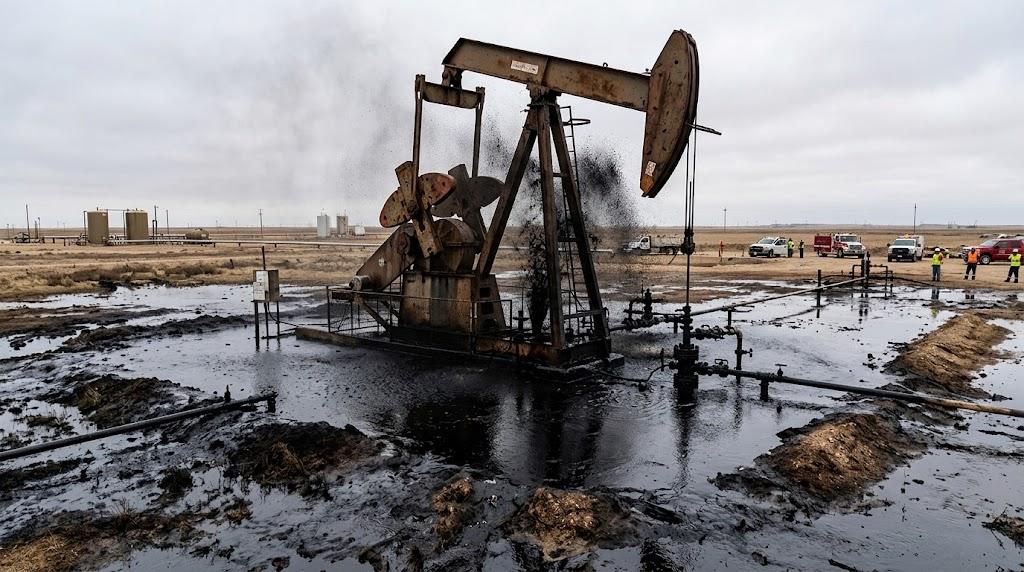
The Sahara’s silent distress call: A technical malfunction in Niger has spiraled into an environmental time bomb, revealing deeper systemic failures in industrial oversight and regulatory negligence.
The untold story behind Goumeri W8: when profit overshadowed safety
On the morning of September 25, 2026, a catastrophic failure at the Goumeri W8 well—part of the Agadem oil block in southern Niger—unleashed a geyser of crude oil and toxic gases into the desert air. What began as a localized incident has since metastasized into a full-blown ecological emergency, exposing a web of poor planning, corporate opacity, and systemic negligence.
More than 1,700 kilometers from the capital, Niamey, the spectacle was both horrifying and symptomatic of an industry out of control. Volumes of crude oil spread across the arid landscape, while an invisible plume of methane began silently climbing into the atmosphere. Yet, for 17 days, the true extent of the disaster remained shrouded in silence.
Seventeen days of denial: the cost of institutional silence
The government in Niamey waited until October 12—nearly three weeks after the eruption—to acknowledge what it called an “environmental incident of exceptional gravity.” In the interim, the state had issued no public warnings, imposed no restrictions, and undertaken no visible action.
The operator, China National Petroleum Corporation (CNPC), maintained a similar stance, offering no transparency on the causes of the accident, the volume of contaminants released, or the emergency response measures. This double wall of silence—official and corporate—mirrored a disturbing pattern: in remote oil fields far from Beijing or Brussels, environmental standards are often treated as optional.
The result? A preventable disaster that grew worse by the hour.
The methane monster: a climate crisis in slow motion
When the Niamey government finally broke its silence, it downplayed the most dangerous dimension of the crisis: methane emissions. Satellite data from the European Space Agency’s Sentinel-5P (Copernicus program) revealed a far graver reality:
- Relentless emissions: Leaks spiked at over 40 tons of methane per hour, persisting unabated for weeks.
- Global warming multiplier: Over 17,000 tons of methane escaped in just 21 days—each ton possessing a global warming potential 84 times greater than carbon dioxide over two decades.
- Uncontrollable flow: Authorities claimed to have “partially contained” the gas leak, yet satellite observations confirmed a sustained, unrelenting plume—unchanged in intensity since the blowout.
The failure to control methane—a potent greenhouse gas—has transformed the Sahara from a carbon sink into a ticking atmospheric bomb.
The extractive illusion: speed over safety in Niger’s oil rush
This disaster was not an unforeseeable accident; it was the predictable outcome of an extractive frenzy prioritizing output over precaution. The Nigerien government has set an aggressive production target, aiming to ramp up output to 90,000 barrels per day to feed the Benin-bound pipeline. But at what cost?
Safety measures were sidelined. Maintenance was deferred. And when two workers were seriously injured during the initial explosion, the state’s response was not to investigate—but to scramble for external help. In a desperate bid to control the blowout, Algerian specialists from Sonatrach were flown in to drill relief wells. This humiliating last-minute maneuver underscored the chasm between political ambition and industrial capability.
Niger’s Sahara is not an industrial sacrifice zone. Yet the scorched earth of the Agadem block tells a different story—one where profit margins matter more than people, more than the planet, and more than the future of the Sahel.
Who is accountable in the age of invisible emissions?
The tragedy at Goumeri W8 exposes a profound truth: a crisis that kills slowly doesn’t register as urgent. There are no dramatic images of charred wildlife or immediate fatalities to shock the public. Instead, there is a slow, invisible poisoning—of the air, the soil, the climate, and the hopes of generations.
The CNPC’s silence speaks volumes: in the Nigerien desert, environmental compliance is not a corporate priority. The government’s delayed response reveals a dangerous complacency: treating the Sahara as a frontier for exploitation, not a fragile ecosystem to protect.
Until these attitudes change, the next Goumeri W8 may already be brewing in the shadows—another ecological time bomb ticking toward global reckoning.