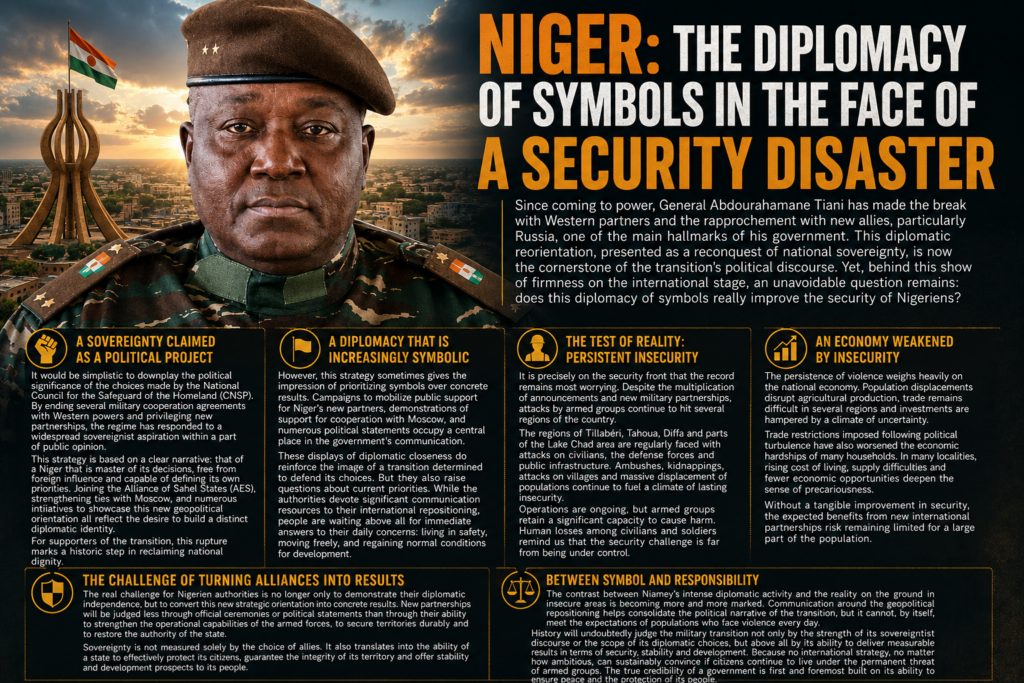
The administration led by General Abdourahamane Tiani has placed considerable emphasis on severing traditional ties with Western partners while actively pursuing new alliances, particularly with Russia. This strategic pivot, framed as a reclaiming of national sovereignty, now underpins the transitional government’s official rhetoric. Yet, as the regime projects an image of unyielding independence on the global stage, a critical question persists: does this symbolic diplomacy genuinely translate into improved security for Nigerien citizens?
A sovereignty-driven political agenda
The decisions made by the National Council for the Safeguarding of the Homeland (CNSP) extend beyond mere political posturing. By terminating multiple military cooperation agreements with Western powers and prioritizing alternative partnerships, the leadership has addressed a longstanding demand among a significant segment of the population for greater self-determination.
Central to this approach is a coherent national narrative: one that positions Niger as a sovereign actor, free from external pressures, and capable of charting its own course. The country’s accession to the Alliance of Sahel States (AES), the deepening of ties with Moscow, and the orchestrated displays of geopolitical realignment all serve to reinforce this distinct diplomatic identity.
For supporters of the transition, these moves represent a historic milestone in restoring national dignity. The government’s messaging underscores the necessity of breaking decades of dependency—both in security and politics—to forge a system rooted in national interest rather than foreign influence.
The limits of symbolic diplomacy
However, this strategy increasingly appears to prioritize symbolic gestures over tangible outcomes. Public mobilization campaigns in favor of new international partners, mass demonstrations celebrating cooperation with Russia, and frequent political declarations dominate the government’s communication efforts.
While these displays reinforce the image of a resolute leadership committed to its chosen path, they raise questions about the regime’s priorities. With significant resources devoted to international repositioning, citizens are left questioning when they will see concrete improvements in their daily lives—security on the roads, safe passage to markets, and the restoration of essential services.
The harsh reality: unrelenting insecurity
The security situation remains the most glaring area of concern. Despite the flurry of diplomatic announcements and new military partnerships, armed groups continue to carry out attacks across multiple regions.
Regions such as Tillabéri, Tahoua, Diffa, and parts of the Lake Chad basin frequently experience violence targeting civilians, defense forces, and public infrastructure. Ambushes, abductions, village raids, and mass displacements contribute to an enduring climate of fear.
Military operations persist, yet armed factions retain significant operational capacity. The human toll—among both civilians and soldiers—highlights the persistent failure to curb the threat. For residents in high-risk areas, geopolitical debates feel increasingly disconnected from their immediate needs: safety for their families, the reopening of schools and health centers, and the resumption of agricultural and commercial activities.
Economic strain in the shadow of instability
Beyond the human cost, prolonged violence has exacted a heavy economic toll. Population displacements disrupt agricultural production, trade routes remain perilous, and investment hesitates in an environment of uncertainty.
The political upheavals of recent years have further strained household economies. In many localities, rising living costs, supply shortages, and dwindling economic opportunities deepen a sense of vulnerability.
Without a visible improvement in security, the anticipated benefits of new international alliances may prove unattainable for the majority of the population.
From alliances to action: the path forward
The true challenge for Nigerien authorities is no longer demonstrating diplomatic independence but converting this strategic shift into measurable results. The success of new partnerships will not be judged by official ceremonies or political speeches, but by their ability to enhance military operational capabilities, secure territories sustainably, and restore state authority.
Sovereignty is not merely a matter of choosing allies; it is measured by a state’s capacity to protect its people, uphold territorial integrity, and offer stability to its citizens.
Symbolism vs. responsibility
The growing gap between Niamey’s diplomatic activism and the lived experience of insecurity underscores a fundamental tension. While the government’s geopolitical repositioning strengthens its political narrative, it cannot—on its own—address the urgent needs of a population living under constant threat.
History will assess the military transition not by the strength of its sovereignist discourse or the scale of its diplomatic maneuvers, but by its tangible achievements in security, stability, and development. No international strategy, however ambitious, can sustain public trust if citizens continue to face the daily menace of armed groups. True credibility is built on the ability to deliver peace and protection.
You may also like
S&P holds Cameroon at B-/B, warning that political succession is now the main risk
Senegal’s 2026 revised finance bill: national assembly confirms receipt after three-day delay
Mali: JNIM’s Dioura attack shatters army’s official narrative
Niger: opposing Tiani’s junta means losing your citizenship
Benin and Spain: a cultural pact built on art and diplomacy