Why military regimes in Burkina Faso, Mali and Niger are turning to repression
Mounting crackdowns, abductions, arbitrary detentions and shrinking civic freedoms are defining the current climate in the Alliance of Sahel States. Human rights advocates and journalists find themselves in the crosshairs as juntas struggle to legitimize their rule.
From promises to crackdowns: the erosion of legitimacy
When Captain Ibrahim Traoré assumed leadership in Burkina Faso, he vowed to restore civilian rule swiftly. Yet today, his administration is doubling down on repression—detentions without cause, enforced disappearances and a tightening grip on the media. The same pattern is visible in Mali and Niger, where juntas originally seized power under the banner of improving security, only to see violence escalate under their watch.
Alioune Tine, founder of Afrikajom Center, underscores the depth of the crisis: „These regimes came to power promising quick elections and a return to democracy. Instead, they have weaponized fear. The security situation has deteriorated further, and their legitimacy is crumbling. History shows that power seized by force is often lost by force—these leaders know it.”
Broken promises and escalating violence
Tine highlights the stark contrast between early rhetoric and current reality. Ibrahim Traoré once declared that the ECOWAS-imposed transition timeline was too long and that elections would follow promptly. Those assurances have vanished. Instead, the junta has intensified human rights abuses, particularly targeting the Fulani community, sparking widespread alarm.
Recent events paint a grim picture. On June 11, an attack in Mansila reportedly claimed over a hundred lives. With no military convoy able to reach the city and communications severed, independent verification remains nearly impossible. The BBC reported that the assault has reportedly shaken troop morale, while rumors of mutiny and coup attempts swirl in Ouagadougou. Just days later, an unexploded shell struck the courtyard of the national broadcaster RTB, injuring several people and fueling further speculation about instability within the armed forces.
In response, Traoré dismissed reports of unrest as “imaginary” and accused foreign media of spreading “fake news.” He went so far as to invite detractors to “take power if the seat is vacant,” in a rare public display of defiance.
International alarm and domestic resistance
Human rights organizations are not staying silent. Amnesty International and the Senegalese Coalition of Human Rights Defenders have announced plans to hold peaceful protests against the suppression of press freedom and civic expression in Burkina Faso. They are also demanding the immediate release of detained activists, including lawyer Guy Hervé Ham, arrested on January 24 and forcibly conscripted into the Volunteers for the Defense of the Homeland.
The situation in Burkina Faso reflects a broader regional trend. Despite initial hopes that military leaders would deliver stability, their performance has fallen short in nearly every metric. In Mali, while some progress has been noted in the north, socio-economic conditions continue to deteriorate. The absence of credible governance has even led to the formation of an opposition government-in-exile, further eroding public trust.
From democratic hope to authoritarian drift
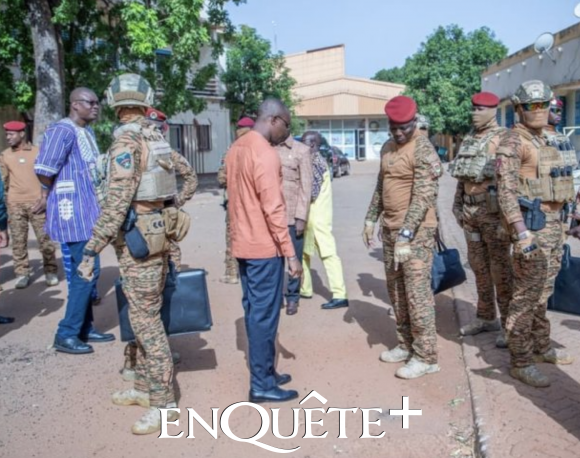
Faced with mounting criticism, the juntas have embraced a strategy of fear. Arbitrary arrests, enforced disappearances, media closures and the harassment of civil society figures have become routine. Tine warns that these measures signal the emergence of full-blown dictatorships: „They are not just removing opponents—they are dragging elderly activists to the front lines. This is no longer governance; it’s pure coercion.”
In a geopolitical shift, the regimes have pivoted toward partners less concerned with human rights, notably Russia. This realignment has fractured the Economic Community of West African States (ECOWAS), splitting member states into pro-Western and pro-Russian factions. Tine laments: „ECOWAS was once a beacon of regional unity. Now, it’s paralyzed by external influences. The CFA franc question, military base politics—these debates are being hijacked by great-power rivalries, not by the needs of our people, especially our youth.”
As repression intensifies, so does resistance. The coming months will reveal whether the juntas can sustain their grip on power—or whether the tide of public discontent will finally break through.