
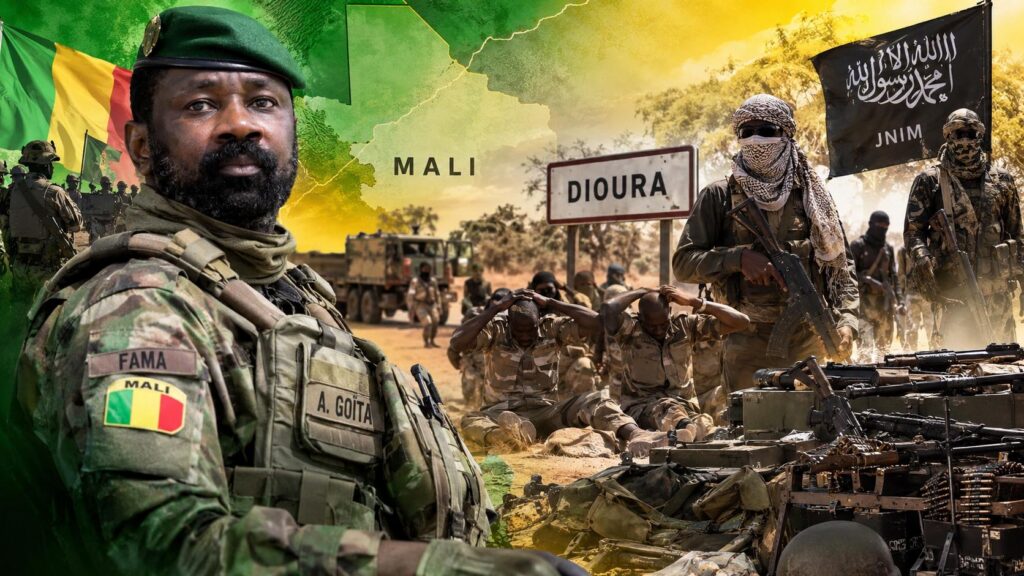
The military outpost at Dioura, in the Tenenkou district of central Mali, was overrun on the morning of Thursday, September 10, 2026, by fighters of the Group for the Support of Islam and Muslims (JNIM), an Al-Qaeda affiliate. What unfolded over several hours was not a skirmish but a systematic dismantling of the camp: heavy shelling, a ground assault, looting, and a withdrawal that left behind stolen heavy weaponry and dozens of hostages. The provisional toll — around 130 Malian soldiers killed and up to 70 taken prisoner — marks the gravest single loss suffered by the Malian armed forces in their long campaign against insurgents.
A tactical catastrophe in the heart of Tenenkou
The assault began at first light, when JNIM columns converged on the Dioura base from multiple directions. For hours, the camp was pounded with heavy fire before being entered and emptied of its supplies. The attackers then pulled back with captured equipment and a large group of detainees, leaving behind a scene that local residents describe as apocalyptic.
Official communication from the Malian Armed Forces (FAMA) and the transitional presidency was, as is customary in such situations, minimal or entirely silent. Yet information reaching the ground tells a different story. Multiple concordant accounts from local actors indicate that the death toll among Malian soldiers may be close to 130, with roughly 70 more taken captive. Propaganda images released shortly afterward by the militant group show rows of young recruits, their faces marked by fear, alongside confiscated stockpiles of weapons and ammunition. For the families of the victims, the anguish is compounded by Bamako’s denial or delayed response.
The Russian partnership illusion and the abandonment of territory
This devastating raid exposes the glaring failure of the security strategy championed by the military junta led by Colonel Assimi Goïta. Since the coup and the geopolitical pivot toward Moscow, the regime promised a rapid build-up of the army and the imminent eradication of the terrorist threat with the backing of Russian mercenaries.
On the ground, that triumphalist rhetoric has collapsed. The departure of international forces — MINUSMA and Barkhane — combined with the inability of Russian partners to stabilize the territory, has left Malian forces isolated, under-equipped and vulnerable. Forward operating bases like Dioura find themselves encircled by mobile armed groups that now strike where and when they choose, illustrating the state’s inability to secure its own defense lines.
Local populations left to fend for themselves
Beyond the military loss, it is the civilian population of the Mopti region that bears the heaviest cost of this fiasco. In Dioura, bewilderment has given way to resignation and despair.
“Every time the camp falls or retreats, we know what awaits us: reprisals, fear and absolute emptiness,” confides a resident of the area, speaking on condition of anonymity. “They talk about sovereignty on television in Bamako, but here we have no protection, no state, no future.”
Local traders report a complete economic paralysis. Weekly markets have been cancelled, roads are cut by insurgents, and the supply of basic necessities has become a miracle. After the attackers pass through, fear of reprisals or post-attack abuses drives many villagers to flee toward major urban centers, swelling the number of internally displaced persons amid near-total indifference.
Toward a political and military dead end
The Dioura tragedy serves as a stark warning for Mali’s transitional authorities. By prioritizing communication warfare over the reality of field operations, the junta is sealing itself into a dead end. The continuous weakening of troop numbers, plummeting morale, and the progressive loss of territorial control in the center and north raise an urgent question: how much longer can reclaimed sovereignty serve as a screen for the collapse of national security?
Without a profound reassessment of alliances, military tactics and dialogue with local communities, Mali risks sinking deeper into a vicious cycle where civilians and soldiers remain the primary victims of political blindness.
You may also like
Burkina Faso’s textile gamble: how retirees’ pensions became collateral for TEXFORCES-BF
Niger’s external liabilities hit 12,900 billion FCFA as dependence persists
Benin’s school meal programme reaches 1.9 million children as government bets on social and economic returns
Alger’s premier visits Bamako: Assimi Goïta’s regime swallows its pride
Burkina Faso: the cost of sovereignty financed on credit