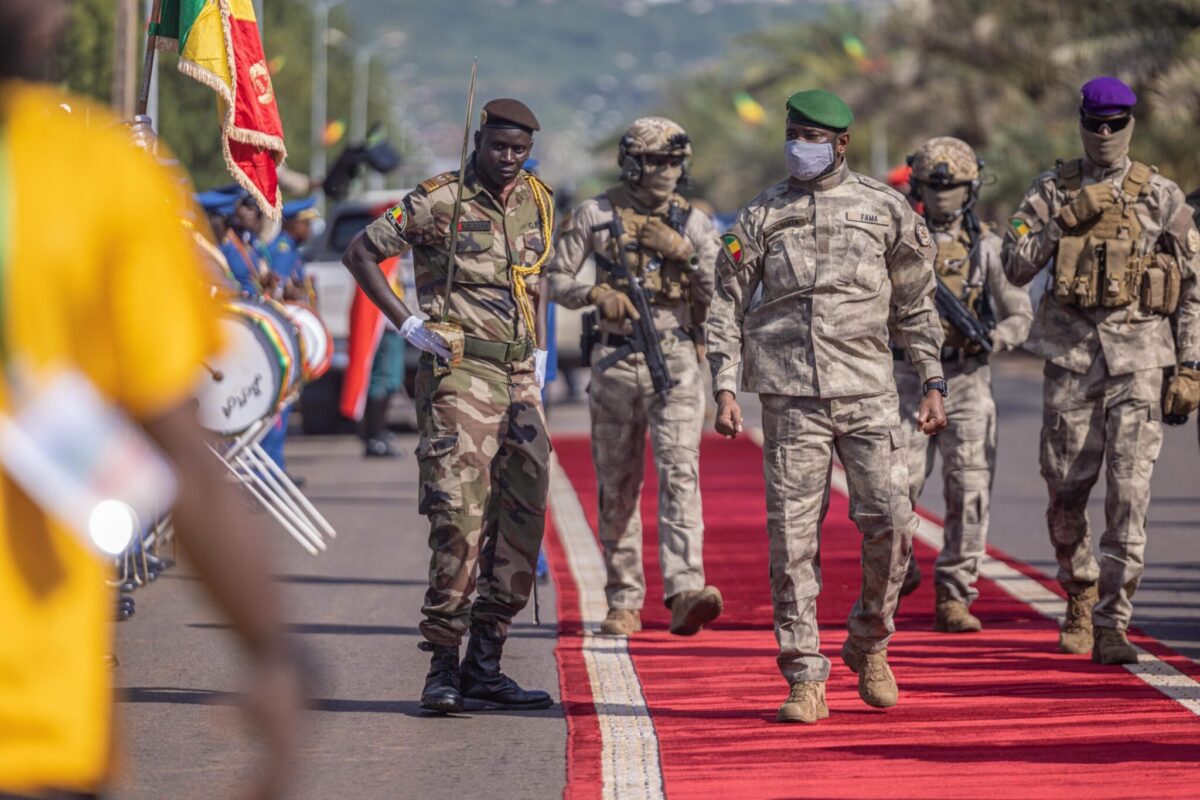
The Malian government claims to have restored its military sovereignty after the withdrawal of French forces and the gradual dismantling of Western security arrangements. Official narratives frame this shift as a historic victory—a triumphant assertion of national control over territory and a rejection of foreign tutelage.
Behind the sovereignty rhetoric
Yet this narrative obscures a deeper transformation within Mali’s political system. The much-vaunted military sovereignty has not eliminated dependency; it has merely redirected it. Bamako’s security fate now rests increasingly with Africa Corps, a mercenary force tasked not only with combating terrorism but also with safeguarding the regime itself.
Conflict has long ceased to be a temporary crisis in Mali—it has become the very framework of political life. The armed forces now dominate state governance, legitimacy, and domestic economic balances. Since the 2022 coup, military leaders have seized control of all decision-making levers. In this context, war is no longer a problem to solve; it has become the foundation of the regime itself.
From symbolic rupture to structural reality
The departure of French troops dramatically altered regional power dynamics. For many Malians, this break represented a symbolic liberation after years of perceived ineffective foreign intervention. The transitional authorities have skillfully harnessed nationalist sentiment to bolster their legitimacy.
But declared sovereignty alone cannot alter the harsh realities of the Sahelian conflict. Armed groups remain active, violence persists across multiple regions, and the state’s logistical capabilities remain severely limited. Today, Bamako faces encirclement by jihadist forces. The central question is no longer about foreign presence but about the Malian state’s capacity to achieve lasting territorial stability.
A shifting security landscape
In this vacuum, new security partners have risen to prominence. Russia, directly and indirectly, has emerged as a major player in the Sahelian military realignment. This presence brings both hope and controversy.
The international debate often reduces this situation to a geopolitical rivalry between Paris and Moscow. Yet the Malian logic is far more complex. The regime prioritizes partners who can support its political survival without imposing the same diplomatic constraints as Western powers.
The militarization of Malian politics
This evolution has one major consequence: the growing militarization of Mali’s political economy. Security budgets swell, military institutions gain institutional influence, and conflict becomes a permanent tool for national mobilization.
The persistent high-security threat allows the government to justify centralized decision-making, reduced political pluralism, and delayed democratic transitions. War ceases to be merely a context—it becomes a governing resource.
The Alliance of Sahel States: sovereignty or fragility?
The Alliance of Sahel States (AES)—comprising Mali, Burkina Faso, and Niger—intensifies this dynamic. The three nations are constructing a political space founded on security sovereignty, criticism of former colonial powers, and the centrality of military apparatuses.
Yet this alliance rests on shaky ground. It depends on weakened economies, severe social tensions, and an unstable regional environment. The Sahelian regimes seek strategic autonomy even as they remain financially and militarily vulnerable.
The paradox of Sahelian sovereignty
The Malian case reveals a broader paradox of contemporary Sahel: breaking away from Western frameworks can yield real symbolic gains in political sovereignty. Yet this sovereignty remains constrained as long as economic, administrative, and security structures continue to revolve around military urgency.
War transforms from a temporary state into a permanent infrastructure of the state itself. In such a system, peace becomes almost a political risk. Real stabilization would force the reopening of long-deferred questions: economic redistribution, corruption, local governance, civilian representation in power, pluralism restoration, and institutional reconstruction.
Thus, the Malian crisis transcends mere competition between foreign powers. It raises a more troubling question: how can a state be rebuilt when war economies progressively become the primary mode of governance?
For Bamako, the challenge is no longer merely military—it is political, social, and structural. As long as sovereignty is conceived primarily as military capacity, Mali risks replacing one external dependency with another: an enduring state organized around war and dependent on Russian mercenaries.