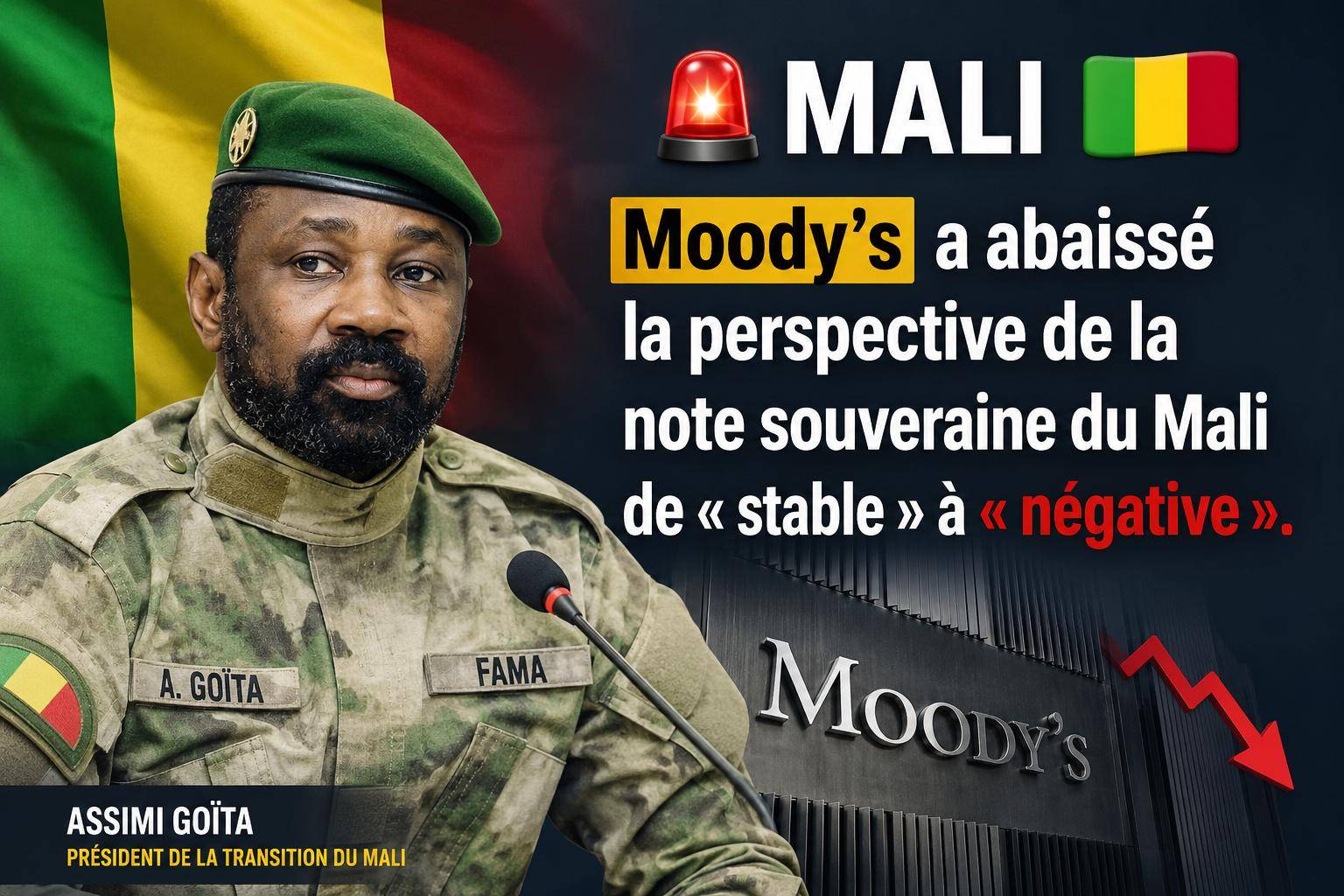
In a significant development for Mali’s economic landscape, the global credit rating agency Moody’s has downgraded the country’s sovereign outlook from stable to negative, while retaining its Caa2 rating. This decision reflects mounting concerns over security risks, tightening financing conditions in the regional market, and persistent political uncertainties—all of which pose fresh challenges to the nation’s economic stability.
financial markets react to deepening concerns
The revised outlook serves as a stark reminder of the fragility of investor confidence. By shifting from a stable to a negative perspective, Moody’s signals a heightened risk that the Caa2 rating could deteriorate further in the near to medium term. This rating already places Mali’s sovereign debt in the speculative, high-risk category, signaling caution for international and regional investors.
security challenges weigh heavily on economic recovery
The primary driver behind Moody’s assessment is the worsening security situation. Despite ongoing military restructuring and counterterrorism operations, Mali continues to grapple with persistent instability. Violent attacks and shifting conflict zones disrupt supply chains, undermine agricultural output, and hinder the state’s ability to collect tax revenues effectively, particularly in rural and border regions.
regional financing becomes increasingly costly
The country’s financial woes extend beyond security threats. Mali has increasingly relied on the West African Economic and Monetary Union (WAEMU) regional bond market to bridge budgetary gaps, especially after losing access to traditional external funding sources due to diplomatic and institutional disruptions. However, this strategy has backfired as financing conditions have tightened sharply.
The West African Central Bank (BCEAO) has aggressively raised interest rates to combat inflation, pushing borrowing costs to unsustainable levels for Bamako. Recent Treasury bond issuances have encountered lukewarm demand, with investors—particularly commercial banks—growing wary of Mali’s credit risk. This reluctance has further strained the government’s ability to fund critical infrastructure projects and sustain essential public spending.
political transition fuels investor skepticism
Moody’s analysis also underscores the destabilizing effects of prolonged political uncertainty. Mali remains in a protracted transition phase, with repeated delays in electoral timelines and an unclear path toward a stable constitutional order. This ambiguity has eroded confidence among multilateral partners and international donors, complicating efforts to secure critical financial support.
Adding complexity to the equation is Mali’s decision to leave the Economic Community of West African States (ECOWAS), formalized through the Alliance of Sahel States (AES) alongside Niger and Burkina Faso. While authorities frame this move as a step toward regained sovereignty and new strategic partnerships, global financial markets interpret it as a source of legal and commercial instability. Investors now fear potential trade barriers or disruptions to capital flows within the subregion, further dampening economic prospects.
real-world consequences for Mali’s citizens
The ripple effects of Moody’s decision extend far beyond financial circles, directly impacting the daily lives of Malians. Higher borrowing costs for the state mean fewer resources available for essential social services, including healthcare, education, and subsidies for basic goods. For businesses, the squeeze is immediate: local banks, heavily exposed to public debt, are becoming increasingly hesitant to extend credit to private enterprises. Small and medium-sized businesses—vital engines of the national economy—are struggling to access financing, stifling job creation and investment.
pathway to economic stabilization
Despite these formidable challenges, Mali’s economy retains pockets of resilience, notably in the gold mining sector and cotton production. Yet, global financial realities cannot be ignored. To reverse Moody’s negative outlook and restore investor confidence, authorities must strike a delicate balance: reinforcing security, clarifying the political roadmap, and implementing prudent fiscal policies. Only through decisive action can Mali hope to regain stability in the eyes of global markets and secure the resources needed for sustainable growth.