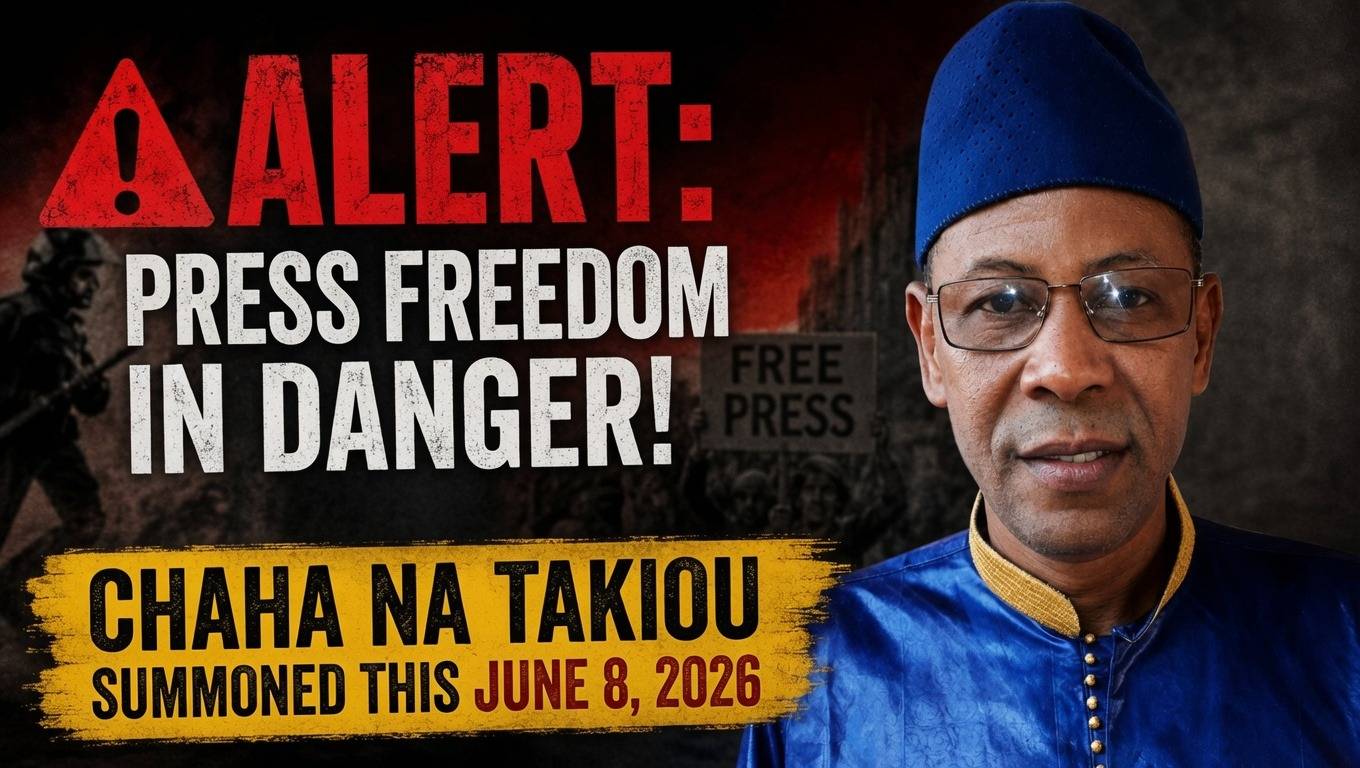
Chahana Takiou, the publishing director of the weekly Le 22 Septembre, has been summoned to appear on Monday, June 8, 2026, at 1:00 p.m. before the prosecutor of the cybercriminality unit in Bamako. The summons follows public criticism he voiced against the ruling military junta. This event underscores the ongoing systematic repression and judicial harassment targeting dissenting voices, journalists, and citizens who refuse to align with the transitional authorities’ official narrative.
A high-stakes summons at the cybercrime unit
The news struck the Malian media community like a blow. Chahana Takiou, a respected figure in national journalism and head of the weekly Le 22 Septembre, must now face cybercrime investigators. For his colleagues, the real reason is clear: his recent public analyses that candidly assessed the military transition’s political, security, and economic management have angered those in power.
In Mali, the cybercriminality unit has become the junta’s favored tool for silencing critics. Under the guise of policing online misconduct, the justice system frequently uses it to intimidate media professionals. For Chahana Takiou, rigorously practicing his journalism now turns into a high-risk legal confrontation.
Press freedom sacrificed for uniformity of thought
Since the military takeover, Mali’s public space has shrunk drastically. Press freedom, once a hallmark of the country’s democracy, is now a distant memory. Information professionals operate in an atmosphere of fear and self-censorship. Reporting neutrally and independently has become an act of courage, even a crime of lèse-majesté.
The junta demands total allegiance to its narrative. Media outlets that refuse to echo official propaganda or raise legitimate questions about the nation’s future are immediately targeted. Suspensions of national and international media, formal warnings from the High Authority for Communication (HAC), and administrative harassment are daily realities for a financially and morally suffocated press corps.
Repression and abductions: a strategy of terror
The crackdown on Chahana Takiou is not an isolated incident. It fits into a broader strategy of repression orchestrated by the transitional authorities. Anyone daring to express a divergent opinion—whether politician, civil society leader, human rights defender, or ordinary citizen on social media—faces severe retaliation.
More alarming still, the junta’s methods have darkened. Beyond official judicial summons, the country now sees a surge in abductions and enforced disappearances. Civilians are picked up by unidentified armed men, often believed to be intelligence agents, and held in secret detention for weeks. This policy of terror aims to paralyze all ability to protest and impose an iron silence across the entire territory.
A media community united but fragile
In response to the summons against the director of Le 22 Septembre, professional press organizations in Mali are rallying in solidarity. Calls for vigilance and support were issued as soon as the news broke. However, this solidarity faces the immense repressive apparatus of a militarized state where fundamental constitutional and judicial safeguards are increasingly trampled.
Journalists’ unions repeatedly remind that constructive criticism is essential for the nation’s survival, especially in times of crisis. Yet for Bamako’s current power holders, any critique is equated with treason or destabilization, closing the door to any pluralistic democratic debate.
The summons of Chahana Takiou on June 8, 2026, marks a worrying new step in the Malian junta’s authoritarian drift. By targeting a journalist of his caliber, the transitional power sends a clear, direct signal: no discordant voice will be tolerated.
This obsessive quest for unanimity—enforced through strength, prison, and intimidation—isolates Mali a little more each day and weakens its internal cohesion. As the country grapples with immense security and humanitarian challenges, silencing those who seek truth will not solve its deep crises. More than ever, the future of independent journalism and citizen liberties in Mali is being played out in the courtrooms of Bamako.