
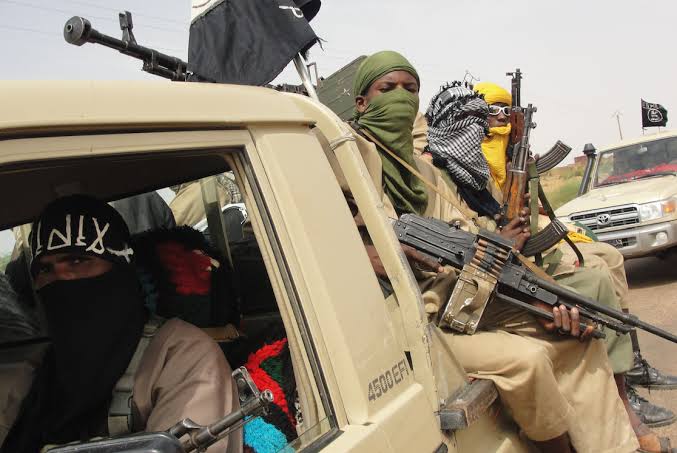
The Malian population faces an increasingly desperate dilemma as the military junta struggles to maintain control against a rising tide of jihadist influence. With the Group for the Support of Islam and Muslims (JNIM, affiliated with Al-Qaeda) and the Azawad Liberation Front (FLA) launching coordinated offensives, the general public is left grappling with an impossible decision: submit to the junta’s unyielding rule or risk falling under the harsh governance of extremist factions promising a strict interpretation of Islamic law.

The junta’s faltering grip and the shadow of the JNIM
Following coordinated attacks on April 25, General Assimi Goïta, leader of the Malian junta, vanished from public view for three days before resurfacing with a speech declaring the situation “under control.” Yet, the reality on the ground tells a different story. The FLA has re-established its presence in Kidal, while the JNIM has tightened its stranglehold around Bamako, imposing a de facto blockade. Despite the junta’s insistence on its military superiority, the persistent inability to regain the initiative has left many questioning the regime’s long-term viability.
A stark reality: charia or chaos
The JNIM’s ambitions have been laid bare in a recent statement, vowing to topple the National Committee for the Salvation of the People (CNSP) and enforce a strict interpretation of Islamic law across the nation. In areas already under jihadist control, civilians are subjected to draconian measures enforced by the group’s interpretation of charia. For some opposition figures, the prospect of an alliance with the JNIM—however unpalatable—has been floated as a means to dislodge the junta. Yet, there is no indication that the group would soften its stance on governance, leaving citizens trapped between two oppressive forces: a failing military regime and an extremist alternative.
The junta’s repression has only deepened the crisis. Since seizing power, the CNSP has systematically silenced dissent, imprisoning opponents and driving others into exile. This vacuum of legitimate political expression has inadvertently empowered armed factions, turning the JNIM into the most formidable voice of opposition. The regime’s heavy-handed tactics—exemplified by the recent abduction of prominent lawyer and politician Mountaga Tall—have further eroded public trust. Reports of state security agents orchestrating such acts underscore a pattern of state-sponsored intimidation designed to suppress all forms of resistance.
No clear path forward for Mali
In a pre-offensive communiqué, the JNIM called for a united front against the junta, appealing to political parties, military factions, religious leaders, and traditional authorities to join forces. The group’s promise of a “new Mali”—one governed by its radical vision—stands in stark contrast to the junta’s hollow assurances of reform. Both factions, however, offer no tangible vision for a return to constitutional order or democratic governance. The military regime’s reliance on force over diplomacy has instead plunged the nation deeper into instability, leaving its people to confront an existential threat with no apparent resolution in sight.
You may also like
In Bamako, the fuel blockade one year on: Mali’s economy held hostage
Dakar, 8 septembre 2026 — Ahmadou Alhaminou Lo promet une méthode resserrée au service du Sénégal 2050
Kpalimé witnessed a destructive midnight blaze that ravaged the Château market
In northern Togo, geopolitical rivalries overshadow the urgent needs of the population
In the National Assembly, Al Aminou Lô unveils his roadmap anchored in Senegal 2050