
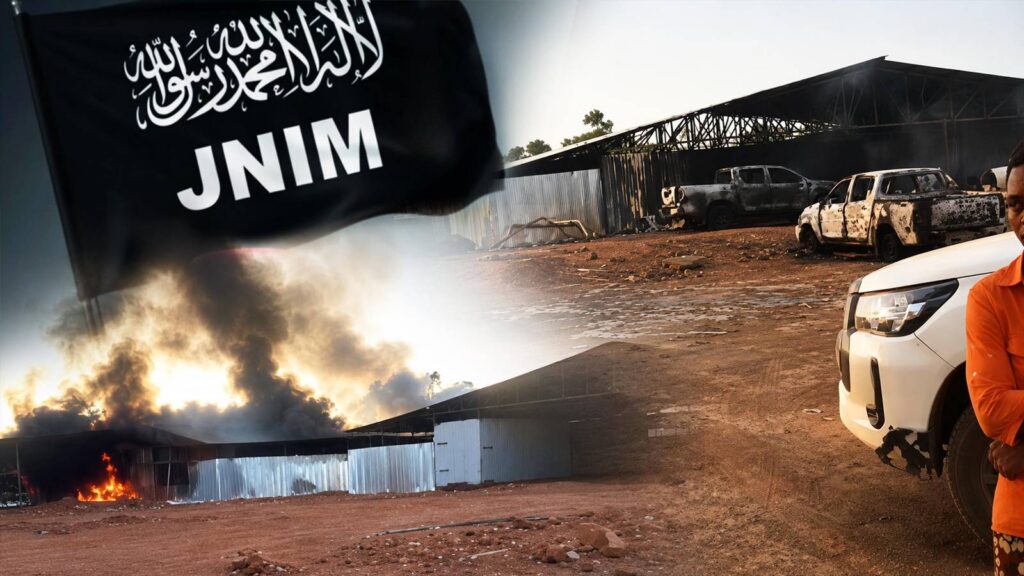
JNIM escalates attacks with bold raid on Chinese-operated mine in southern Mali
In a brazen overnight assault, the Group for the Support of Islam and Muslims (JNIM) launched a coordinated strike on a Chinese-owned mining facility in Naréna, a district in southern Mali near the Guinea border. The attack, which left significant damage in its wake, also resulted in the abduction of nine Chinese nationals, underscoring the escalating threat posed by jihadist groups to both security and economic interests in the region.
A meticulously planned strike with devastating consequences
The operation unfolded with precision. Armed assailants, moving swiftly on motorcycles and four-wheel-drive vehicles, descended upon the mining site under the cover of darkness. The targeted area, part of the Kangaba district, had previously been considered relatively safe from large-scale jihadist incursions. The attackers systematically set ablaze mining equipment, electrical generators, and administrative buildings, crippling operations. However, the human toll was even more severe: according to local accounts, nine Chinese workers were forcibly taken and transported to an undisclosed location. Such hostage-taking tactics provide the JNIM with a powerful bargaining chip, both politically and financially, in dealings with the Malian government and Beijing.
Security vacuum: Mali’s army struggles to maintain control
The raid on Naréna starkly highlights the deteriorating security situation in Mali. Once confined to the northern and central regions, the conflict has steadily spread southward and westward, threatening the country’s economic lifelines. The ease with which armed groups can penetrate deep into Malian territory—even near international borders—exposes the glaring failures of the national security apparatus. The Malian Armed Forces (FAMa) appear increasingly paralyzed, relying on defensive postures within fortified bases rather than proactive countermeasures. The inability to anticipate or pursue the attackers underscores critical weaknesses in military intelligence and operational capacity. Promises of regaining national sovereignty under the current transitional leadership are increasingly overshadowed by the harsh reality of a state losing control of its own territory.
Russian mercenaries fail to deliver on security promises
To justify the withdrawal of Western forces and the departure of the UN peacekeeping mission (MINUSMA), Malian authorities pivoted toward a strengthened military partnership with Russia, including the deployment of the former Wagner Group, now rebranded as the Africa Corps. Yet, the results have fallen far short of expectations. Russian mercenaries, known for their heavy-handed counterinsurgency tactics often targeting civilians, have proven ill-equipped to secure industrial sites or engage in high-stakes asymmetric warfare. Their patrols have failed to deter attacks, and their presence has not slowed the JNIM’s territorial expansion. The once-touted Russian solution is rapidly unraveling as jihadist activities creep closer to the capital and key mining zones.
China’s strategic interests under direct threat
The JNIM’s decision to target Chinese operations sends a clear message: economic interests are now squarely in the crosshairs. China remains a critical partner for Mali, particularly in gold mining and infrastructure development. By attacking foreign economic assets, the jihadist group aims to cripple the Malian economy while signaling to the international community that the state can no longer guarantee the safety of investors. This development may compel Chinese authorities to reassess their investment strategies in the Sahel and intensify pressure on Bamako to provide security guarantees—demands the current regime is ill-prepared to satisfy.
The assault on Naréna marks a dangerous escalation in Mali’s ongoing crisis. By striking a major mining site near the Guinean border, the JNIM has demonstrated its ability to strike at will, wherever and whenever it chooses. With the Malian army and its Russian allies stretched to their limits, the country risks descending further into lawlessness unless a fundamental shift in strategy occurs—one that prioritizes both civilian protection and the safeguarding of economic ventures.
You may also like
In Bamako, the fuel blockade one year on: Mali’s economy held hostage
Dakar, 8 septembre 2026 — Ahmadou Alhaminou Lo promet une méthode resserrée au service du Sénégal 2050
Kpalimé witnessed a destructive midnight blaze that ravaged the Château market
In northern Togo, geopolitical rivalries overshadow the urgent needs of the population
In the National Assembly, Al Aminou Lô unveils his roadmap anchored in Senegal 2050