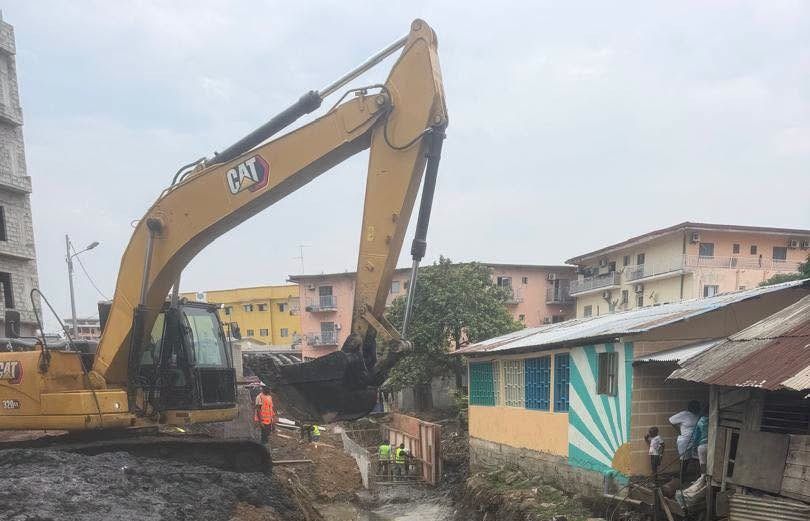
Libreville, Thursday 25 June 2026 – On 26 June 2026, a major milestone in the urban transformation of Libreville begins. After weeks of announcements and consultations, the first demolition operations will start in the strategic area of Baie des Cochons, in the third arrondissement of the Gabonese capital.
Behind the heavy machinery about to move in lies far more than a simple road construction project. It is one of the flagship initiatives of the new urban modernisation policy launched by President Brice Clotaire Oligui Nguema, aimed at reshaping traffic, sanitation, and territorial integration across several districts of Libreville in a lasting way.
This operation, which notably covers Sipagel, the Léon Mba intersection, and the entire corridor along the installations of the Société d’énergie et d’eau du Gabon up to the Petit-Paris roundabout, symbolises the authorities’ clear choice to prioritise major infrastructure to support urban growth. Yet it also raises a universal challenge faced by all large African metropolises: how to modernise the city without destabilising populations that have sometimes lived there for decades?
Opening up a capital city in transformation
Baie des Cochons occupies a critical position in Libreville’s spatial organisation. Located at the heart of dense economic and human flows, this area has long been a major congestion point between the Mont-Bouët market, the city centre, Boulevard Bessieux, and several outlying neighbourhoods.
The government plans to build a new main axis there, complemented by several secondary roads to ease traffic and strengthen connections between the Centre Hospitalier Universitaire de Libreville, Petit-Paris, the Léon Mba intersection, and surrounding areas.
During a site visit on 23 June, the Minister of Housing, Habitat, Urban Planning, and Cadastre, Mays Mouissi, directly explained the project’s objectives to residents. According to officials, clearing public right-of-way is an essential step before the appointed contractor begins actual work.
Beyond traffic, the project also aims to tackle a recurring problem affecting thousands of residents every year: flooding. The programme includes cleaning existing drains, rehabilitating damaged hydraulic structures, and building new stormwater drainage systems. For the authorities, the goal is to address two major urban emergencies simultaneously: mobility and sanitation.
The social trial of large-scale urban transformations
As with all major development operations, future benefits come with immediate consequences for affected populations. Some families have occupied the targeted areas for many years; others run economic activities there that sustain their daily livelihoods. The prospect of demolitions naturally raises questions, concerns, and expectations.
Recent history of large urban projects across Africa shows that success is measured not only by the quality of roads built or the modernity of infrastructure delivered, but also by the authorities’ ability to manage the transition humanely. Issues of compensation, possible relocation, protection of local economic activities, and social support become as important as the construction work itself.
Aware of this challenge, the ministry says it prioritised dialogue with residents before launching operations. The coming weeks will provide a concrete measure of how effective this approach is, and whether the authorities can maintain a balance between the general interest and protecting affected populations.
The real-life test of urban modernisation
Baie des Cochons has become a symbol – of a city that can no longer develop along past logics. Faced with demographic explosion, rapid urbanisation, and environmental challenges, Libreville must adapt its infrastructure to a new reality. Chronic traffic jams, difficult access for emergency services, sanitation problems, and the isolation of certain districts are now obstacles to the capital’s economic development.
That is precisely what the authorities aim to correct through this operation. But the project also represents a major political test. It will gauge the state’s capacity to carry out ambitious urban reforms while preserving social cohesion. A modern city is built not only with concrete, roads, and drains – it is also built with the support of its people.
At Baie des Cochons, Gabon is playing a significant part of its modernisation strategy. The first bulldozer strikes will start the work, but the true success of this announced transformation will ultimately be determined by its concrete impact on residents’ daily lives.
You may also like
Senegal’s December 2, 2026: will Diomaye Faye dissolve parliament or play the long game?
Senegal’s 2026 budget revision: can Dakar still rescue its growth and investment agenda?
Senegal’s 2026 revised budget: a trap vote for Pastef or a necessary evil?
Burkina Faso’s armored vehicles: can Faso Armored’s 300-unit claim survive the scrutiny?
Can Senegal and Azerbaijan turn a New York memorandum into a lasting political partnership?