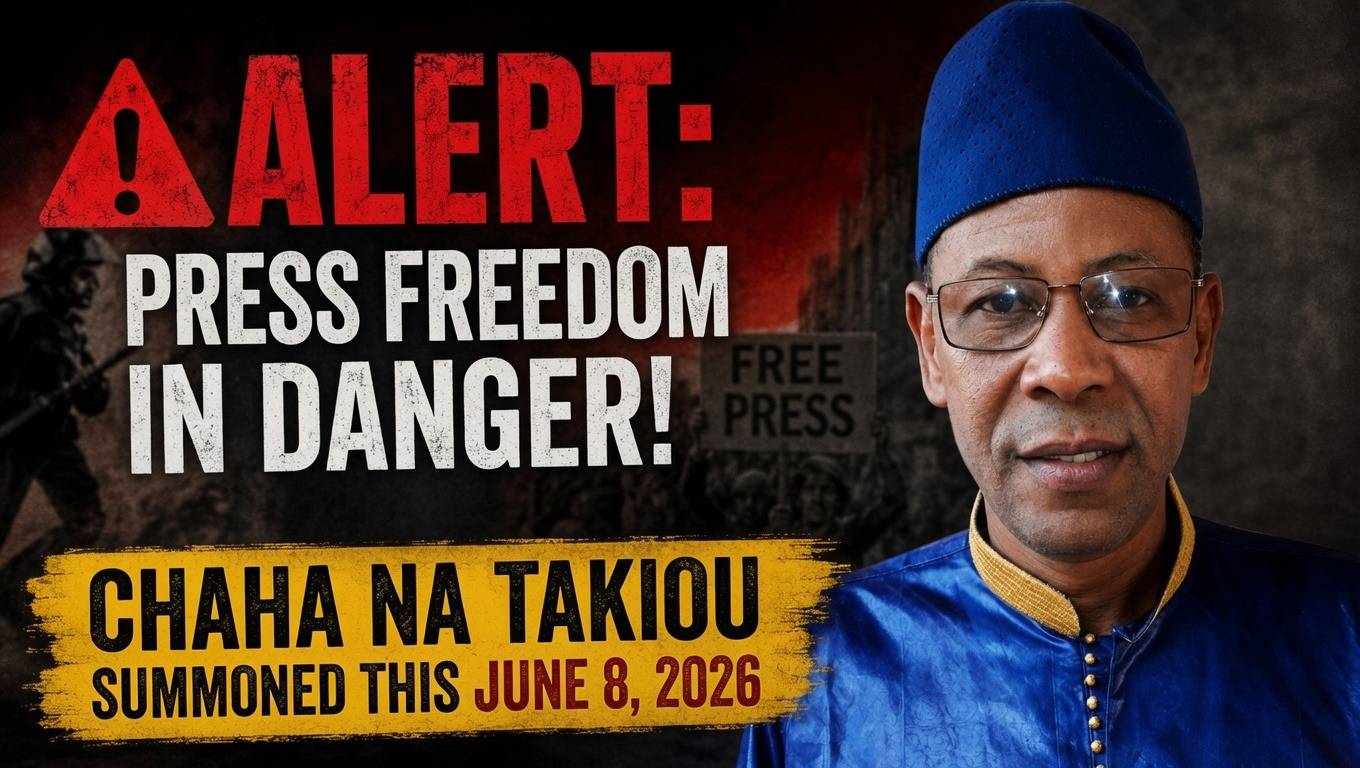
The publisher of the weekly newspaper Le 22 Septembre, Chahana Takiou, has been ordered to appear before the public prosecutor of Bamako’s cybercrime division on Monday, 8 June 2026 at 1 p.m. The summons comes after he publicly aired critical analyses of the ruling military junta. This event once again highlights the systematic repression and judicial harassment faced by dissenting voices, journalists, and citizens who refuse to toe the official line of Mali’s transitional authorities.
A tense summons at the cybercrime unit
The news landed like a guillotine in Mali’s media circles. Chahana Takiou, a respected figure in the national press and head of the weekly Le 22 Septembre, must now face investigators specialised in cybercrime. For his colleagues, the real motive is unmistakable: his recent public statements in which he candidly analysed the political, security and economic management of the military transition. Over the past months, Mali’s cybercrime unit has become the regime’s preferred tool for silencing critics. Under the guise of cracking down on social media excesses, the judiciary routinely uses it to intimidate media professionals. For Chahana Takiou, the rigorous exercise of his profession has now turned into a high-stakes legal appointment.
Press freedom sacrificed on the altar of uniformity
Since the junta seized power, Mali’s public space has shrunk dramatically. Press freedom, once a source of pride for Mali’s democracy, is now a distant memory. Information professionals operate in an atmosphere of fear and self-censorship. Reporting neutrally and independently has become an act of bravery, almost a crime of lese-majesty. The junta demands total allegiance to its narrative. Media outlets that refuse to parrot official propaganda or try to raise legitimate questions about the country’s future are immediately targeted. Suspensions of national and international media, formal notices from the High Authority for Communication (HAC), and administrative harassment are the daily reality for a press that is financially and morally suffocated.
Repression and abductions: a strategy of terror
The crackdown on Chahana Takiou is not an isolated case. It is part of a wider strategy of repression orchestrated by the transitional authorities. Anyone daring to voice a dissenting opinion — whether a politician, civil society leader, human rights defender, or ordinary citizen on social media — risks severe retaliation. Even more alarming, the junta’s methods have entered a darker phase. Beyond official judicial summonses, the country is witnessing a surge in kidnappings and enforced disappearances. Citizens are grabbed by unidentified armed men, often linked to intelligence services, and held incommunicado for weeks. This policy of terror aims to paralyse any capacity for protest among the population and impose a leaden silence across the entire territory.
A media community united yet fragile
In response to the summons of Le 22 Septembre‘s publisher, solidarity is mobilising within Mali’s professional press organisations. Calls for vigilance and support went out as soon as the news broke. But this solidarity runs up against the power of a militarised state’s repressive apparatus, where fundamental constitutional and judicial guarantees are increasingly flouted. Journalist unions keep reminding the authorities that constructive criticism is essential for the nation’s survival, particularly in times of crisis. Yet for those currently in power in Bamako, any criticism is equated with treason or an attempt to destabilise the country, shutting the door to any pluralist democratic debate.
The summons of Chahana Takiou on 8 June 2026 marks a worrying new milestone in the authoritarian drift of Mali’s junta. By targeting a journalist of his stature, the transitional power sends a clear and direct signal: no dissenting voice will be tolerated. This obsessive quest for unanimity, achieved through force, prison and intimidation, isolates Mali a little more each day and weakens its internal cohesion. While the country faces immense security and humanitarian challenges, silencing those who seek the truth will not solve its deep crises. More than ever, the future of independent journalism and citizen freedoms in Mali is being decided in the corridors of Bamako’s courts.